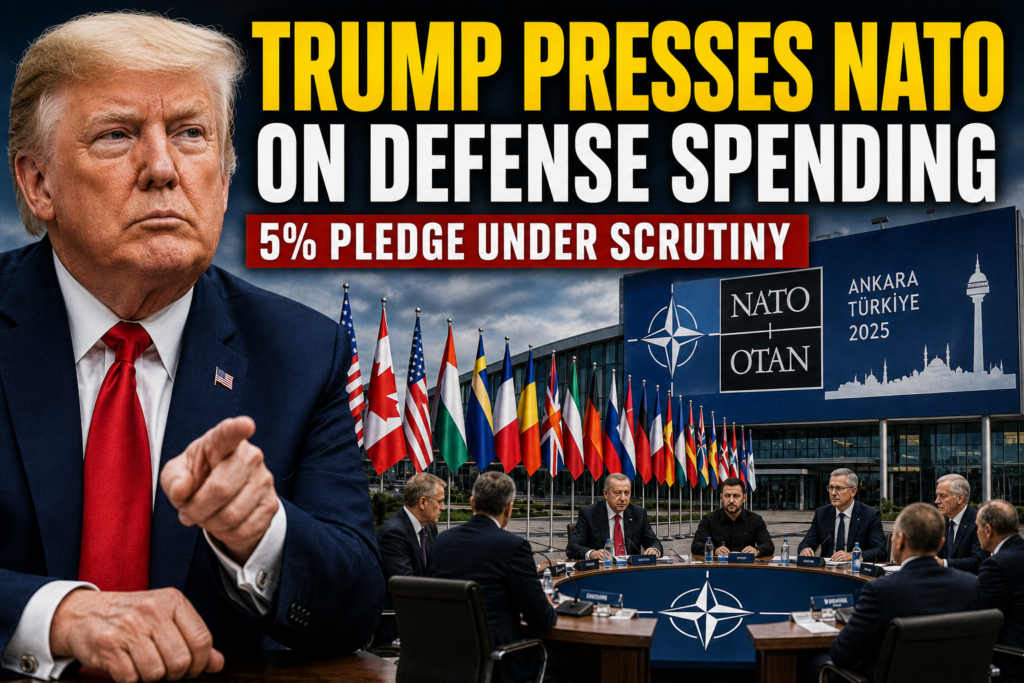
President Donald Trump is set to attend the NATO summit in Ankara, Turkey, this week with a clear objective: ensuring alliance members follow through on their commitment to significantly increase defense spending. The meeting marks the first major test of the pledge made by NATO leaders last year to raise military investment to 5% of their gross domestic product (GDP) over the next decade.
According to a report by NPR, Trump views this year’s summit as an opportunity to hold allies accountable after successfully pushing for higher defense spending commitments during the previous NATO gathering in The Hague.
Trump Seeks Accountability From NATO Allies
Last year’s NATO summit represented a major diplomatic victory for Trump, who has long argued that European allies should shoulder a greater share of the alliance’s defense burden rather than relying heavily on the United States.
The agreed framework calls for NATO members to dedicate 5% of GDP to defense-related spending by the mid-2030s. Of that amount, 3.5% would be allocated to core military expenditures, while the remaining portion would fund defense infrastructure and related security investments.
Ahead of the Ankara summit, U.S. Ambassador to NATO Matt Whitaker said the administration expects allies to begin implementing the agreement immediately and demonstrate measurable progress.
Political analysts have described the gathering as the alliance’s first major “report card” since the historic spending agreement was reached.
Ukraine War Remains a Central Focus
Beyond defense budgets, the ongoing war in Ukraine is expected to dominate discussions among NATO leaders.
Trump is scheduled to meet Ukrainian President Volodymyr Zelenskyy during the summit following recent conversations with both Zelenskyy and Russian President Vladimir Putin. The conflict, now entering its fifth year, remains one of NATO’s most pressing security challenges.
The administration has also continued broader discussions surrounding European security following recent developments in the Middle East, including tensions involving Iran. Readers can also explore how the administration has addressed Iran-related security threats and the Strait of Hormuz as regional conflicts continue influencing global defense strategy.
Additional High-Level Meetings Planned
In addition to NATO meetings, Trump is expected to hold bilateral talks with Turkish President Recep Tayyip Erdoğan, whose government is hosting the summit.
The White House also confirmed plans for Trump to meet Syrian President Ahmad al-Sharaa. While officials have not detailed the agenda, the meeting comes amid discussions over Syria’s potential role in regional security efforts involving Hezbollah and Lebanon.
Unlike previous international summits, Trump has not scheduled formal bilateral meetings with several European leaders despite recent diplomatic tensions involving Britain, France, Italy, and Canada.
NATO 3.0: A New Strategic Direction
The Trump administration continues promoting what officials describe as “NATO 3.0″—a strategy designed to encourage Europe to assume greater responsibility for its own defense while allowing the United States to redirect military resources toward other global priorities.
Defense Secretary Pete Hegseth recently announced a six-month review of U.S. military deployments across Europe, signaling that Washington may further reshape its military posture depending on allies’ progress.
Earlier this year, Trump’s administration also outlined broader strategic priorities affecting U.S. global alliances while continuing negotiations on international trade and economic policy. Readers may also be interested in Trump’s approach toward European digital tax disputes and tariff negotiations, another area where relations with European partners continue evolving.
European Leaders Face Growing Pressure
Although many NATO members have increased defense budgets since Trump’s return to office, experts note that much of Europe still depends heavily on U.S. military capabilities, particularly regarding intelligence, logistics, missile defense, and rapid deployment.
Several countries have expressed concerns about reaching the ambitious 5% spending target, with Spain among those questioning whether the goal is financially achievable within the agreed timeframe.
Security analysts nevertheless acknowledge that Russia’s continued aggression against Ukraine has accelerated defense investments across much of Europe.
Congressional Support Differs From White House Tone
A bipartisan delegation of U.S. senators is also attending the summit, aiming to reinforce congressional support for NATO despite Trump’s often confrontational rhetoric toward alliance members.
Sen. Jeanne Shaheen said Congress continues to view NATO as essential to U.S. national security, economic stability, and long-term partnerships, emphasizing that maintaining strong alliances remains critical despite policy disagreements.
What Happens Next
The Ankara summit will likely determine whether NATO members can maintain momentum behind last year’s historic defense spending commitments. While Trump’s administration views the agreement as evidence that allies are responding to U.S. pressure, implementation will ultimately determine whether the alliance achieves its long-term security objectives.
The summit’s outcomes could significantly influence NATO’s future structure, America’s military presence in Europe, and the broader balance of global security as geopolitical tensions continue to evolve.
The summit will assess whether NATO members are meeting last year’s commitment to increase defense spending to 5% of GDP.
Trump is expected to focus on NATO defense spending, the Ukraine war, European security, and meetings with leaders including Volodymyr Zelenskyy, Recep Tayyip Erdoğan, and Ahmad al-Sharaa.