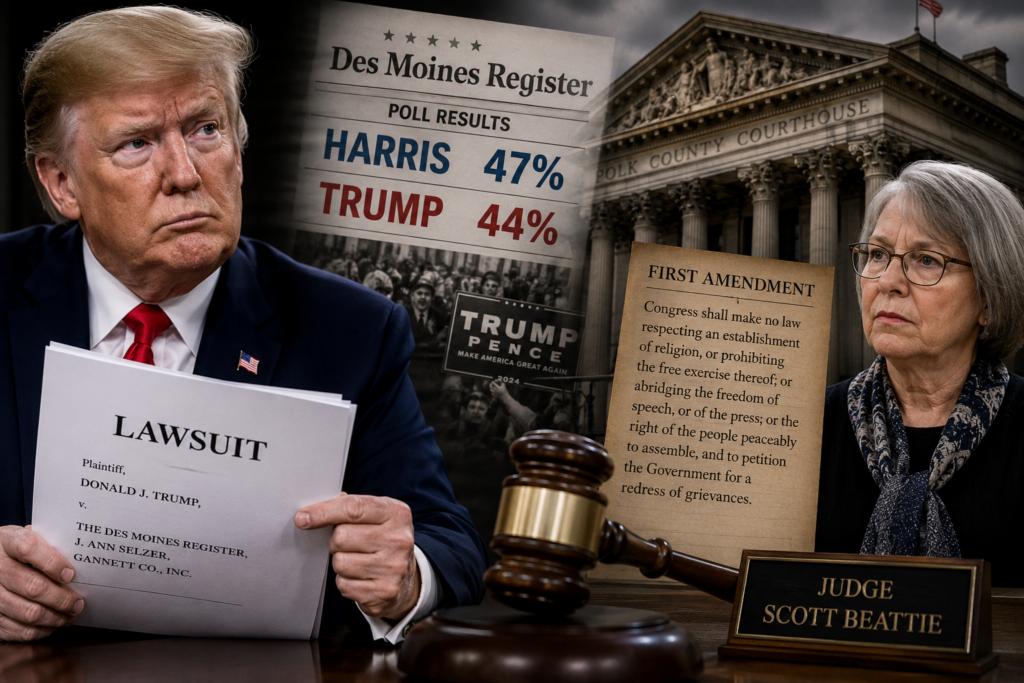
President Donald Trump is asking an Iowa state judge to allow his lawsuit against the Des Moines Register and veteran pollster J. Ann Selzer to move forward, arguing that a widely criticized 2024 election poll was fraudulently manipulated to damage his presidential campaign. The defendants maintain the lawsuit should be dismissed, saying the First Amendment fully protects political polling and news reporting.
According to a report by Courthouse News, attorneys for both sides presented arguments before Polk County District Judge Scott Beattie on July 10, with the court weighing whether the case can proceed or should be dismissed on constitutional grounds.
What Happened?
Trump filed the lawsuit after a Des Moines Register poll released three days before the November 2024 presidential election showed then-Vice President Kamala Harris leading him by three percentage points in Iowa.
The final election results differed significantly from the survey, with Trump ultimately defeating Harris in Iowa by more than 13 percentage points.
Trump alleges the poll was intentionally manipulated to influence public opinion and voter perception during the final days of the campaign.
The lawsuit also names Republican Rep. Mariannette Miller-Meeks and former Iowa state Sen. Bradley Zaun as co-plaintiffs, both of whom claim polling published by the newspaper inaccurately portrayed their races.
Trump’s Legal Argument
Consumer Fraud Rather Than Protected Speech
Trump’s legal team argues that the poll qualifies as commercial speech rather than protected political journalism.
Attorney Alan Ostergren told the court that the Iowa Consumer Fraud Act should apply because the allegedly misleading poll was published and distributed to consumers.
The plaintiffs contend the case deserves to proceed through discovery, allowing investigators to examine:
- How the polling methodology was developed
- Internal communications regarding the survey
- Whether statistical concerns were raised before publication
- Whether the poll results accurately reflected collected data
Trump’s attorneys argue these questions cannot be answered unless the court allows the lawsuit to move forward.
Newspaper and Pollster Seek Dismissal
First Amendment at the Center of the Case
Lawyers representing the Des Moines Register, its parent company Gannett, and pollster J. Ann Selzer argue the lawsuit should be dismissed immediately.
Robert Corn-Revere, representing Selzer through the Foundation for Individual Rights and Expression (FIRE), described the lawsuit as legally baseless.
Attorneys for the newspaper argued that political polling is protected speech under the First Amendment and warned that allowing lawsuits over inaccurate polls could discourage political reporting and opinion research.
They also argue Trump’s complaint fails to identify any consumer transaction or financial loss required under Iowa’s consumer fraud statute.
Judge Raises Constitutional Concerns
During the hearing, Judge Scott Beattie acknowledged the case presents significant constitutional questions.
He noted that allowing the lawsuit to proceed could have substantial implications for First Amendment protections and potentially create a chilling effect on political speech and news reporting.
The judge questioned Trump’s attorneys about what evidence they expected to obtain through discovery.
In response, Ostergren argued that examining internal polling decisions could determine whether the published results reflected legitimate polling data or were knowingly inaccurate.
Background of the Lawsuit
Trump originally filed the lawsuit in December 2024 after winning both Iowa and the presidential election.
His complaint alleges the poll falsely suggested growing momentum for Kamala Harris nationwide despite what he characterizes as overwhelming evidence to the contrary.
Over the past 18 months, the litigation has moved between state and federal courts.
A separate lawsuit filed by another Iowa plaintiff raising similar allegations was dismissed by a federal judge in 2025 and is currently on appeal before the U.S. Court of Appeals for the Eighth Circuit.
The case unfolds alongside other legal and political disputes involving President Trump, including ongoing federal legal actions related to executive branch authority and broader debates over the Trump administration’s domestic political agenda.
Political and Legal Implications
Legal experts say the outcome could establish an important precedent regarding whether political polls may become subject to consumer protection laws.
If Trump’s lawsuit survives the motion to dismiss, it could open the door to broader legal challenges involving polling organizations and media outlets following election campaigns.
Media organizations argue such a precedent could expose news outlets to litigation whenever polling results prove inaccurate, potentially discouraging independent political reporting.
What Happens Next?
Judge Scott Beattie has not yet ruled on the defendants’ motion to dismiss.
If the judge allows the case to continue, the parties would enter the discovery phase, giving Trump’s legal team access to documents, communications, and polling records they argue are essential to proving their claims.
If the lawsuit is dismissed, Trump could pursue an appeal through Iowa’s appellate courts.
The case is expected to remain closely watched because it raises significant questions about political polling, media protections under the First Amendment, and the legal limits of election-related reporting in the United States.
Trump alleges a 2024 Iowa poll showing Kamala Harris ahead was intentionally manipulated to influence the election and violated Iowa’s consumer fraud law.
The court must decide whether the poll is protected political speech under the First Amendment or whether it can be challenged under Iowa’s consumer protection laws.