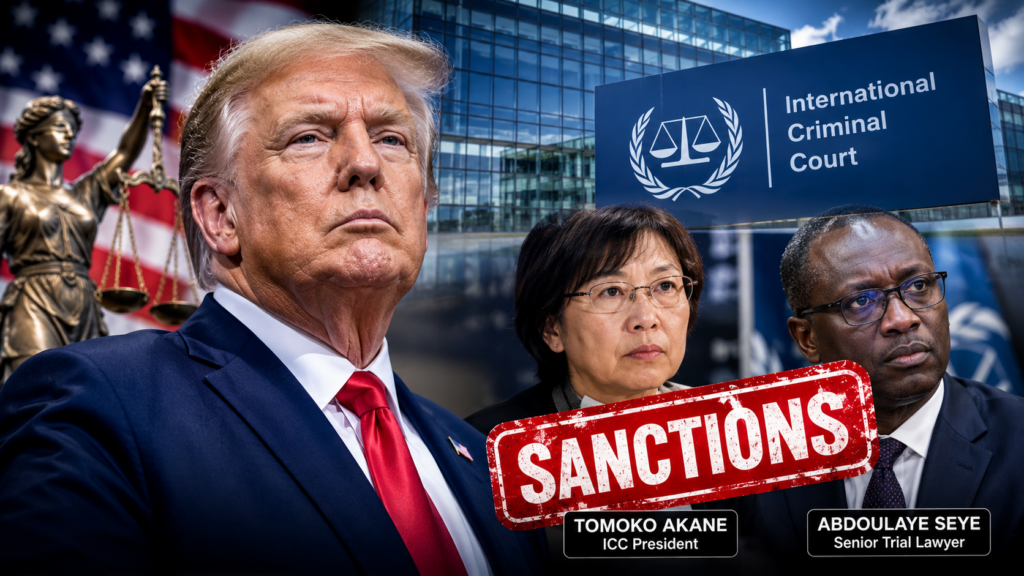
The ICC sanctions announced by the Trump administration are expanding Washington’s campaign against the International Criminal Court, with Secretary of State Marco Rubio imposing new measures on ICC President Tomoko Akane and senior trial lawyer Abdoulaye Seye. The move deepens the administration’s confrontation with the Hague-based court over its investigations involving officials from countries that have not accepted its jurisdiction.
What Happened
The United States imposed sanctions on two senior International Criminal Court officials on August 18, 2026, escalating the Trump administration’s effort to restrict the court’s ability to operate.
According to a report by BBC News, Secretary of State Marco Rubio announced sanctions against ICC President Tomoko Akane of Japan and senior trial lawyer Abdoulaye Seye of Senegal.
Rubio accused the officials of participating in the ICC’s efforts to investigate and prosecute officials whose governments had not consented to the court’s jurisdiction.
The State Department said the latest designations are part of a broader campaign to address what the administration describes as the ICC’s threat to U.S. sovereignty. Reuters and The Associated Press independently confirmed the sanctions and the identities of the two targeted officials.
New Sanctions Target Senior ICC Officials
Tomoko Akane and Abdoulaye Seye
Tomoko Akane, a Japanese judge, has served as president of the ICC since 2024. Abdoulaye Seye, a Senegalese national, is a senior trial lawyer in the court’s Office of the Prosecutor.
The two were designated under Executive Order 14203, signed by President Donald Trump in February 2025. The order established a sanctions framework targeting ICC officials involved in actions the administration considers outside the court’s authority.
The sanctions can freeze assets under U.S. jurisdiction and restrict Americans and U.S.-linked financial institutions from conducting transactions with the designated individuals. Reuters reported that the measures cut the officials off from the U.S. financial system.
The financial restrictions can also have broader consequences because banks and companies with exposure to the U.S. financial system may need to comply with the sanctions.
Trump Administration Seeks to Dismantle the ICC
The latest ICC sanctions are part of a much larger campaign by the Trump administration.
Rubio has accused the court of being a politicized institution that has exceeded its mandate and interfered with national sovereignty. In July, he called on the ICC’s member states to withdraw from the court as Washington pursued what the State Department described as a campaign to dismantle the institution.
The United States has never been a party to the Rome Statute that created the ICC. Washington has long objected to the court exercising jurisdiction over U.S. nationals without American consent.
Trump’s opposition to the ICC dates back to his first administration, when he described the court as a threat and rejected its authority over the United States.
The current administration has gone further by combining diplomatic pressure with sanctions against individual judges, prosecutors and staff members.
Why the ICC Is a Target
The International Criminal Court was established in 2002 and has jurisdiction to prosecute genocide, crimes against humanity, war crimes and aggression under circumstances established by the Rome Statute.
The court can investigate situations in member states and cases referred by the U.N. Security Council. Palestine became a member of the ICC in 2015, allowing the court to examine alleged crimes connected to Palestinian territory.
The Trump administration has strongly objected to ICC investigations involving U.S. personnel and Israeli officials.
The court previously issued arrest warrants for Israeli Prime Minister Benjamin Netanyahu and former Defense Minister Yoav Gallant over alleged war crimes connected to the Gaza conflict. Israel has rejected the allegations and criticized the court’s actions.
The United States and Israel are not members of the ICC.
ICC Condemns the U.S. Measures
The International Criminal Court has rejected the sanctions and defended the independence of its judges and prosecutors.
In a statement following the announcement, the ICC described the measures as a “flagrant attack” on an independent judicial institution and said the sanctions undermine the rule of law. The court said it would continue carrying out its mandate despite the pressure.
The court also warned that targeting judicial officials could threaten the broader international legal system.
The ICC said nine of its 18 judges, both deputy prosecutors, a former prosecutor and one staff member were under U.S. sanctions following the latest designations.
Human Rights Groups Challenge the Campaign
The administration’s approach has also triggered legal challenges inside the United States.
Human Rights Watch, the American Friends Service Committee, the Center for Constitutional Rights and the Open Society Institute filed a lawsuit challenging the sanctions campaign and arguing that it interferes with their ability to work with the ICC on international justice matters. Human Rights Watch confirmed the lawsuit was filed on August 11, shortly before the newest sanctions were announced.
Three ICC judges also sued the administration in federal court in June, arguing that sanctions imposed against them were unlawful and represented an attempt to pressure judicial officials.
The White House has maintained that the president has lawful authority to impose the measures under the International Emergency Economic Powers Act.
The disputes place the administration’s sanctions policy within a wider legal battle over the limits of presidential power and the United States’ relationship with international institutions.
Wider Implications for U.S. Foreign Policy
The escalation demonstrates how the Trump administration is increasingly relying on sanctions, diplomatic pressure and economic restrictions as instruments of foreign policy.
The strategy extends beyond the ICC itself. Washington has also expanded the use of economic tools against foreign actors in other strategic areas, including Trump administration drone tariff policies, reflecting a broader willingness to use economic leverage to advance national-security goals.
At the same time, the administration has increased its focus on protecting U.S. interests from foreign threats, including efforts addressing cyber threats to private companies.
The ICC dispute is particularly sensitive because it combines questions of sovereignty, international law and accountability for alleged war crimes.
What Happens Next
The Trump administration is expected to continue pressing ICC member states to reconsider their participation in the court while expanding measures against officials involved in cases that Washington considers illegitimate.
The ICC, meanwhile, says it will continue operating under the authority granted by its member states.
The growing confrontation could put additional pressure on countries that maintain close ties with both Washington and the ICC, particularly allies that support the court but also rely on U.S. cooperation.
The latest ICC sanctions therefore represent more than another set of financial restrictions. They are part of a fundamental dispute over whether an international court can investigate alleged crimes involving nationals of countries that have not accepted its jurisdiction. As Washington and The Hague continue down opposing paths, the outcome could have lasting consequences for international justice, U.S. foreign policy and the future role of the ICC.
ICC President Tomoko Akane and senior trial lawyer Abdoulaye Seye were placed under U.S. sanctions.
The administration says the ICC has exceeded its jurisdiction and threatened U.S. sovereignty by pursuing cases involving officials from non-member states.