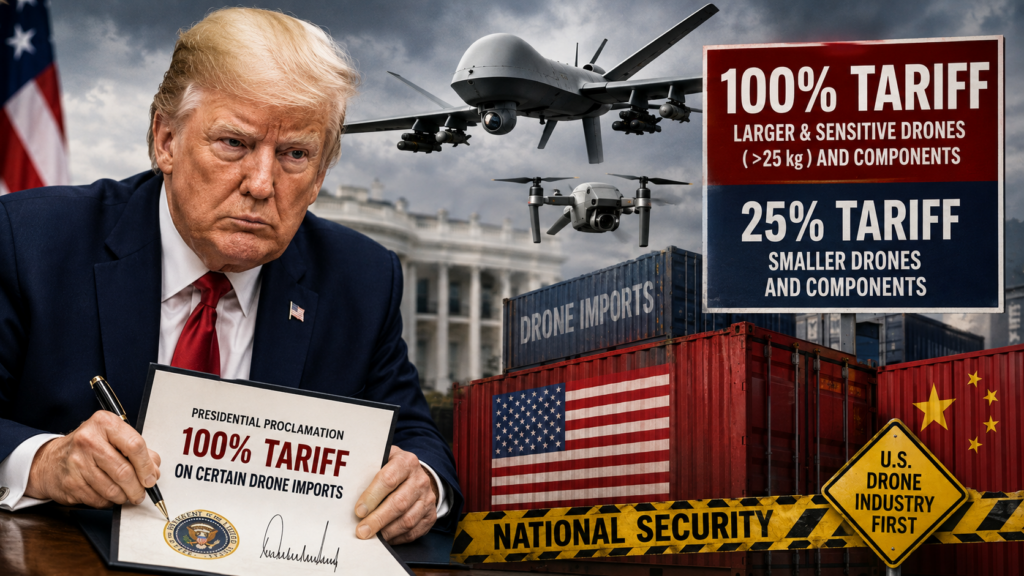
President Donald Trump has imposed a 100% tariff on certain drone imports and components, citing U.S. national security concerns and the need to strengthen domestic production. The new drone tariffs will target larger and particularly sensitive unmanned aircraft systems, while smaller drones will face a lower 25% duty.
What Happened
Trump signed a proclamation on Thursday imposing new Section 232 tariffs on certain imported drones and drone components.
Section 232 of the Trade Expansion Act of 1962 allows the U.S. government to restrict imports when they are determined to threaten national security.
According to a report by NHK World-Japan, the 100% duty will apply to “particularly sensitive” drones and their components.
The administration’s decision comes as unmanned aerial vehicles become increasingly important for both commercial and military purposes. Washington is seeking to reduce reliance on foreign-made drones while encouraging stronger domestic production and supply chains.
Key Details of the New Drone Tariffs
The tariff system establishes different rates based on the type and size of the drone.
100% Tariff on Larger and Sensitive Drones
The highest tariff rate will apply to particularly sensitive drones and components.
The measure covers drones with a maximum takeoff weight of more than 25 kilograms and their covered components.
These products will face a 100% import tariff, significantly increasing the cost of bringing affected drones into the United States.
25% Tariff on Smaller Drones
Smaller drones and components that do not fall into the particularly sensitive category will face a lower 25% tariff.
The two-tier structure allows the administration to impose the strongest trade restrictions on drones it considers most important from a national security perspective.
The main tariffs are scheduled to take effect 21 days after Trump’s proclamation.
Certain drone components classified as less sensitive will have a longer implementation period, with their tariffs taking effect 180 days after the proclamation.
Lower Tariff Rates for Some U.S. Trade Partners
Not every foreign-made drone will necessarily face the full 100% tariff.
Japan, the European Union and other U.S. trading partners that have reached trade agreements with Washington could qualify for a 15% tariff rate if they meet the conditions established by the administration.
This creates a significant difference between suppliers from countries receiving preferential treatment and those whose products are subject to the highest national-security tariff.
The policy could also encourage foreign manufacturers to strengthen their relationships with U.S. companies and potentially expand production within the United States.
Why Trump Is Targeting Drone Imports
The Trump administration says the new drone tariffs are intended to strengthen U.S. national security and reduce dependence on foreign manufacturers.
Drones are no longer limited to recreational use. Unmanned aircraft are increasingly used in defense, surveillance, agriculture, infrastructure inspection, public safety and other commercial applications.
That growing importance has made control over drone manufacturing and critical components a strategic issue.
The administration’s approach is designed to encourage American companies to produce more drones and components domestically, potentially reducing vulnerabilities in the U.S. supply chain.
China and the Drone Supply Chain
The new tariff policy comes amid growing U.S.-China competition over technology and strategic supply chains.
China is a major player in the global drone industry, making Beijing’s trade policies particularly relevant to Washington’s decision.
Just one week before Trump’s tariff announcement, China’s Commerce Ministry said it would tighten export controls on drones bound for the United States.
The move creates a potential cycle of restrictions, with Washington imposing tariffs while Beijing tightens controls over exports.
The two countries are also engaged in broader trade negotiations ahead of Chinese President Xi Jinping’s planned visit to the United States in September.
Economic Impact of the Drone Tariffs
The new drone tariffs could create both opportunities and challenges for the U.S. economy.
American drone manufacturers could benefit if higher import costs make domestically produced products more competitive.
Companies that depend on imported drones and components, however, could face significantly higher costs.
Those additional expenses could eventually affect businesses, government agencies and consumers that rely on unmanned aircraft for commercial or operational purposes.
The policy may also encourage manufacturers to move more production and component sourcing into the United States.
For additional context on the Trump administration’s broader tariff strategy, U.S. Presidential Report has covered Trump tariff refunds and the administration’s trade policy.
National Security and Military Implications
The administration’s decision is closely tied to the growing military importance of drone technology.
Modern militaries increasingly use unmanned aircraft for surveillance, reconnaissance and battlefield operations. The war in Ukraine has further demonstrated the importance of drones in modern warfare.
That has raised concerns about whether the United States can depend on foreign suppliers for technologies that may have direct military applications.
By imposing higher tariffs on sensitive drone imports, the Trump administration is attempting to encourage a stronger domestic industrial base.
The strategy reflects a broader effort to secure critical technologies and reduce dependence on foreign supply chains.
Potential Impact on U.S. Allies
The new policy could also affect American allies that manufacture drones and components.
Countries such as Japan and members of the European Union may receive preferential treatment if they satisfy the requirements for the lower tariff rate.
That could limit the impact on some allied manufacturers while maintaining pressure on suppliers from countries considered more strategically sensitive.
The policy could also encourage U.S. allies to increase cooperation with American manufacturers and develop supply chains that are less dependent on China.
What Happens Next
The first wave of drone tariffs is expected to take effect 21 days after Trump’s proclamation.
Companies importing affected products will need to determine which tariff category applies to their drones and components.
The administration will also face the challenge of determining whether the new policy produces the intended increase in domestic manufacturing.
If American production expands, the tariffs could become an important part of Trump’s broader strategy to build domestic capacity in strategically important industries.
However, if domestic manufacturers cannot quickly replace foreign suppliers, higher tariffs could result in increased costs for companies and consumers.
Broader Trade and National Security Strategy
The drone tariff announcement is part of a wider shift in U.S. trade policy toward using tariffs and other economic measures to protect strategic industries.
Washington has increasingly linked trade policy with national security, particularly when dealing with technologies that could have military applications.
The administration’s broader foreign-policy strategy also includes efforts to increase economic pressure on countries viewed as security threats. For example, lawmakers have pursued new Russia sanctions legislation as part of the broader U.S. response to Russia’s international activities.
The approach suggests that tariffs are increasingly being used not simply as economic tools but as part of a wider national-security strategy.
What Trump’s Drone Tariff Means for the U.S.
Trump’s decision to impose a 100% tariff on certain drones represents a significant escalation in the U.S. effort to secure strategic technology supply chains.
The policy could benefit domestic manufacturers by making foreign alternatives more expensive, while also encouraging companies to develop U.S.-based production and sourcing networks.
At the same time, businesses dependent on imported drones could face higher costs, particularly if domestic alternatives remain limited.
The effectiveness of the policy will ultimately depend on whether the tariffs lead to a stronger American drone industry without creating excessive costs for the wider economy. As unmanned aircraft become increasingly important to both national security and commercial activity, the new drone tariffs could have lasting consequences for U.S. manufacturing, trade relations and technology competition with China.
Trump has imposed a 100% tariff on certain sensitive drones and components, while smaller drones will face a 25% tariff.
The main tariffs will take effect 21 days after Trump’s proclamation, while certain less-sensitive components have a 180-day implementation period.