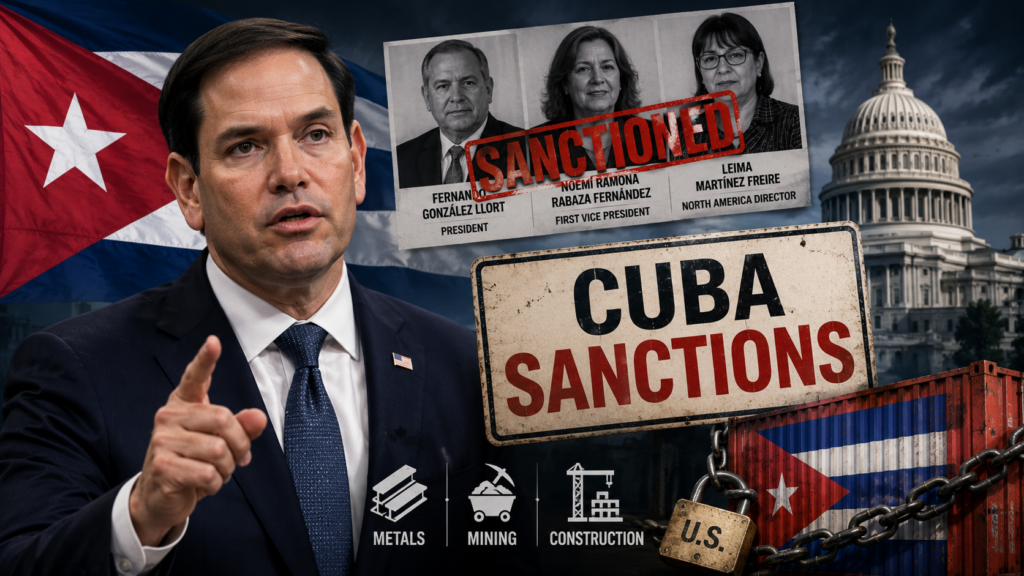
The Cuba sanctions campaign is escalating as the Trump administration targets three senior officials at the Cuban Institute of Friendship with the Peoples and nine state-linked companies across the metals, mining and construction sectors. Secretary of State Marco Rubio said the measures are intended to restrict the Cuban government’s ability to finance repression and what Washington describes as anti-American activities.
What Happened
Secretary of State Marco Rubio announced the new sanctions on August 20, expanding the Trump administration’s pressure campaign against Havana.
According to a report by The Hill, the latest measures target the leadership of the Cuban Institute of Friendship with the Peoples, or ICAP, as well as state-owned or state-affiliated entities in key economic sectors.
The three ICAP officials sanctioned are President Fernando González Llort, First Vice President Noemí Ramona Rabaza Fernández and North America Director Leima Martínez Freire. The organization itself had already been sanctioned by the United States in June.
Rubio accused ICAP of using educational and cultural exchanges to cultivate support for the Cuban government and said the administration would not allow Havana to use American freedoms to advance what he characterized as subversive activities.
New Sanctions Target Cuba’s Economy
Metals, Mining and Construction
The latest Cuba sanctions also focus on strategic parts of the Cuban economy.
The Treasury and State departments designated nine state-owned or state-linked entities tied to metals, mining and construction. The targets include Cuba’s Ministry of Construction, a nickel producer, a mineral resources company, companies involved in importing heavy industrial products and businesses involved in vehicles, automotive parts and construction materials.
Washington’s strategy is intended to restrict access to financial resources and limit the Cuban government’s control over industries that generate or facilitate economic activity.
Rubio said the designations were aimed at entities that sustain what the administration describes as Cuba’s repressive apparatus through control of important economic sectors.
The measures reflect the broader Trump strategy of using economic leverage to pressure foreign governments. That approach has also appeared in other areas of U.S. policy, including Trump administration drone tariff measures targeting strategic technology and industrial interests.
ICAP Becomes a Major Focus
The sanctions against ICAP leadership reflect Washington’s growing concern about Cuban-government-linked exchanges with Americans.
Rubio said the administration believes the organization has been used to build relationships with sympathizers in the United States under the cover of cultural and educational engagement. He specifically pointed to events surrounding the 100th anniversary of Fidel Castro’s birth.
The announcement came shortly after an event in Washington, D.C., involving Cuban Ambassador Lianys Torres Rivera and a discussion of Castro’s legacy.
Several Americans who had traveled to Cuba for events marking Castro’s centennial were also briefly detained at Miami International Airport after returning to the United States, according to U.S. officials cited by AP. Some had electronic devices seized for inspection.
The operation illustrates how the administration is combining sanctions enforcement with increased scrutiny of Americans who may have dealings with Cuban government-affiliated entities.
Trump Administration Seeks Greater Pressure on Havana
The latest Cuba sanctions are part of a broader campaign that President Donald Trump has made a foreign-policy priority.
The administration has sought to increase economic and political pressure on Cuba while portraying the Cuban government as a national-security concern for the United States.
The measures follow a May executive order that broadened sanctions against Cuban government officials, security forces and supporters.
The administration has also imposed an oil blockade on Cuba following the U.S. military operation that removed Venezuelan leader Nicolás Maduro, according to AP. Venezuela had been an important source of subsidized oil for Cuba.
The pressure has intensified as Cuba’s economy has deteriorated.
Cuba Pushes Back Against the Sanctions
Cuban Foreign Minister Bruno Rodríguez strongly rejected the latest measures.
Rodríguez accused Washington and Rubio of deliberately damaging the Cuban economy and restricting the government’s ability to provide essential services. He also defended ICAP as an organization that has promoted international solidarity and relations with foreign groups for decades.
Reuters reported that Rodríguez said the sanctions could hinder access to food, medicine and medical equipment, including supplies purchased by Cuban private businesses.
The dispute highlights a central disagreement between Washington and Havana: the Trump administration argues that economic pressure can weaken the Cuban government, while Cuban officials say the measures worsen conditions for ordinary citizens.
Cuba Faces a Deepening Economic Crisis
The escalation comes as Cuba confronts severe economic problems.
AP reported that the island has experienced extensive blackouts as fuel shortages restrict electricity generation. Public transportation has also been severely disrupted, medicine shortages have worsened and tourism has suffered major losses.
The economic pressure has also complicated Cuba’s efforts to pursue greater private and foreign investment.
In separate reporting, AP noted that Cuba has introduced reforms intended to attract investment and expand private economic activity, while U.S. sanctions continue to restrict the financial channels needed for those reforms to succeed.
That tension could become increasingly important as Washington seeks to force political change through economic pressure.
Broader U.S. National Security Strategy
The Cuba policy is part of a wider Trump administration approach that increasingly combines sanctions, trade restrictions and military pressure in pursuit of foreign-policy objectives.
Washington is also strengthening its broader national-security posture, including U.S. Navy shipbuilding efforts designed to maintain American military capacity.
While the Cuba measures are primarily economic and diplomatic, their broader significance lies in how the administration is using economic power as a national-security tool.
What Happens Next
The Trump administration is signaling that additional pressure on Cuba could follow rather than treating the latest sanctions as a final step.
The administration is likely to continue targeting Cuban government-linked entities and individuals while tightening enforcement against Americans and businesses that conduct prohibited transactions with sanctioned entities.
For Cuba, the immediate challenge will be managing an increasingly severe economic crisis while facing restrictions on energy, trade and access to international finance.
The latest Cuba sanctions deepen the confrontation between Washington and Havana and increase the economic stakes for both governments. Whether the strategy produces political change remains uncertain, but the Trump administration has made clear that it intends to keep using financial and economic pressure to challenge Cuba’s leadership.
Three senior ICAP officials and nine Cuban state-linked entities in metals, mining and construction were sanctioned.
Washington says the measures are designed to restrict Cuba’s economic resources and counter activities it considers hostile to the United States.