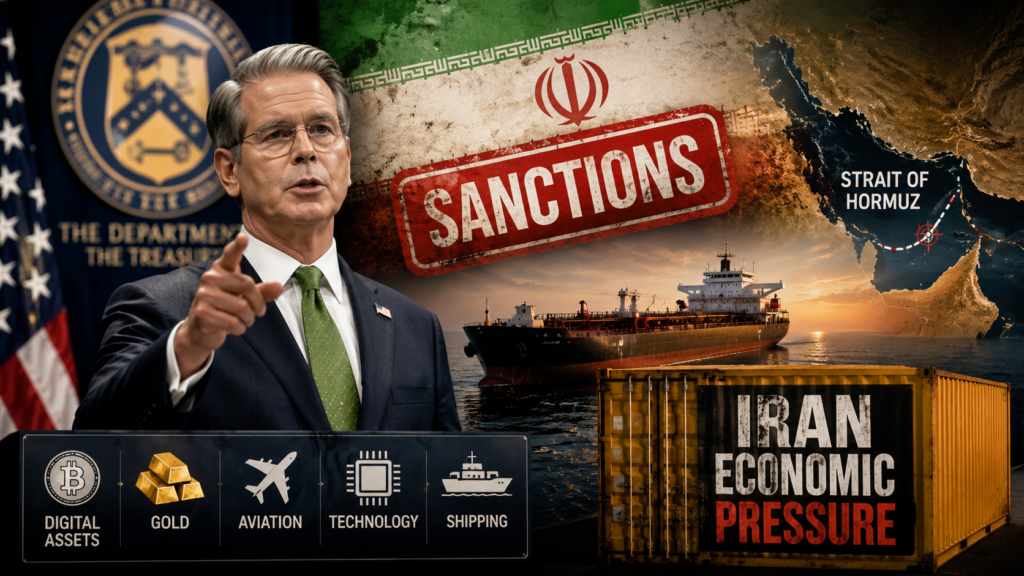
The Iran sanctions campaign is entering a major new phase as Treasury Secretary Scott Bessent prepares an expanded economic offensive under President Donald Trump, targeting entities and countries that continue doing business with Tehran. The campaign, described by Bessent as an “economic D-Day,” is intended to increase pressure on Iran, reopen the Strait of Hormuz and push the conflict toward an endgame.
What Happened
Treasury Secretary Scott Bessent is leading a new push to intensify the Trump administration’s economic pressure on Iran following months of military operations and unsuccessful negotiations.
According to a report by CBS News, Bessent was scheduled to outline the administration’s expanded sanctions strategy during a Treasury Department press conference on August 24.
The administration is broadening its existing sanctions framework by threatening stronger secondary sanctions against entities and countries that conduct business with Tehran. Reuters independently reported that the Treasury Department planned to expand the scope of secondary sanctions against foreign entities and countries supporting Iran’s economy.
Bessent has characterized the new effort as an “economic D-Day,” portraying it as a decisive financial campaign intended to isolate Iran economically.
New Iran Sanctions Target Multiple Sectors
The expanded Iran sanctions effort is designed to reach beyond traditional restrictions on Iranian entities.
The campaign includes additional sanctions across sectors such as digital assets, gold, aviation, technology and shipping, while also expanding the categories of foreign transactions that could trigger secondary sanctions.
Reuters reported that Washington is particularly focused on Iran’s ability to use third countries, front companies and alternative financial channels to evade existing restrictions. The United States has already targeted Iranian oil, military and financial networks while maintaining exceptions for essential goods such as medicine.
The strategy reflects an effort to make sanctions harder to circumvent by increasing the risks for international companies and governments that continue economic dealings with Tehran.
Bessent Calls It an “Economic D-Day”
Bessent previewed the campaign in a Financial Times opinion article published Sunday.
He argued that the administration had already weakened Iran’s military and nuclear capabilities and was now moving toward what he described as an economic endgame.
Bessent said the United States intended to use its financial authorities to cut off economic channels supporting the Iranian government.
The Treasury secretary’s comments represent one of the strongest public indications yet that the Trump administration intends to use financial pressure as a central component of its strategy toward Tehran. The Washington Post likewise reported that Bessent had warned of sweeping sanctions designed to isolate Iran financially and potentially reduce the need for additional U.S. military force.
Trump Says Iran Is Collapsing
President Trump has repeatedly argued that Iran’s government and military capabilities are deteriorating.
On Monday morning, Trump wrote on Truth Social that Iran was “completely collapsing,” according to CBS News.
The administration’s economic strategy follows months of military confrontation between the United States and Iran. CBS reported that the conflict had reached its sixth month after the administration originally indicated that the war could last four to six weeks.
The Trump administration is now seeking to combine military pressure with increasingly aggressive financial measures.
Treasury Has Already Escalated Pressure on Iran
The new campaign follows a series of Treasury Department actions against Iranian financial networks.
On August 7, the department sanctioned companies and individuals accused of laundering hundreds of millions of dollars. CBS reported that it was the eighth such Treasury action targeting Iran since the start of the second Trump administration.
Among those designated were Shahr Bank and Dubai-based exchange houses Titan Exchange and Alps International. Treasury alleged that the entities helped Shahr Bank recover oil revenue for major Iranian exporters, including the National Iranian Oil Company and Naftiran Intertrade Co.
The department also sanctioned several Iranian nationals and companies operating through Hong Kong, Singapore and Dubai that were accused of facilitating payments through intermediary accounts.
Separately, the Treasury Department’s Office of Foreign Assets Control sanctioned former Fly Baghdad CEO Basheer Abdulkadhim Alwan al-Shabbani over allegations that he helped Iran’s Islamic Revolutionary Guard Corps-Qods Force move fighters, weapons and money to regional militia groups.
Economic Pressure Could Reach Iran’s Global Partners
One of the most significant elements of the new Iran sanctions strategy is the potential impact on companies and countries outside Iran.
Secondary sanctions can create substantial pressure on foreign businesses by threatening their access to the U.S. financial system if they continue transactions with sanctioned Iranian entities.
Reuters reported that the administration is considering stronger action against countries and entities conducting business with Tehran, with particular attention to sanctions evasion networks and third-country transactions.
China could become a particularly sensitive issue because it remains a major buyer of Iranian oil. Reuters reported that Washington has already targeted Chinese refineries and is weighing further measures involving Chinese financial institutions, creating the potential for additional tensions between Washington and Beijing.
The approach reflects a broader Trump administration strategy of using trade and financial leverage to influence foreign policy. The administration has also pursued separate measures involving technology and trade, including Trump administration drone tariff policies that have expanded the use of economic tools in strategic industries.
Strait of Hormuz Remains a Central Objective
The sanctions campaign is closely tied to the Strait of Hormuz, a critical route for global energy shipments.
The Trump administration is seeking to use economic pressure to encourage Iran to reopen the waterway and ultimately help bring the conflict to an end. CBS reported that this objective is one of the central reasons behind the expanded sanctions strategy.
The prolonged disruption has kept energy markets focused on the conflict. MarketWatch reported that Brent crude remained above $90 a barrel on August 24 as traders awaited Bessent’s announcement, while analysts warned that stronger sanctions could affect oil prices and intensify the broader economic confrontation.
The economic pressure therefore extends beyond Iran itself, with potential consequences for energy markets, international trade and countries that depend on Middle Eastern energy flows.
Military and Economic Pressure Are Increasingly Linked
The new sanctions campaign also comes as the Trump administration continues its broader military strategy in the Middle East.
Bessent has argued that the military campaign against Iran created the conditions for the administration to apply stronger financial pressure.
That broader national-security approach includes efforts to strengthen American military capacity. The administration’s separate U.S. Navy shipbuilding push reflects the wider emphasis on maintaining American military capabilities while economic tools are used alongside defense policy.
The combination of military action, financial restrictions and diplomatic pressure represents a comprehensive attempt to force Tehran into a more constrained position.
What Happens Next
The immediate focus will be on how the new sanctions are implemented and which foreign entities could face penalties for continuing business with Iran.
The biggest test for the administration will be whether expanded secondary sanctions can significantly restrict Iran’s access to international finance without creating broader disruption in energy markets or triggering major confrontations with countries that continue trading with Tehran.
The Trump administration is also seeking to determine whether economic pressure can achieve its political objectives after months of military operations and failed negotiations.
The Iran sanctions campaign marks a significant escalation in Washington’s use of financial power against Tehran. By targeting not only Iran but also the international networks that support its economy, the administration is attempting to make continued economic ties with Tehran increasingly costly and difficult. Whether that pressure can reopen the Strait of Hormuz and contribute to an end to the conflict will be a major test of Trump’s broader strategy toward Iran.
The expanded measures strengthen secondary sanctions and target digital assets, gold, aviation, technology, shipping and other economic channels.
The administration aims to isolate Iran financially, pressure Tehran to reopen the Strait of Hormuz and help end the conflict.