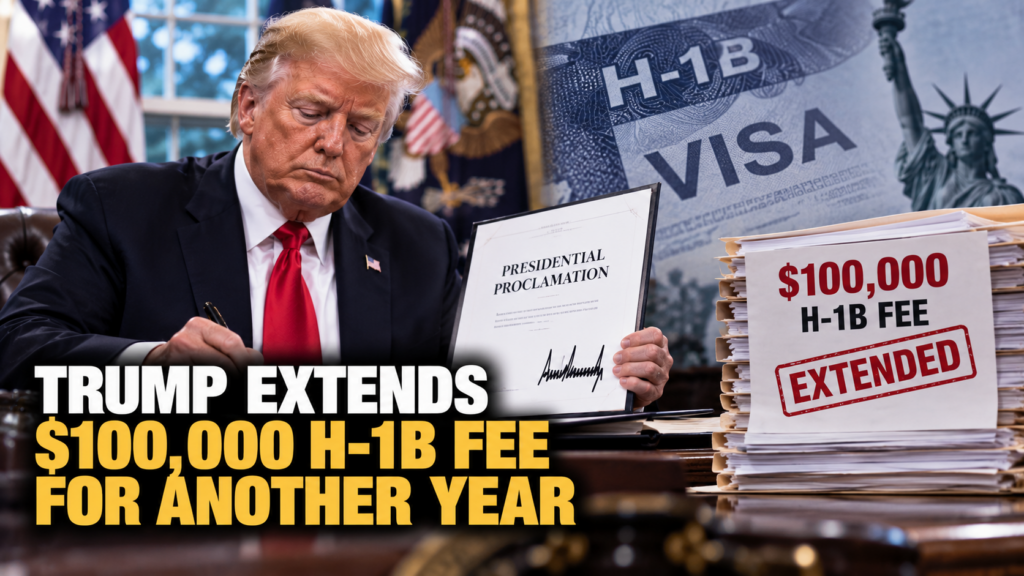
President Donald Trump has extended the $100,000 H-1B fee requirement for another year, keeping restrictions on certain new foreign workers in place through September 21, 2027. The Trump administration says the H-1B fee is intended to discourage lower-paid recruitment and protect U.S. workers, while legal challenges to the policy continue.
According to a report by The White House, Trump signed the proclamation on September 18, 2026, extending restrictions first imposed in 2025.
What Happened
Trump’s latest proclamation extends the restrictions established under Proclamation 10973, which introduced a $100,000 payment requirement for certain H-1B petitions.
The restriction takes effect at 12:01 a.m. Eastern Daylight Time on September 21, 2026, and will remain in place for 12 months unless extended again.
Under the policy, employers seeking to bring certain H-1B specialty occupation workers into the United States must provide documentation showing that the $100,000 payment has been made.
The White House says the extension is necessary because the conditions that prompted the original restriction remain unresolved.
How the $100,000 H-1B Fee Works
The H-1B program allows U.S. employers to hire foreign workers for specialty occupations, including jobs in technology and other highly skilled fields.
The Trump administration argues that some employers, particularly IT staffing and outsourcing companies, have used the program to recruit lower-paid workers and replace or displace American employees.
The administration says the $100,000 payment is intended to discourage this type of recruitment while encouraging companies to seek highly skilled and highly paid workers.
Reuters reported that the original fee was substantially higher than the previous H-1B government charges, which generally ranged from about $2,000 to $5,000 depending on the circumstances.
Who Is Covered by the Restriction?
The proclamation applies to certain H-1B specialty occupation workers who are outside the United States and require admission to the country to begin employment under an affected petition.
The proclamation specifically directs the Department of Homeland Security to restrict decisions on affected petitions that are not accompanied by the $100,000 payment.
There are also exceptions.
The Secretary of Homeland Security may determine that the restriction does not apply to an individual, a company’s workers or workers in an industry when hiring those workers is considered to be in the national interest and does not pose a threat to U.S. security or welfare.
The White House says the restriction does not generally apply to people already in the United States under other qualifying immigration statuses or to renewals of existing H-1B visas. Reuters reported that foreign graduates already in the United States on student visas and current H-1B visa renewals were not covered by the original fee requirement.
Administration Points to Changes in H-1B Applications
The White House says the 2025 restrictions have already changed how companies participate in the H-1B program.
According to the proclamation, the largest IT staffing and outsourcing companies reduced their combined H-1B registrations from 24,946 to 2,055, a 92 percent decrease.
The administration also reported a nearly 97 percent decrease in consular processing requests between the FY2025 and FY2027 H-1B cap seasons.
The White House attributed these changes partly to the $100,000 payment requirement and a new weighted H-1B selection process introduced by the Department of Homeland Security.
Higher-Paid and Higher-Skilled Workers
The administration also pointed to changes in the profile of H-1B registrations.
According to the proclamation, registrations for beneficiaries with at least a U.S. master’s degree increased from 45.1 percent of total registrants for FY2026 to 66.1 percent for FY2027.
The administration also said jobs corresponding to the two highest wage levels represented approximately 46.3 percent of H-1B registration selections, while the lowest wage level represented 17.8 percent.
The White House characterized these changes as evidence that the new policies are shifting the program toward higher-skilled and higher-paid workers.
Employer Scrutiny and Wage Rules
The H-1B fee extension is part of a broader effort to increase scrutiny of employers using the program.
In December 2025, DHS finalized a weighted selection process that gives greater priority to higher-skilled and higher-paid workers.
The Department of Labor also proposed changes to prevailing wage rules in March 2026. The proposal would seek to better align wage levels for H-1B workers with wages earned by comparable U.S. workers.
The administration says these measures are intended to address wage suppression and improve the integrity of the H-1B program.
Legal Challenges Continue
The extension comes while the $100,000 H-1B fee faces legal challenges.
Reuters reported that a Boston-based appeals court is reviewing a federal judge’s June ruling that found the higher fee imposed by the Trump administration was unlawful and blocked the government from collecting it. Another court is considering a separate challenge brought by the U.S. Chamber of Commerce.
The legal disputes could therefore affect whether the administration can continue collecting the $100,000 payment requirement.
The extension itself does not resolve those pending challenges.
Impact on Employers and Foreign Workers
The H-1B program is particularly important to technology companies and employers recruiting specialized workers from overseas.
The program was established by Congress in 1990 and is widely used by companies seeking workers in technology and other specialized occupations. Reuters reported that India and China are particularly important sources of H-1B workers.
The higher fee can significantly increase the cost for employers seeking to bring qualifying workers from outside the United States.
Companies have also adjusted hiring and expansion strategies in response to changes in H-1B processing. Reuters reported that some major H-1B users, including Alphabet, have increased operations in India amid the changing immigration environment.
What Happens Next
The Trump administration will continue enforcing the $100,000 payment requirement through September 21, 2027, unless the policy is changed or blocked.
The proclamation also requires senior officials from the State Department, Justice Department, Labor Department and Department of Homeland Security to submit a recommendation on whether the restriction should be extended again after the next H-1B lottery.
The pending court cases could become a significant factor in determining the future of the policy.
For employers and foreign professionals, the extension means the H-1B program will continue operating under substantially higher costs and additional scrutiny while the administration pursues changes designed to shift recruitment toward higher-paid and higher-skilled positions.
Related Reading
Hyundai Plant Workers File Claims After ICE Raid in Georgia
Trump Faces Bipartisan Backlash as AI Guardrails Push Grows
FAQs
Trump’s proclamation extends the restriction for another 12 months, beginning September 21, 2026, unless it is extended, changed or blocked.
No. The restriction primarily affects certain new H-1B workers outside the United States. The proclamation also provides exceptions for cases determined to be in the national interest.