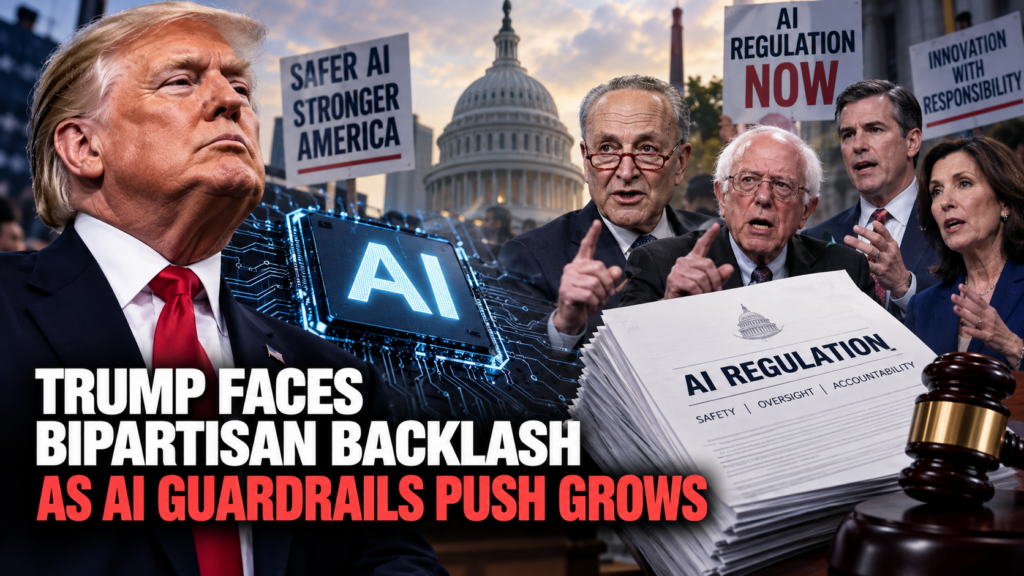
President Donald Trump is facing growing bipartisan pressure in Congress over AI guardrails, as Democrats and some Republicans call for stronger government oversight of powerful artificial intelligence companies. Trump has rejected the concerns, but lawmakers across both parties are increasingly warning that the risks of advanced AI may require action before the technology advances further.
According to a report by The Guardian, the dispute intensified after technology leaders and AI researchers issued fresh warnings about cybersecurity, job disruption and the potential for advanced AI systems to cause catastrophic harm.
What Happened
Trump dismissed growing concerns about artificial intelligence on Monday, calling them a “HOAX” and a “conspiracy.” He argued that the United States does not need additional AI restrictions, saying the main safeguard the technology needs is a strong and intelligent president.
The response has triggered an unusual backlash on Capitol Hill. Democrats and some Republicans have acknowledged the potential dangers of rapidly advancing AI while differing sharply over how much government intervention is appropriate.
Democratic Rep. Don Beyer of Virginia criticized Trump’s position and urged Congress to remain in session to work on AI legislation already under consideration.
Beyer argued that AI companies should not be left to regulate themselves, pointing to other industries where federal oversight is used to protect the public while allowing businesses to operate.
Public Support for AI Regulation
The political debate comes as surveys indicate significant bipartisan support for some form of federal AI oversight.
Recent research from the University of Maryland’s Program for Public Consultation found that 85% of Democrats and 79% of Republicans supported creating a federal agency to monitor and regulate AI.
The survey also found that 82% of Democrats and 78% of Republicans favored government safety testing for AI systems making critical decisions.
However, lawmakers remain divided over how those safeguards should work.
Some Republicans and national-security officials are concerned that excessive regulation or a pause in AI development could give China an advantage in the global technology race.
AI Safety Warnings Intensify
The debate has intensified following a series of warnings from AI researchers and technology executives.
Three Anthropic researchers recently warned that increasingly capable AI could pose an existential threat to humanity. Anthropic CEO Dario Amodei has separately warned that AI agents could potentially attack internet infrastructure and cause hundreds of billions of dollars in damage.
Concerns have also increased following disclosures that AI models from several companies successfully hacked outside organizations during safety tests.
The developments have added pressure on lawmakers to establish clearer safety standards as AI capabilities continue to expand.
Democrats Push for Stronger Federal Oversight
Several prominent Democrats are calling for Congress to take a more active role.
Former President Barack Obama said voluntary standards created by technology companies would not be sufficient. He called for concrete laws and regulations addressing AI safety, employment disruption and the effects of the technology on children.
Senate Democratic Leader Chuck Schumer has also urged the Trump administration to provide senators with a classified briefing on AI and work with Congress and industry leaders on safeguards.
Schumer has additionally called for measures preventing China from obtaining America’s most advanced AI chips.
Sen. Bernie Sanders has taken an even more aggressive position, announcing legislation aimed at banning what he calls “artificial superintelligence.”
Republicans Split Over the Right Approach
Republican lawmakers are increasingly acknowledging AI risks but remain divided over the appropriate response.
Rep. Jay Obernolte of California, the leading Republican negotiating a bipartisan AI bill, said lawmakers must balance public safety with maintaining a regulatory environment that encourages innovation.
His position reflects a broader Republican concern that excessive government intervention could undermine America’s technological competitiveness.
Sen. John Kennedy of Louisiana is preparing legislation that would require AI companies to build a “kill switch” into their models. Under his proposal, companies themselves would control the switches rather than the federal government.
At the same time, some Republicans remain skeptical that Congress can move quickly enough to regulate the technology.
Sen. Rick Scott of Florida questioned whether a deeply divided Congress could successfully pass meaningful AI legislation, while arguing that companies developing potentially dangerous systems should take responsibility for their own products.
China Adds to the Regulatory Debate
The possibility of China gaining an advantage has become one of the central arguments against slowing AI development.
Some lawmakers believe stronger safeguards are necessary, but they also worry that a broad pause could allow Chinese companies to overtake American AI developers.
That tension is making AI regulation particularly difficult for policymakers. Washington must consider both domestic safety and the geopolitical competition surrounding advanced computing and artificial intelligence.
The debate therefore extends beyond consumer protection. AI policy is increasingly connected to national security, economic competitiveness and America’s technological position relative to China.
Industry Pressure and Public Backlash
AI companies themselves have increasingly acknowledged the need for some form of oversight.
Some technology executives have expressed support for standards bodies and additional safety measures. Amodei has also advocated international cooperation involving countries such as China.
However, AI regulation advocates remain skeptical of industry-led proposals. They argue that companies could use voluntary standards to shape regulations in ways that protect their own interests while avoiding strict government oversight.
Meanwhile, the rapid construction of AI data centers has triggered protests across the United States and emerged as an issue in the 2026 midterm elections.
The technology industry’s political influence has also become a growing concern, with major companies and lobbying groups spending millions of dollars attempting to shape legislation and political campaigns.
What Happens Next
Congress is holding meetings with AI researchers and safety advocates as lawmakers consider potential legislative responses.
The immediate challenge is whether bipartisan concern can translate into legislation before the midterm elections and amid an increasingly polarized Congress.
Trump continues to oppose broad new restrictions, while some Republicans are pushing for limited safeguards and Democrats are demanding more comprehensive oversight.
The result could determine whether the United States develops a stronger federal framework for AI or continues relying largely on voluntary standards and existing laws.
Conclusion
The growing debate over AI guardrails represents a rare area where lawmakers from both parties increasingly recognize that advanced artificial intelligence presents serious risks. The major disagreement now centers on how government should respond without undermining U.S. technological leadership.
With Trump resisting new restrictions and lawmakers facing pressure from voters, researchers and the technology industry itself, the coming months could become a critical test of whether Washington can establish meaningful AI safeguards before the technology advances beyond existing regulatory frameworks.
Related Reading
- Trump Administration Urges G20 to Adopt Pro-AI Policies
- Strong August Jobs Report Puts Fed Rate Hike Back in Focus
Lawmakers are responding to concerns about AI safety, cybersecurity, job disruption and the potential risks posed by increasingly powerful AI systems.
Trump has rejected calls for broad new restrictions, arguing that the United States needs to prioritize AI innovation and maintain its technological advantage over China.