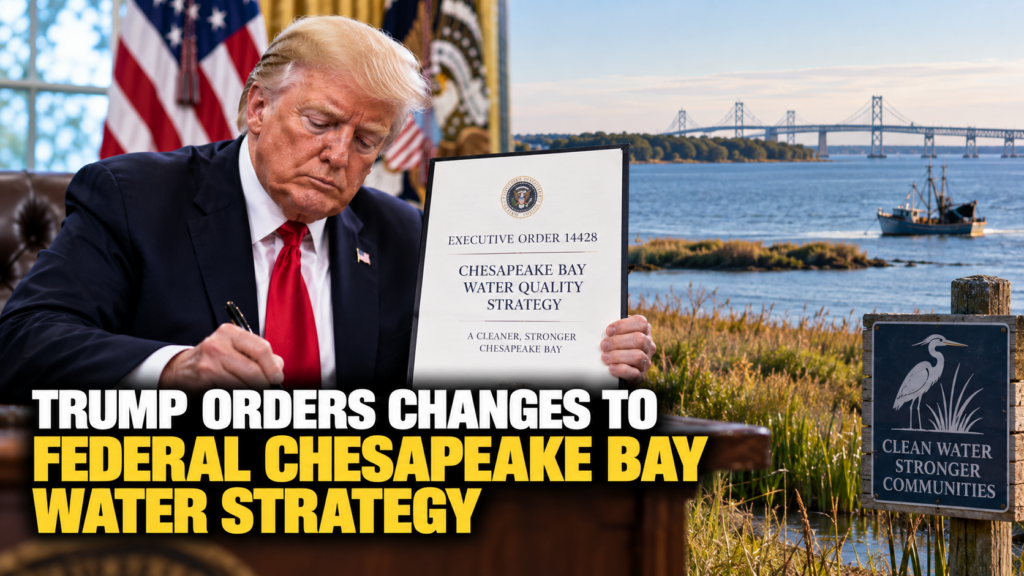
President Donald Trump has ordered major changes to the federal government’s approach to Chesapeake Bay water quality, revoking a 2009 executive order and directing federal agencies to prioritize measurable pollution reductions while examining the costs of local stormwater fees. The new policy was issued through Executive Order 14428 on September 16, 2026.
According to a report by The White House, the order revokes Executive Order 13508, signed in 2009, and instructs federal agencies to redirect resources toward projects that produce measurable improvements in Chesapeake Bay water quality.
What Happened
Executive Order 14428 revokes the 2009 Chesapeake Bay Protection and Restoration order and establishes a new framework for federal support of Chesapeake Bay cleanup efforts. The Trump administration argues that the previous order lacked sufficient clarity and had been associated with stormwater management fees imposed by some states and localities.
The new order directs the Environmental Protection Agency, along with the departments responsible for agriculture, commerce, homeland security, interior and the Department of War, to review their existing Chesapeake Bay programs and focus federal resources on direct projects in areas with the greatest need.
The White House said the new strategy is intended to emphasize environmental protection while also considering the economic interests of communities surrounding the bay.
Key Details of the Chesapeake Bay Order
2009 Executive Order Revoked
The Trump administration has formally revoked Executive Order 13508, which was issued on May 12, 2009, during the Obama administration.
The earlier order established a broad federal framework for coordinating efforts among states, municipalities and federal agencies to improve the Chesapeake Bay’s environmental health.
The new order states that the previous framework did not clearly specify how its requirements should be implemented. The Trump administration also argues that some jurisdictions incorrectly relied on the order when imposing stormwater management fees, commonly referred to as “rain taxes.”
Federal Funding to Focus on Measurable Results
Under Executive Order 14428, federal agencies supporting Chesapeake Bay restoration must prioritize projects that directly address water-quality goals.
The order specifically identifies reductions in sediment, phosphorus and nitrogen runoff as performance indicators. Agencies are instructed to document outcomes using objective metrics, scientific analysis and measurable results.
This means federal resources could be redirected away from activities that the administration determines do not produce measurable progress toward Chesapeake Bay restoration goals.
EPA to Examine Stormwater Fees
The EPA is also instructed to work with Maryland, Virginia, Pennsylvania, Delaware, New York, West Virginia and the District of Columbia.
The agency must assess the financial burden created by stormwater management fees, explore approaches that improve the bay without increasing costs for residents and encourage states or localities to repeal or rescind such fees.
The order itself does not directly repeal state or local stormwater fees. Instead, it directs federal officials to encourage jurisdictions to reconsider them.
Chesapeake Bay Water Quality Progress
The White House cited improvements in Chesapeake Bay water quality as part of the justification for changing the federal strategy.
According to the executive order, the Chesapeake Bay watershed jurisdictions had collectively reached 100% of their sediment-reduction goal, 90% of their phosphorus-reduction goal and 57% of their nitrogen-reduction goal as of 2025.
The order also cited 2026 research indicating that the bay’s annual dead zone was projected to be approximately 31% below its long-term average and potentially among the smallest recorded since 1985.
The administration argues that these developments demonstrate progress while supporting a shift toward more targeted and measurable federal investments.
Reactions and Concerns
The policy has drawn criticism from Maryland officials and other supporters of the existing Chesapeake Bay restoration framework.
Maryland Matters reported that Maryland’s congressional delegation, including Republican Rep. Andy Harris, issued a joint statement opposing the order. The delegation said the 2009 framework had provided federal resources supporting state-led efforts to improve the bay.
Maryland Natural Resources Secretary Josh Kurtz also questioned the timing of the decision, particularly after federal officials and Chesapeake Bay states renewed their restoration commitments in 2025. State officials said they were assessing how the order could affect the federal government’s role in the long-running cleanup effort.
The Chesapeake Bay Foundation has also criticized the order, arguing that changing the federal coordination framework could disrupt established state-federal partnerships.
Political and Economic Impact
The Chesapeake Bay water-quality order changes how federal agencies are instructed to allocate resources toward restoration efforts.
For residents and businesses in watershed states, one of the most immediate issues will be the administration’s effort to encourage changes to stormwater management fees. The order directs EPA to assess those costs and pursue alternatives that do not increase expenses for individual residents.
For environmental agencies, the order places greater emphasis on quantifiable outcomes, including nutrient and sediment reductions. It also shifts federal attention toward projects that the administration says can demonstrate direct improvements in water quality.
The policy therefore creates a new federal framework while leaving implementation to agencies and the affected states and local governments.
What Happens Next
Federal agencies must assess their existing Chesapeake Bay programs and determine how resources can be redirected toward projects that directly improve water quality.
The EPA must also coordinate with the seven Chesapeake Bay watershed jurisdictions and the District of Columbia on stormwater fees and alternative approaches to improving the bay without increasing costs for residents.
The longer-term effect will depend on how agencies implement the new requirements and how state and local governments respond to the administration’s request to reconsider stormwater management fees.
The Chesapeake Bay water quality strategy is therefore entering a new phase, with the Trump administration emphasizing measurable environmental outcomes, targeted federal spending and lower costs for residents. At the same time, state officials and environmental groups are questioning how the changes could affect the decades-long federal-state restoration effort.
Related Reading
Trump Administration Rolls Back EPA Power Plant Emissions Rules
Judge Rules Trump Administration FEMA Workforce Cuts Violated Law
FAQs
Executive Order 14428 revoked the 2009 federal Chesapeake Bay order and directed agencies to focus resources on measurable water-quality improvements.
No. It directs the EPA to assess the fees and encourage states and localities to repeal or rescind them.