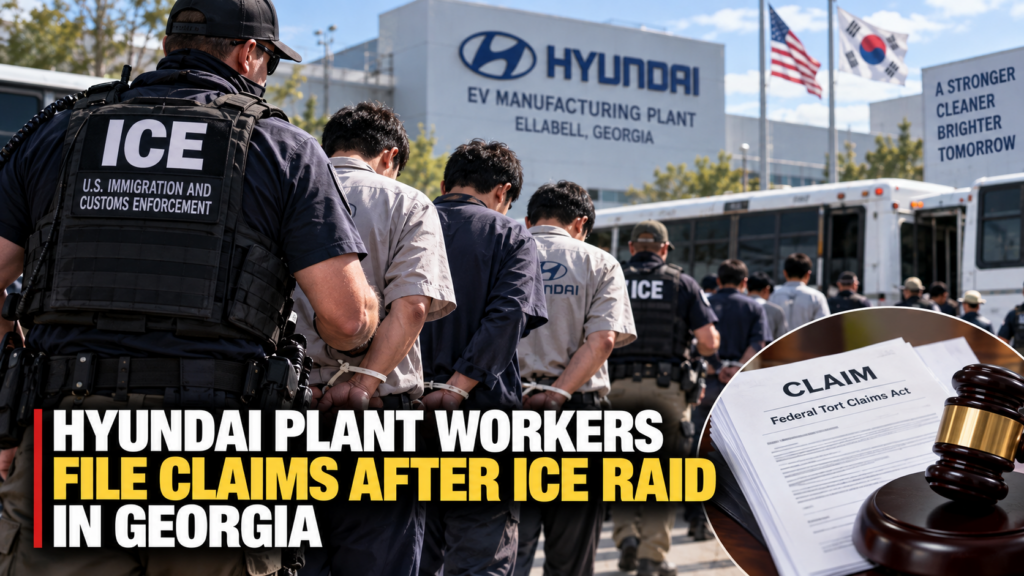
More than 300 South Korean workers detained during a major ICE raid at a Hyundai electric-vehicle plant in Georgia are filing administrative claims against the U.S. government, potentially opening the way to a federal lawsuit over their arrests, detention conditions and treatment.
What Happened
The workers were among 475 people detained during a September 4, 2025, immigration raid at Hyundai Motor Group’s 2,900-acre manufacturing complex in Ellabell, Georgia, about 25 miles west of Savannah.
The operation was described by Homeland Security Investigations as the largest single-site enforcement action in the agency’s history. Most of those detained were South Korean nationals working at the Hyundai EV and battery facilities.
According to a report by CNN report, administrative claims have begun to be filed with nine federal agencies, including the Department of Homeland Security, Immigration and Customs Enforcement, Customs and Border Protection, the FBI, and the Departments of Justice and Labor.
The filings are a required step before the workers can pursue a lawsuit against the federal government under the Federal Tort Claims Act.
Key Details
Workers Allege Unlawful Detention
The first claim, filed on behalf of one of the detained workers, alleges unlawful detention and what the worker described as demeaning conditions during seven days in ICE custody.
The claim seeks compensation for confiscated belongings, lost income and psychological harm. It also alleges false imprisonment, abuse of process and intentional infliction of emotional distress.
The attorney representing the workers told CNN that the other claimants have similar allegations and that she hopes to have all of the claims filed by the end of 2026.
The workers are seeking more than financial compensation. Their attorney said the objective is for the government to acknowledge what she described as a serious mistake and apologize for the treatment of the workers.
Workers Describe Conditions in ICE Custody
Several workers told CNN that they were arrested without adequate explanations or Korean-language interpreters.
Some said they were ordered to sign documents they could not understand and later learned that the documents were consent-to-arrest forms. Several workers said they signed because they believed doing so would allow them to return home more quickly.
The workers also described being restrained at their wrists and ankles before being transported to an ICE detention facility in Folkston, Georgia.
One worker said detainees were initially held in a crowded room with as many as 80 men, limited toilet facilities and extremely cold conditions. Some reportedly had little or nothing to sleep under.
The workers also described concerns about food and water at the facility.
Federal Officials Defend the Raid
The Department of Homeland Security told CNN that ICE had executed a judicial search warrant as part of an ongoing criminal investigation into alleged unlawful employment practices and other federal crimes.
Customs and Border Protection said those detained were believed to have been working illegally in violation of their visa or immigration status.
Federal officials previously said those arrested included people who had entered the United States illegally, overstayed visas or held visa waivers that did not permit employment.
However, several workers interviewed by CNN disputed those explanations and said they were working under valid visas.
Legal Claims Could Lead to Federal Lawsuit
The administrative claims are being filed under the Federal Tort Claims Act, which generally requires claimants to first present their allegations to the federal government before filing certain lawsuits.
If the government does not respond within six months, the workers could pursue the matter in federal court.
Stanford law professor Nora Engstrom told CNN that the process could force the government to provide information about why the workers were detained, what evidence supported the arrests and whether federal officers followed agency policies.
The government is expected to raise legal defenses involving federal employees’ discretionary duties. Those protections could make parts of the workers’ claims difficult to pursue.
The workers also face individual legal requirements. Northwestern law professor James E. Pfander said each person generally must exhaust their own administrative remedies rather than relying on one collective filing.
Hyundai Raid Exposes Immigration and Manufacturing Tensions
The dispute highlights a conflict between two major Trump administration priorities: expanding domestic manufacturing and aggressively enforcing immigration laws.
Hyundai’s Georgia complex was designed as a major investment in U.S. electric-vehicle manufacturing and battery production.
The facility also relies on specialized foreign workers to install equipment, provide technical expertise and train American employees.
Some of the South Korean workers told CNN they had previously performed similar technical assignments at U.S. battery plants using business visas, including B-1 visas.
Those visas can permit certain business activities such as training and equipment-related work, but they do not generally authorize ordinary production employment or receiving a U.S. salary.
Workers involved in the Georgia project said they were paid in South Korea and were brought to the United States to provide specialized technical expertise and train American workers.
Hyundai Facility Has Since Resumed Operations
The raid temporarily disrupted construction at the Hyundai-LG battery facility.
The battery plant has since been completed, and commercial production began in April 2026. The joint venture told CNN that its first battery-cell shipment was delivered in May.
The company said it now employs more than 500 people at the site, with most workers hired locally.
LG Energy Solution said it prioritizes compliance with U.S. laws and regulations and sends specialists temporarily until facilities can operate independently.
Despite the earlier raid, some of the South Korean workers have returned to U.S. battery projects.
Several workers told CNN they remain concerned about another immigration enforcement operation. One worker said companies have since begun providing employees with cards identifying their visa, employer and job duties in case they encounter immigration officials again.
Economic and Political Impact
The legal action could have implications beyond the workers themselves.
South Korea has made major investment commitments in the United States, including large projects connected to electric vehicles and battery manufacturing. Washington has also pushed South Korean companies to increase investment and manufacturing inside the United States.
The Georgia raid therefore raised concerns about whether aggressive immigration enforcement could make foreign companies more reluctant to send specialized personnel needed to build and operate advanced manufacturing facilities.
The workers’ claims could also draw attention to the complexity of the U.S. visa system for highly specialized industrial projects, particularly when foreign engineers and technicians are temporarily required to install equipment or train American employees.
What Happens Next
The immediate next step is the completion of the administrative claims process.
The attorney representing the workers intends to file claims for more than 300 South Korean workers. If federal agencies fail to resolve the claims within the required period, the workers could pursue litigation in federal court.
The government could challenge the claims on several legal grounds, including protections related to discretionary federal actions.
The outcome could determine whether the workers receive compensation and whether the government faces further scrutiny over the legal basis and conditions surrounding the 2025 raid.
Conclusion
The Hyundai plant workers’ claims mark one of the most significant legal challenges arising from the Trump administration’s immigration enforcement campaign at a major U.S. manufacturing site. The case puts immigration enforcement, foreign investment and the need for specialized technical workers into direct tension. As Hyundai’s Georgia operations expand, the legal dispute could also influence how international companies assess the risks of sending specialized employees to the United States.
Related Reading
- Strong August Jobs Report Puts Fed Rate Hike Back in Focus
- Trump and World Cup Give U.S. Travel Industry a Boost
The workers allege unlawful detention, poor detention conditions, false imprisonment and emotional harm following the 2025 ICE raid in Georgia.
The administrative claims are a required step under the Federal Tort Claims Act. If the government does not resolve them within six months, the workers may pursue federal court action.