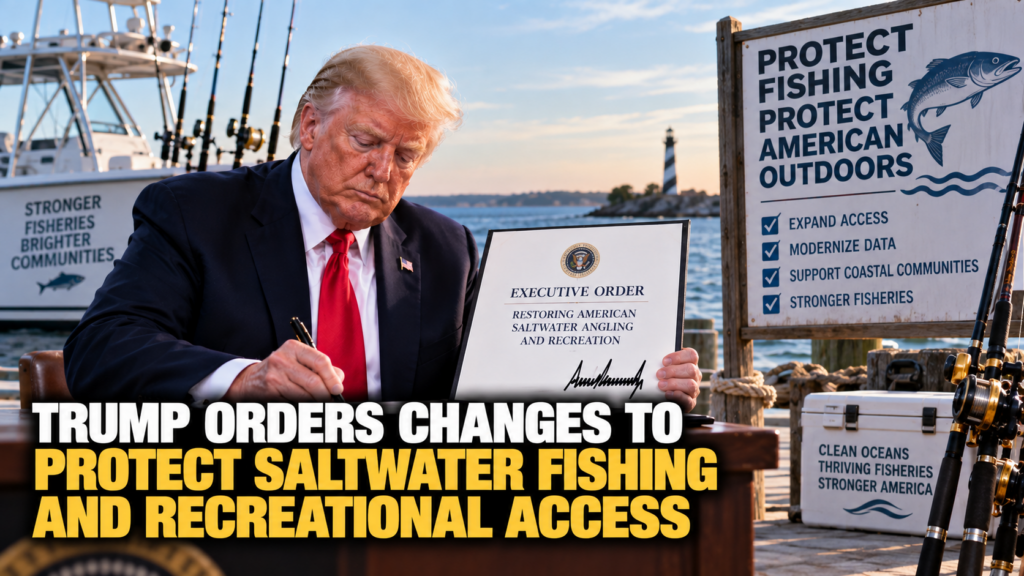
President Donald Trump has ordered federal agencies to change how the government manages recreational saltwater fishing, directing officials to modernize fisheries data, reduce regulatory barriers and expand access for anglers, boaters and charter operators. The saltwater fishing executive order, signed September 17, 2026, also calls for new approaches to artificial reefs, shark depredation and recreational fishing permits.
According to a report by The White House, the order makes recreational fishing an important consideration in federal decisions involving oceans, coastal areas and public lands. It directs agencies to work with states and the private sector to improve fisheries data and remove restrictions the administration considers unnecessary.
What Happened
The executive order, titled “Restoring American Saltwater Angling and Recreation,” establishes a new federal policy focused on recreational fishing access and the economic role of coastal recreation.
The White House said the outdoor recreation sector generates more than $1.2 trillion annually and supports more than 5 million jobs. The order specifically identifies saltwater anglers, offshore boaters and charter operators as important parts of that economy.
The order builds on two earlier Trump administration initiatives, including the Make America Beautiful Again Commission and an April 2025 executive order on American seafood competitiveness.
Key Changes to Federal Fishing Policy
Modernizing Recreational Fishing Data
A central part of the order is a planned overhaul of how federal officials collect recreational fishing data.
The Commerce Department and NOAA are directed to evaluate traditional mail-in surveys used to estimate recreational catch and fishing effort. Officials are also instructed to develop standardized mobile applications for electronic reporting by recreational anglers and for-hire operators.
The proposed data system would aggregate information into a modern federal data architecture capable of processing catch, effort and observational data. The information could then be used for stock assessments, seasonal quotas and other fisheries management decisions.
Greater Use of State-Level Data
The order also directs the Commerce Department to review federal fisheries guidelines under the Magnuson-Stevens Fishery Conservation and Management Act within 180 days.
The review must consider National Standard 1, which addresses optimum yield, and National Standard 2, which concerns the best scientific information available. The administration wants state-level data to be integrated more rapidly into federal decisions when appropriate.
The order further directs NOAA to consider replacing federal Marine Recreational Information Program data when specified error thresholds are reached and a state’s recreational catch-and-effort data has a lower error rate.
New Approach to Fishing Permits
Federal agencies are instructed to consider multi-year permits of at least three years for qualifying operators, with a presumption of renewal where permitted by law.
The order also calls for a unified interagency Special Use Permit application and aims to establish a “One-Stop” joint permit portal within one year.
For permittees to qualify as being in good standing, agencies may consider factors including compliance with Coast Guard safety rules, the absence of major environmental or fisheries violations and full compliance with mandatory electronic catch reporting.
Artificial Reefs and Marine Infrastructure
The order directs the Interior Department to establish a federal Reef-in-Place Program within 60 days.
The program would facilitate converting qualifying decommissioned offshore oil and gas and other-use structures into permanent artificial reefs. Offshore wind energy infrastructure is specifically excluded from the program. Projects would still have to meet applicable environmental, navigational and safety requirements.
NOAA and Interior are also instructed to review permitting procedures for artificial reefs in National Marine Sanctuaries and Marine National Monuments, with the stated goal of creating more transparent permitting pathways and identifying areas suitable for reef development.
Shark and Pinniped Depredation
The saltwater fishing executive order also addresses predators that can affect recreational fishing.
It directs the creation of an Interagency Shark and Pinniped Depredation Task Force. Federal agencies are also instructed to develop a standardized real-time reporting system for depredation incidents within 90 days.
The system is intended to integrate with federal and state-linked mobile data platforms so officials can map depredation events more quickly and incorporate the information into fisheries management.
The order also calls for partnerships involving charter boat captains and recreational fishing organizations.
Reactions to the Order
The National Marine Manufacturers Association welcomed the order, highlighting its focus on recreational access, updated fisheries data and reducing administrative barriers for boaters and fishing businesses.
Conservation groups have raised different concerns about how the access provisions will interact with declining fish populations.
The Ocean Conservancy said the order recognizes the importance of better fisheries data but argued that expanding fishing access must be considered alongside the condition of fish stocks. Its statement emphasized that recreational fishing depends on healthy and abundant fisheries.
These differing responses reflect the central policy issue surrounding implementation: how federal officials balance recreational access and the economic interests of fishing communities with fisheries conservation requirements.
Economic and Environmental Impact
The administration’s approach places greater emphasis on the economic value of recreational fishing when federal agencies make fisheries decisions.
The order requires a five-year strategic plan for improving the collection and use of recreational fisheries economic data. That plan is intended to account for the value of for-hire fishing operations and businesses that support the recreational fishing industry when officials consider fisheries management and harvest opportunities.
At the same time, the order retains requirements that implementation comply with existing law and remain subject to available appropriations. Several provisions also require further rulemaking, agency review or regulatory action before they can take effect.
What Happens Next
Federal agencies face multiple deadlines under the saltwater fishing executive order. Some actions must begin within 30, 60 or 90 days, while major reviews and strategic planning requirements have deadlines of up to 180 days.
The Commerce Department must review relevant fisheries guidelines within 180 days, while agencies are expected to evaluate permitting reforms within 60 days. Interior must establish the Reef-in-Place Program within 60 days, and the shark and pinniped reporting protocol is due within 90 days.
The practical effect on anglers, charter operators and coastal businesses will depend on how agencies translate the executive order into regulations, data systems and permitting procedures.
The saltwater fishing executive order marks a broad federal effort to change recreational fisheries management by combining expanded access with updated data collection, revised permitting, artificial reef development and new approaches to fisheries science. Its implementation will determine how those priorities are balanced with conservation requirements and existing federal law.
Related Reading
Supreme Court Rejects Trump Mail Ballot Restrictions Ahead of Midterms
Trump Faces Bipartisan Backlash as AI Guardrails Push Grows
FAQs
It directs federal agencies to modernize recreational fisheries data, review regulations, expand access and streamline permits for anglers and fishing businesses.
Not necessarily. Many provisions require agency reviews, rulemaking or further implementation before changes to fisheries management take effect.