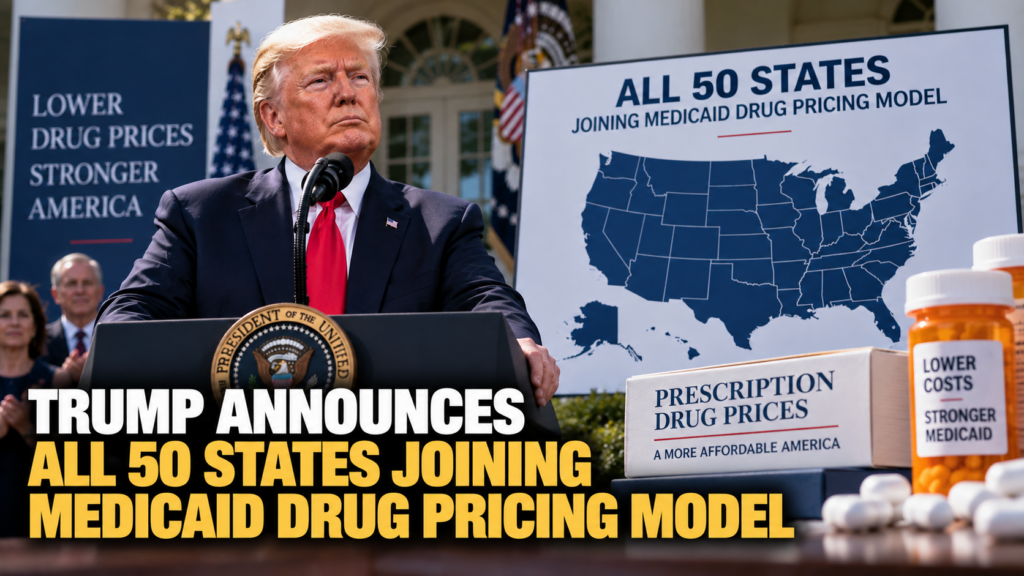
President Donald Trump announced September 18, 2026, that all 50 states will participate in a Medicaid drug pricing model designed to bring the net prices of selected prescription drugs closer to prices paid in other developed countries. The Medicaid drug pricing model, known as the GENEROUS model, is expected by the administration to reduce government spending, although experts say the eventual savings remain difficult to verify because details of the pharmaceutical agreements have not been made public.
According to a report by ABC News, the announcement comes as prescription drug costs and broader affordability concerns remain prominent issues ahead of the November midterm elections.
What Happened
Trump announced that Medicaid programs in all 50 states would participate in the administration’s Most Favored Nation, or MFN, drug pricing initiative.
The program is being implemented through the Medicaid GENEROUS model, which is designed to provide participating state Medicaid programs with lower prices on selected prescription drugs.
The initiative also includes Washington, D.C., and Puerto Rico. CMS said all 50 states, Washington, D.C., and Puerto Rico had applied to participate, while 40 states and Puerto Rico had already signed agreements as of September 18. Remaining states have until September 30 to finalize agreements.
How the Medicaid Drug Pricing Model Works
Most Favored Nation Pricing
The MFN approach seeks to link U.S. prescription drug prices to prices paid in other developed countries.
Under the GENEROUS model, participating pharmaceutical manufacturers provide rebates to state Medicaid programs so that the final price for covered drugs does not exceed the applicable MFN price.
The model covers hundreds of drugs across major therapeutic categories, including medicines used for cancer treatment, diabetes and asthma.
The model launched in January 2026 and is scheduled to run for five years, according to the Centers for Medicare & Medicaid Services.
Estimated Medicaid Savings
The Trump administration says the Medicaid drug pricing model could generate substantial savings for taxpayers.
The White House Council of Economic Advisers estimates that the program could produce $64.3 billion in savings over 10 years. Of that amount, $36.6 billion is projected to accrue to the federal government and $27.6 billion to state governments.
The administration says lower drug costs could give states additional funds for other priorities while maintaining Medicaid coverage.
However, the projected savings remain estimates rather than independently verified results.
Why the Savings Are Unclear
Experts have raised questions about the amount of money the program will ultimately save because many details of the pharmaceutical agreements have not been publicly disclosed.
Kathy Hempstead, a senior policy adviser at the Robert Wood Johnson Foundation, told the Associated Press that more detailed information would be needed to assess the administration’s savings claims.
She also questioned how Congress could codify the administration’s MFN arrangements without knowing the terms of the agreements.
Another issue is how long the negotiated price reductions would remain in effect. The agreements could face questions about their durability if the administration changes in the future.
Impact on Medicaid
Medicaid is jointly funded by the federal government and states and provides health coverage to eligible low-income Americans.
For beneficiaries, prescription drug copayments are generally relatively small. As a result, the most direct financial impact of lower drug prices could fall on state and federal Medicaid budgets rather than directly reducing what most beneficiaries pay at the pharmacy counter.
CMS said the model is intended not only to reduce drug spending but also to improve access to medicines and strengthen Medicaid programs.
The agency estimates that the model could reduce Medicaid drug spending by $64.3 billion over the next decade.
Reactions and Concerns
The administration has presented the Medicaid drug pricing model as part of its broader effort to reduce prescription drug costs in the United States.
Trump has argued that Americans should not pay substantially more for medicines than patients in other developed countries.
The pharmaceutical industry has opposed aspects of the administration’s MFN approach. Reuters reported that the Pharmaceutical Research and Manufacturers of America, or PhRMA, argued that the policy could affect access to medicines and future pharmaceutical investment.
Some advocates have also argued that lower prices should extend beyond government programs.
JD Hayworth, a former Republican congressman and spokesperson for the Pharmaceutical Reform Alliance, said the announcement represented progress but argued that millions of Americans outside government health programs also want lower prescription drug costs.
Broader Drug Pricing Strategy
The Medicaid drug pricing model is part of Trump’s broader effort to use MFN pricing to reduce the gap between U.S. drug prices and those paid in other wealthy countries.
The White House has also promoted lower prices for certain direct-to-consumer purchases through TrumpRx.gov.
The administration previously estimated that its pharmaceutical pricing agreements could generate hundreds of billions of dollars in savings over a decade, although outside experts have questioned how those projections can be independently evaluated without greater transparency around the agreements.
What Happens Next
The remaining states that have not finalized their agreements have until September 30 to sign up for the GENEROUS model.
The next major issue will be whether the negotiated prices produce the savings projected by the administration once the program operates across Medicaid programs nationwide.
Congress could also face pressure to codify some of the administration’s drug pricing arrangements. However, questions about the terms and durability of the agreements could complicate any legislative effort.
The Medicaid drug pricing model now gives all 50 states access to the administration’s MFN framework, but its longer-term impact will depend on the actual prices negotiated, the drugs covered and whether the projected savings materialize.
Related Reading
Senate Advances Landmark Cryptocurrency Legislation
Trump Escalates Canada Trade War With New Tariffs and Import Bans
FAQs
The GENEROUS model is a federal Medicaid initiative that uses Most Favored Nation pricing to lower the final price of selected prescription drugs.
The White House estimates $64.3 billion in taxpayer savings over 10 years, but experts say the actual savings remain uncertain because deal details are not fully public.