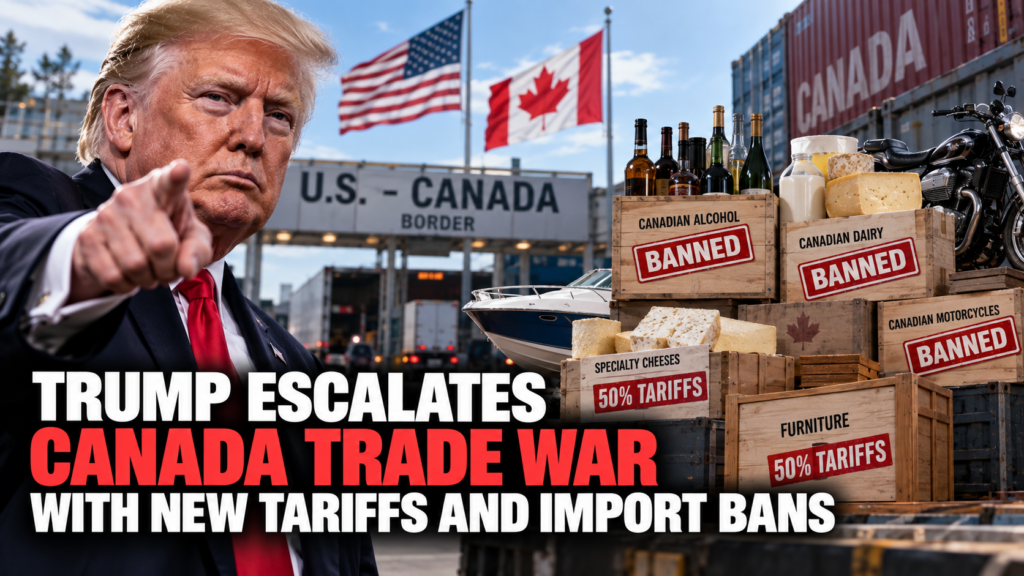
President Donald Trump has escalated the U.S.-Canada trade war by banning imports of selected Canadian alcohol, dairy products and motorcycles while expanding 50% tariffs to additional Canadian goods, including specialty cheeses, furniture, boats and certain industrial products. The measures deepen the economic dispute between the two North American trading partners after Canada imposed retaliatory tariffs on roughly $20 billion of U.S. goods.
According to a report by Manufacturing Dive report, the new measures were issued through five presidential proclamations as Canada’s counter-tariffs took effect.
What Happened
The latest Canada trade war escalation includes outright U.S. import bans on several categories of Canadian products. The bans are scheduled to begin September 29, 2026.
The targeted goods include beer, wine, cider and other fermented beverages, high-proof alcohol and major spirits categories. The restrictions also cover whey products, molasses, non-alcoholic beer and motorcycles, mopeds and cycles equipped with internal-combustion engines larger than 800 cubic centimeters.
The products covered by the import bans represented less than $1 billion in annual trade value, according to Deborah Elms, a trade and economic policy expert at the Hinrich Foundation.
Until the bans take effect, the affected goods will continue to face a 50% Section 338 tariff.
More Canadian Goods Face 50% Tariffs
The administration is also expanding the list of Canadian products subject to a 50% Section 338 tariff beginning September 15.
The newly targeted goods include:
- Specialty cheeses
- Modified fats and oils
- Bovine hides and upholstery leather
- Certain raw and dressed furskins
- Recreational motorboats
- Specialty paper
- Selected steel and aluminum products
- Metal fittings and welding inputs
- Golf carts
- Furniture and lamps
The tariffs apply even when products would otherwise qualify for preferential treatment under the United States-Mexico-Canada Agreement.
The new tariffs also stack on existing Section 232 tariffs covering certain steel and aluminum products.
Some Products Removed From the Tariff List
The administration simultaneously removed several products from the Section 338 tariff list, including toilet paper, salt, cement and certain large containers of whiskies, liqueurs and cordials.
Elms described the overall changes as essentially a wash in terms of the broader tariff list, although companies producing the newly targeted products could face significant consequences.
Why the Canada Trade War Escalated
The latest measures follow a breakdown in U.S.-Canada trade negotiations in August.
Trump’s administration had previously imposed 50% tariffs on about $20 billion worth of Canadian imports, covering products such as agricultural goods, chemicals, textiles, consumer products, wood, paper, machinery and tools.
Canada responded with tariffs on approximately the same value of U.S. goods.
Canadian counter-tariffs targeted products including steel, dairy, appliances, agricultural equipment, electronics and pulp and paper.
Reuters reported that the U.S. import bans were announced after Canada’s retaliatory tariffs took effect, marking a significant escalation from tariffs to outright restrictions on trade.
Trump Targets Canadian Products in Federal Contracts
The trade measures extend beyond tariffs and import bans.
Trump directed the U.S. Trade Representative and the General Services Administration to remove $50 billion worth of Canadian-origin products from the GSA’s Multiple Award Schedules.
The federal procurement system allows government agencies at the federal, state, local and tribal levels to purchase commercial products and services.
Trump said the action was necessary because Canadian federal and provincial governments had allegedly restricted U.S. companies from participating in their government procurement markets.
Reuters separately reported that Trump ordered the GSA and USTR to begin removing Canadian-origin products unless Canada restores what he described as “full and fair reciprocity” for American companies and farmers.
Economic Impact on U.S. and Canadian Businesses
The Canada trade war is creating additional uncertainty for companies operating across the North American supply chain.
The direct value of the newly banned products is relatively small compared with total U.S.-Canada trade. However, the impact could be much larger for individual manufacturers, agricultural producers, beverage companies and retailers that depend heavily on the cross-border market.
Canada is the largest trading partner of the United States, making even relatively narrow tariff measures potentially significant for businesses concentrated in affected industries.
The dispute could also raise costs for consumers if companies pass tariffs and import restrictions through to retail prices.
At the same time, Canadian businesses face pressure to find alternative markets as Ottawa seeks to reduce its dependence on the U.S. market.
Canada Responds
Canada’s retaliatory tariffs were introduced after negotiations between the two countries broke down.
Prime Minister Mark Carney has argued that Canada needs to strengthen its economic independence and diversify its trading relationships. AP reported that Carney has vowed to accelerate efforts to expand Canada’s trade with countries outside the United States.
More than 70% of Canadian exports still go to the United States, meaning that a prolonged trade confrontation could carry substantial costs for Canadian companies and workers.
However, Canadian officials have also signaled that they remain open to negotiations while pursuing alternative markets.
Broader Implications for North American Trade
The escalating Canada trade war is also raising questions about the future of the USMCA, the trade agreement that governs much of the economic relationship between the United States, Canada and Mexico.
The dispute comes despite decades of deep integration between the three economies. Companies in sectors such as automotive manufacturing, agriculture, energy and industrial production rely heavily on cross-border supply chains.
Additional tariffs and import restrictions could therefore affect companies beyond the products directly named in Trump’s latest measures.
The confrontation also demonstrates how quickly trade policy can move from tariffs to broader restrictions on procurement and market access.
What Happens Next
The import bans are scheduled to take effect September 29, while the expanded 50% tariff list begins September 15.
Canadian officials must now decide whether to introduce additional retaliation or prioritize negotiations. AP reported that Carney later characterized the latest U.S. measures as relatively modest compared with previous actions, suggesting Ottawa could initially exercise restraint.
For businesses, the immediate challenge is navigating higher costs, changing tariff classifications and uncertainty over whether additional measures will follow.
The longer-term question is whether Washington and Ottawa can prevent the dispute from damaging the deeply integrated North American trading system. With both countries facing pressure from affected industries, consumers and political constituencies, the next round of negotiations could determine whether the Canada trade war remains a targeted dispute or develops into a broader restructuring of U.S.-Canadian commerce.
Related Reading
- Trump Administration Backs New Rancher-Focused Executive Orders
- Trump and World Cup Give U.S. Travel Industry a Boost
Trump expanded 50% tariffs to products including specialty cheeses, furniture, boats, leather, paper and selected steel and aluminum goods.
The U.S. import bans covering selected Canadian alcohol, dairy products and motorcycles are scheduled to begin September 29, 2026.