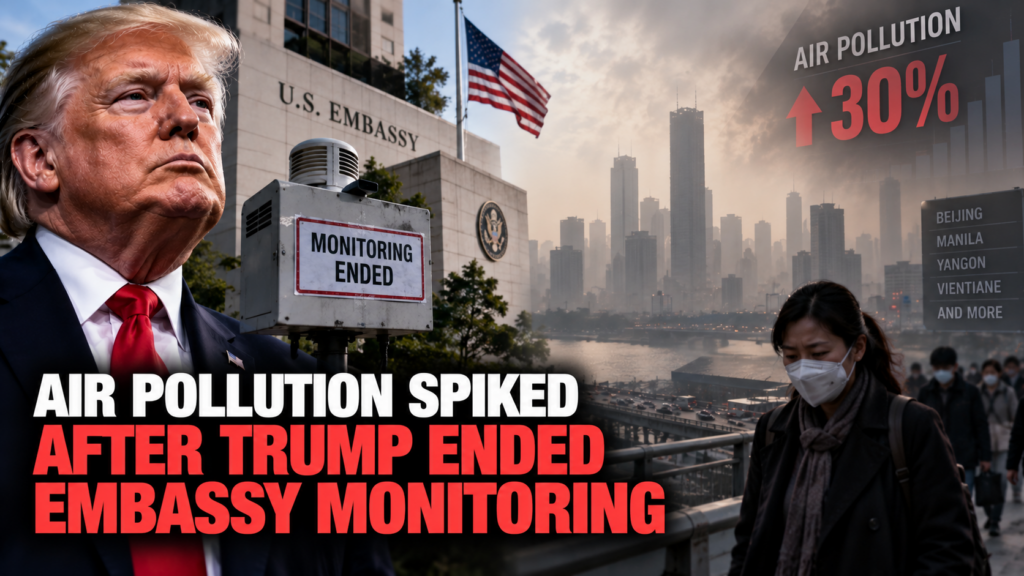
Air pollution increased sharply in dozens of cities after the Trump administration ended a U.S. embassy monitoring program in March 2025, with a new study finding pollution levels rose by roughly 24% to 33% in the months that followed.
What Happened
The Trump administration shut down the State Department’s global air-quality monitoring program in March 2025, citing financial costs. The program had provided publicly available pollution data from more than 80 U.S. embassies and consulates around the world.
A new study published in the Proceedings of the National Academy of Sciences examined what happened after the monitoring ended. Researchers analyzed 46 cities and found that air pollution increased approximately three to four months after the U.S. stopped publicly reporting the data.
According to a report by NPR, satellite measurements showed pollution levels increasing by about 30% on average after the monitoring shutdown.
The State Department did not respond to NPR’s request for comment before publication.
Key Details
U.S. Embassy Monitoring Began in Beijing
The monitoring program began in 2008, when U.S. officials installed an air-quality monitor at the U.S. Embassy in Beijing and began publishing the readings publicly.
The information provided residents with an independent source of pollution data at a time when many people in China did not fully recognize hazardous smog as a serious health threat.
Eric Zou, an environmental economist at the University of Michigan, said the availability of pollution information helped people recognize the value of cleaner air and created greater pressure for environmental improvements.
The program subsequently expanded to more than 80 U.S. embassies and consulates.
Previous research found that the availability of U.S. embassy pollution data was associated with improvements in air quality, particularly in countries where reliable local monitoring systems were limited.
Pollution Increased After Monitoring Stopped
Researchers led by Zoey Yiyuan Zhou of Columbia University compared pollution patterns before and after the monitoring program ended across 46 cities.
The researchers found no significant pollution trend during the 300 days before U.S. reporting ended. But approximately three to four months after the shutdown, satellite-based pollution measurements increased by about 30% on average.
The broader range reported by the study was approximately 24% to 33%, depending on the period examined.
Because satellite measurements are not identical to ground-based monitoring, researchers estimated that the observed change corresponded to roughly a 4% increase in PM2.5, the fine particulate pollution capable of entering the lungs and bloodstream.
Southeast Asia Saw Some of the Largest Increases
The pollution increase was particularly pronounced in Southeast Asian cities, including Manila in the Philippines, Rangoon in Myanmar and Vientiane in Laos.
Researchers also found larger increases in cities where alternative air-quality monitoring systems were limited.
The study does not establish a definitive cause for the increase. Instead, it identifies a strong association between the end of U.S. monitoring and subsequent pollution changes.
Why Air Quality Data Matters
The researchers and outside experts say the monitoring program did more than simply provide information to the public.
Publicly available measurements could create accountability for governments and businesses by making pollution levels easier to identify and compare.
Andrea La Nauze, an environmental economist at Deakin University who has studied the benefits of the U.S. monitoring program, described the new research as high quality but said the findings were concerning.
She noted that earlier research had found sustained improvements in air quality following the introduction of the embassy monitoring system.
In countries with limited monitoring infrastructure, U.S. embassy measurements could also serve as an independent reference point for citizens and policymakers.
Potential Economic and Health Impact
Air pollution has significant health consequences, particularly when people are exposed to fine particulate matter over extended periods.
PM2.5 particles can penetrate deep into the lungs and enter the bloodstream, increasing health risks.
The new study does not provide a complete estimate of additional illnesses or deaths caused by the monitoring shutdown. Instead, it documents changes in pollution levels following the withdrawal of U.S. monitoring.
The economic implications may also extend beyond healthcare. When pollution data is unavailable, businesses and regulators may face less pressure to identify and reduce pollution sources.
Zhou suggested that companies facing costs to reduce emissions could have fewer incentives to do so when independent monitoring disappears.
Pollution Later Declined Somewhat
The researchers also found a potentially encouraging development.
Pollution levels appeared to decline after reaching their peak approximately three to four months following the end of U.S. reporting.
However, researchers cannot yet determine why the decline occurred or whether it will continue.
One possibility is that local governments or other organizations began replacing some of the monitoring capacity that disappeared when the U.S. program ended.
But Zhou cautioned that this may not be possible everywhere, particularly in countries where air-quality monitoring systems are still developing.
What Happens Next
The study highlights a broader question about the role of publicly available environmental data in international policy.
The U.S. embassy monitoring program had operated for years and provided a trusted source of information in cities where comparable local systems were sometimes unavailable.
The termination of the program also means that researchers have lost access to an important source of long-term environmental information. The U.S. Embassy air-quality monitoring data was part of a network that generated roughly 17 years of readings before the State Department shut it down.
Whether other governments, researchers or local organizations can permanently replace that monitoring remains uncertain.
The latest findings suggest that environmental monitoring is not merely an information service. Reliable public data can influence public awareness, government accountability and incentives for reducing pollution.
Conclusion
The rise in air pollution following the Trump administration’s decision to end U.S. embassy monitoring illustrates the potential consequences of removing independent environmental information. While the study does not prove that the shutdown directly caused the pollution increase, its findings indicate that the loss of monitoring coincided with significant deterioration across dozens of cities. The research also underscores the broader value of transparent environmental data for protecting public health and maintaining accountability.
Related Reading
- Trump Administration Moves to Change Federal Protections for Gray Wolves
- Trump Administration Urges G20 to Adopt Pro-AI Policies
Researchers found pollution rose after monitoring stopped, but the study cannot establish a definitive cause. Reduced accountability and monitoring may have contributed.
The Trump administration ended the State Department program in March 2025, citing financial costs, after years of providing public pollution data worldwide.