The executive authority legal challenge 2026 landscape represents one of the most significant constitutional battlegrounds in recent American history. As presidential power continues to evolve through executive orders, administrative actions, and policy directives, the judiciary and states are increasingly scrutinizing the limits of executive authority. This year has witnessed unprecedented challenges across multiple domains, from artificial intelligence regulation to voting rights protections, testing fundamental questions about the separation of powers and federalism that define American governance.
Understanding the Constitutional Framework for Executive Authority
The President's executive authority derives from Article II of the Constitution, which grants the executive branch power to "take Care that the Laws be faithfully executed." This foundational principle has been interpreted and reinterpreted across centuries of American jurisprudence, creating a complex web of precedents that shape current legal challenges.
Executive orders serve as the primary mechanism through which presidents exercise unilateral authority. These directives carry the force of law when properly grounded in constitutional or statutory authority, yet their validity depends on several critical factors:
- Constitutional authorization from Article II powers
- Statutory delegation from Congress
- Absence of direct contradiction with existing legislation
- Compliance with procedural requirements under the Administrative Procedure Act
The Supreme Court established critical boundaries in Youngstown Sheet & Tube Co. v. Sawyer (1952), creating a three-tier framework for evaluating executive actions. Justice Jackson's concurring opinion remains the touchstone for modern executive authority analysis, distinguishing between actions taken with congressional approval, congressional silence, and congressional opposition.
The Separation of Powers Doctrine in Practice
Presidential authority exists in constant tension with legislative and judicial powers. When presidents exercise executive authority that encroaches on congressional prerogatives or contradicts federal law, courts must determine whether the executive has exceeded constitutional bounds.

The executive authority legal challenge 2026 cases frequently invoke this framework, particularly when executive orders attempt to preempt state regulations or implement policies without explicit congressional authorization. Courts examine whether the President acted within the "zone of twilight" where authority remains ambiguous or ventured into forbidden territory by contradicting legislative intent.
Major Executive Authority Legal Challenge 2026 Cases
Several high-profile legal battles are defining the boundaries of presidential power this year. These cases span diverse policy areas but share common constitutional questions about executive overreach, federalism, and administrative law.
Artificial Intelligence Regulation Challenges
The December 2025 executive order on artificial intelligence has spawned numerous legal challenges in 2026. This order attempted to establish a comprehensive federal framework for AI regulation, explicitly seeking to preempt state-level regulations that had proliferated across California, New York, and other jurisdictions.
Key Legal Issues:
- Federal preemption authority without explicit congressional authorization
- Commerce Clause limitations on executive power
- Administrative Procedure Act compliance
- Tenth Amendment state sovereignty protections
Multiple states filed lawsuits challenging this executive action, arguing that the legal obstacles to implementation are insurmountable without congressional legislation. The central dispute involves whether existing statutory frameworks provide sufficient authority for sweeping AI preemption or whether such comprehensive regulation requires new legislation.
| Challenge Type | Plaintiff Category | Primary Legal Theory | Current Status |
|---|---|---|---|
| Preemption | State Governments | Tenth Amendment violation | Pending in Circuit Courts |
| Procedural | Industry Groups | APA notice-and-comment failure | Mixed rulings |
| Statutory | Tech Companies | Ultra vires agency action | Discovery phase |
| Constitutional | Privacy Advocates | First Amendment concerns | Preliminary injunctions granted |
The legal issues raised by the proposed executive order on AI preemption extend beyond immediate regulatory concerns to fundamental questions about executive power in emerging technology sectors.
Voting Rights and Electoral Administration
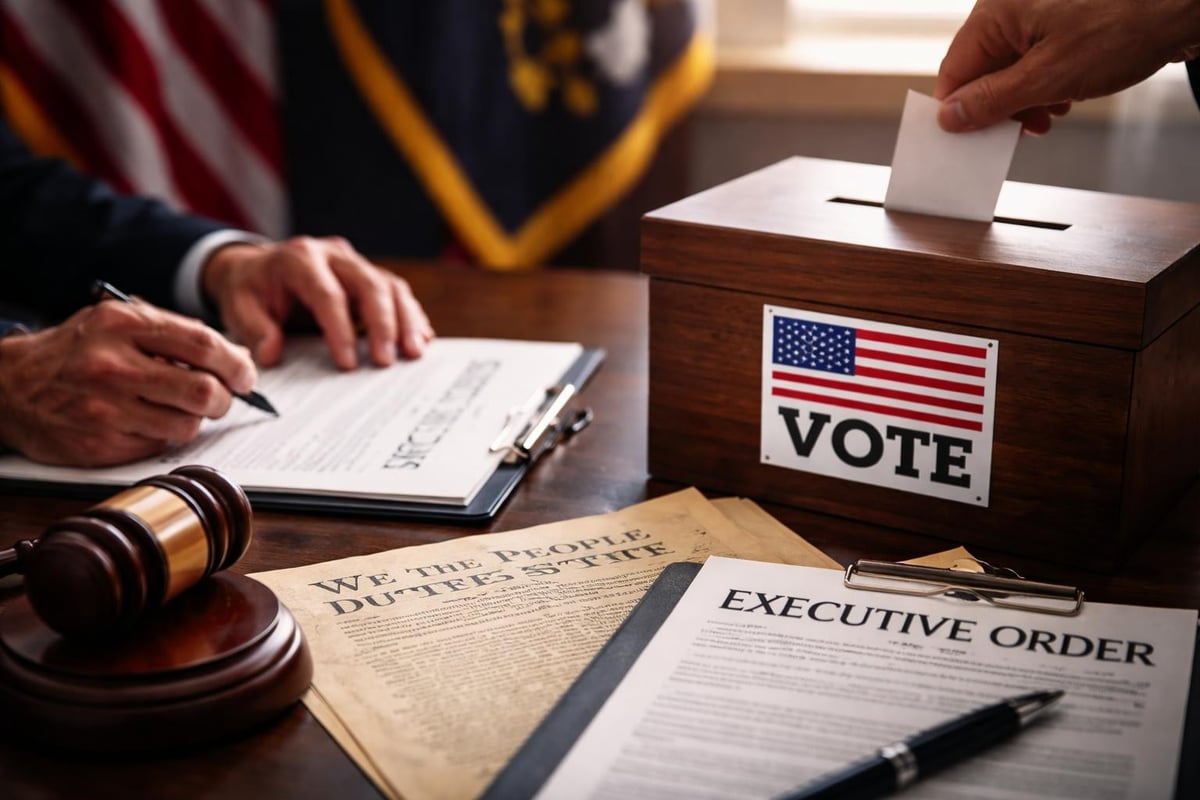
The executive authority legal challenge 2026 docket includes significant disputes over voting rights protections and electoral administration. Recent executive orders have attempted to expand federal oversight of state election procedures, particularly concerning voter identification requirements, early voting access, and mail-in ballot protocols.
Key legal battles in 2026 concerning voting rights, executive authority, and Department of Justice actions reflect deep partisan divisions over federal versus state control of election administration. Several states contend that these executive directives violate the Elections Clause of the Constitution, which grants state legislatures primary authority over election procedures.
Constitutional Questions at Stake:
- Does the President possess inherent authority to regulate state election procedures?
- Can executive orders override state legislative determinations on voting requirements?
- What role does the Voting Rights Act play in authorizing executive action?
- How do equal protection principles interact with federalism concerns?
Courts examining these challenges must balance the federal government's interest in ensuring voting rights against traditional state sovereignty over election administration. The outcomes will significantly impact how presidential policy on domestic matters develops in future administrations.
Environmental and Energy Policy Disputes
Executive orders addressing climate change, energy production, and environmental protection have generated substantial litigation. The executive authority legal challenge 2026 landscape includes disputes over:
- Renewable energy mandates on federal lands
- Emissions standards for existing power plants
- International climate agreement implementation
- Federal preemption of state energy regulations
These cases often involve the "major questions doctrine," a principle the Supreme Court has increasingly applied to limit agency authority over issues of vast economic and political significance. Under this doctrine, courts presume that Congress does not delegate decisions of major national importance to agencies through ambiguous statutory language.
Legal Strategies and Procedural Considerations
Challenging executive authority requires sophisticated legal strategies that navigate complex procedural requirements. Plaintiffs must establish standing, exhaust administrative remedies, and time their challenges appropriately under various statutes of limitations.
Standing Requirements
Courts require plaintiffs to demonstrate:
- Injury in fact: Concrete and particularized harm
- Causation: Direct connection between executive action and injury
- Redressability: Likelihood that judicial relief will remedy the harm
States possess unique advantages in challenging executive orders that affect their sovereign interests or regulatory authority. The Supreme Court has recognized special state standing in cases involving federal preemption of state law or commandeering of state resources.
Preliminary Injunctions and Emergency Relief
Many executive authority legal challenge 2026 cases begin with motions for preliminary injunctions to halt enforcement pending full adjudication. Courts apply a four-factor test:
- Likelihood of success on the merits
- Irreparable harm without injunctive relief
- Balance of equities favoring the movant
- Public interest served by the injunction
Recent statistics show that preliminary injunctions against executive orders have succeeded in approximately 40% of cases filed in 2026, with significant variation across circuit courts based on judicial philosophy and case-specific circumstances.
The Role of Administrative Agencies
Executive authority frequently operates through administrative agencies that implement presidential directives. The executive authority legal challenge 2026 cases often target both the executive orders themselves and subsequent agency actions taken to enforce them.
Administrative Procedure Act Compliance
The Administrative Procedure Act (APA) requires agencies to follow notice-and-comment rulemaking procedures when creating substantive regulations. Executive orders that direct agencies to implement policies without proper APA compliance face legal vulnerability.
Courts examining the federal push to override state AI regulations have scrutinized whether agencies conducted adequate notice-and-comment proceedings before implementing preemptive rules.
Common APA Violations Alleged:
- Insufficient public comment periods
- Failure to address significant public comments
- Inadequate explanation of policy changes
- Arbitrary and capricious decision-making
Chevron Deference and Agency Interpretation
The doctrine of Chevron deference traditionally required courts to defer to reasonable agency interpretations of ambiguous statutes. However, recent Supreme Court decisions have narrowed this deference, particularly when agencies claim expansive authority based on vague statutory language.
The executive authority legal challenge 2026 cases increasingly invoke anti-deference principles, arguing that courts should independently interpret statutory limits on executive power rather than accepting agency interpretations that maximize presidential authority.

State Sovereignty and Federalism Concerns
The Tenth Amendment reserves powers not delegated to the federal government to the states or the people. Executive authority legal challenge 2026 litigation frequently invokes this principle when federal executive actions attempt to regulate traditional areas of state concern.
Anti-Commandeering Doctrine
The Supreme Court has established that the federal government cannot commandeer state legislative or executive processes to implement federal programs. This anti-commandeering principle limits presidential authority to compel state cooperation with federal initiatives.
Recent challenges argue that certain executive orders effectively commandeer state resources by requiring state officials to enforce federal policies without adequate funding or by preempting state regulatory choices in areas of traditional state authority.
| Executive Action Domain | Traditional State Role | Federal Interest | Legal Precedent |
|---|---|---|---|
| Election Administration | Primary authority | Civil rights enforcement | Shelby County v. Holder |
| AI Regulation | Consumer protection | Interstate commerce | Dormant Commerce Clause cases |
| Environmental Policy | Land use control | National standards | Massachusetts v. EPA |
| Healthcare | Insurance regulation | Medicare/Medicaid | NFIB v. Sebelius |
Preemption Analysis
Federal preemption occurs when federal law supersedes state law in a particular area. Courts recognize three types of preemption:
Express preemption exists when federal statutes explicitly state their preemptive scope. Executive orders cannot create express preemption without underlying statutory authority.
Field preemption occurs when federal regulation is so comprehensive that it occupies the entire regulatory field. President Trump’s executive order challenging state AI laws claims field preemption, arguing that federal AI regulation must be uniform nationwide.
Conflict preemption arises when state law conflicts with federal law, making compliance with both impossible or frustrating federal objectives. The executive authority legal challenge 2026 cases debate whether executive orders alone can establish sufficient federal policy to trigger conflict preemption.
Congressional Response and Legislative Checks
Congress possesses several mechanisms to check executive authority, though political dynamics often prevent their effective use. The executive authority legal challenge 2026 environment reflects congressional dysfunction, with courts filling the vacuum created by legislative inaction.
Congressional Review Act
The Congressional Review Act allows Congress to overturn agency rules through simple majority votes in both chambers. However, this mechanism applies only to formal agency rules, not executive orders themselves, limiting its utility in checking presidential power.
Appropriations Power
Congress controls federal spending through appropriations legislation. By withholding funding for specific executive initiatives, Congress can effectively nullify presidential directives. Recent appropriations battles have centered on funding for enforcement of controversial executive orders.
Legislative Overrides
Congress can pass legislation explicitly contradicting executive orders or clarifying that existing statutes do not authorize claimed presidential actions. Such legislation faces veto threats, requiring two-thirds supermajorities to override presidential opposition.
The political reality is that Congress rarely achieves the coordination necessary to effectively check executive authority, particularly during periods of divided government or when the President's party controls one or both chambers.
Judicial Philosophy and the Courts
The executive authority legal challenge 2026 outcomes depend significantly on judicial philosophy regarding executive power. Courts split along predictable lines based on textualist versus purposivist interpretive methods and formalist versus functionalist approaches to separation of powers.
Textualist judges emphasize statutory language and constitutional text, requiring clear authorization for executive actions and rejecting broad delegations of authority. They tend to view executive authority skeptically, demanding explicit congressional permission for significant presidential initiatives.
Purposivist judges consider statutory purposes and practical governance needs, sometimes permitting executive flexibility to address modern challenges not explicitly contemplated by older legislation. They may defer to executive expertise in technical or rapidly evolving policy areas.
Circuit Court Variations
Different federal circuit courts have developed distinct approaches to executive authority challenges:
- The D.C. Circuit, which handles many administrative law cases, has produced nuanced precedents balancing deference with meaningful review
- The Ninth Circuit has frequently ruled against executive immigration and environmental actions
- The Fifth Circuit has consistently applied narrow interpretations of executive authority
- The Sixth Circuit has split based on panel composition
These variations create forum shopping opportunities and ensure that major executive authority legal challenge 2026 cases will ultimately reach the Supreme Court for definitive resolution.
International and Foreign Policy Implications
Executive authority receives greatest deference in foreign affairs and national security contexts. The Supreme Court has recognized the President as the "sole organ" of foreign relations, granting substantial discretion in international negotiations, treaty implementation, and diplomatic recognition.
However, even this broad authority faces limits. Executive agreements cannot override contrary federal statutes, and presidential foreign policy initiatives require statutory authorization when they significantly affect domestic law or individual rights.
Current foreign policy disputes involving executive authority include:
- Sanctions imposed without explicit congressional authorization
- Troop deployments exceeding War Powers Resolution limits
- Trade agreement implementations affecting domestic industries
- Immigration policies based on foreign policy rationales
Courts apply the political question doctrine cautiously, avoiding cases that genuinely involve unreviewable executive discretion while still examining whether presidential actions exceed statutory or constitutional bounds.
Looking Forward: Implications for Presidential Power
The executive authority legal challenge 2026 cases will establish precedents shaping presidential power for decades. These disputes reflect fundamental tensions in American constitutional design between energetic executive action and democratic accountability through congressional and judicial checks.
Potential outcomes include:
- Clarification of when executive orders require congressional authorization
- Refined standards for state challenges to federal preemption claims
- Enhanced procedural requirements for agency implementation of executive directives
- Narrowed or broadened interpretations of emergency and national security powers
The resolution of these cases will influence how future presidents approach policymaking, potentially encouraging greater congressional engagement or, alternatively, emboldening more expansive uses of executive authority if courts provide deferential review.
For citizens and policymakers, understanding these legal battles is essential to grasping how governmental power operates in practice. The executive authority legal challenge 2026 landscape demonstrates that constitutional principles remain vibrant and contested, requiring continuous negotiation among the branches and levels of government.
The constitutional challenges to executive authority in 2026 highlight the ongoing evolution of presidential power and the critical role courts play in maintaining the balance among governmental branches. For comprehensive coverage of how these legal battles affect presidential governance and policy implementation, U.S. Presidential Report provides non-partisan analysis of the latest developments in executive authority, judicial decisions, and their implications for American democracy. Stay informed about these crucial constitutional questions as they shape the future of presidential power.