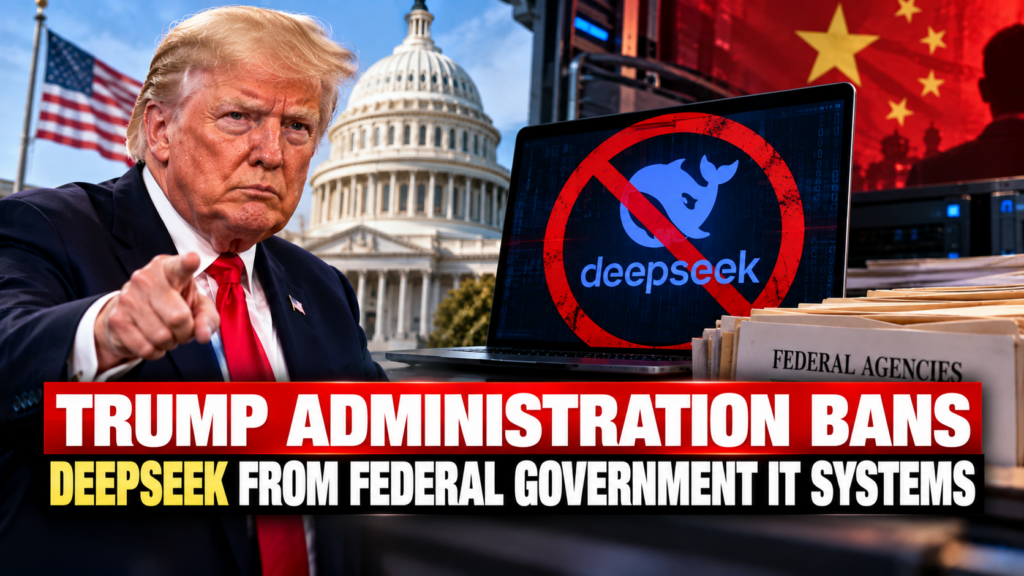
The Trump administration has ordered U.S. civilian federal agencies to remove Chinese artificial intelligence company DeepSeek’s products from government IT systems, citing national security and data privacy concerns. Announced on October 19, 2026, the order also prohibits agencies from acquiring DeepSeek products and third-party services built using its technology.
What Happened
The U.S. Department of Homeland Security (DHS) issued an order requiring federal civilian agencies to remove DeepSeek products and services from their information technology systems. The restrictions also cover products developed by DeepSeek affiliates and third-party services that use DeepSeek technology.
According to a report by Reuters, DHS said the AI models posed “multiple threat vectors,” including potential risks involving sensitive government data, intelligence gathering, malware, and other security vulnerabilities.
The order was issued under the Federal Acquisition Supply Chain Security Act of 2018, following a recommendation from the Federal Acquisition Security Council.
Key Details of the DeepSeek Ban
Why the U.S. Government Is Restricting DeepSeek
DHS warned that using DeepSeek could expose sensitive information to the People’s Republic of China (PRC), particularly if government employees or contractors entered confidential information into the AI system.
The department also raised concerns that information processed by the models could potentially be used to develop actionable intelligence about U.S. individuals or government agencies.
Additional concerns include the possibility of malware or other security vulnerabilities embedded in AI models or related products. The department’s order reflects the government’s efforts to reduce potential risks associated with foreign-developed technology in federal information systems.
These concerns represent the U.S. government’s stated security rationale for the restrictions, rather than a public determination that every DeepSeek product contains malware or has transferred government data to China.
What the Order Requires
The DHS order establishes two main requirements:
- Removal: DeepSeek products, products from affiliated entities, and third-party services built using DeepSeek implementations must be removed from federal civilian agency IT systems.
- Procurement restrictions: Federal civilian agencies may not acquire covered DeepSeek products and services.
The order applies to civilian federal government systems. It should not automatically be interpreted as a nationwide prohibition on DeepSeek for private individuals or businesses.
Earlier Security Measures Against DeepSeek
The latest restrictions follow earlier actions by U.S. government agencies and state governments concerning DeepSeek’s use on official devices.
The Commerce Department and U.S. Navy had previously restricted the technology, while several states, including New York, Tennessee, and Virginia, had introduced their own limitations.
The federal order expands the scope of restrictions by covering not only DeepSeek’s own products but also third-party services built using its technology.
Political and Economic Impact
Rising Tensions Between the U.S. and China
The DeepSeek ban adds to growing technology tensions between Washington and Beijing. The two countries have increasingly treated artificial intelligence as a strategic priority, with competition extending to advanced chips, computing infrastructure, software, and data security.
The U.S. government has previously introduced restrictions aimed at limiting China’s access to advanced semiconductor technology. The DeepSeek order extends these concerns to the AI applications used within federal agencies.
China criticized the decision on October 20, arguing that Washington was using national security concerns to suppress Chinese businesses. Beijing called on the United States to reverse the restrictions and said it would protect Chinese companies’ interests.
Implications for Artificial Intelligence Companies
The restrictions could affect government contractors and technology providers that have integrated DeepSeek models into their products. Companies supplying software and AI services to federal agencies may need to review their technology stacks to ensure compliance with the order.
The decision also highlights the importance of understanding where AI models are developed, how they process data, and whether third-party services rely on restricted technologies.
For businesses outside the federal government, the order does not itself establish a general ban on DeepSeek. However, organizations handling sensitive information may reassess their AI security policies in response to the government’s concerns.
What Happens Next
Federal civilian agencies will need to implement the removal and procurement restrictions. The DHS order establishes the legal basis for excluding covered products from government systems, although the publicly available notice does not specify a universal removal deadline.
Agencies and contractors will also need to identify third-party tools that incorporate DeepSeek technology, rather than checking only for applications directly branded with the company’s name.
The broader implications will depend on how the restrictions are implemented and whether additional federal measures follow. The dispute also adds another point of tension ahead of expected U.S.-China discussions on artificial intelligence.
The DeepSeek ban underscores how national security considerations are increasingly shaping government decisions about AI adoption. As artificial intelligence becomes more deeply integrated into public administration, scrutiny of data handling, software supply chains, and foreign technology providers is likely to remain a major policy issue.
Related Reading
- Trump Administration Plans to Move AI Testing Officials to White House
- Trump Awards National Science and Technology Medals to Six Innovators
The Department of Homeland Security cited concerns about potential data transfers to China, intelligence gathering, malware, and other cybersecurity vulnerabilities.
No. The order targets federal civilian agency IT systems and procurement. It does not establish a nationwide ban on private individuals or businesses using DeepSeek.