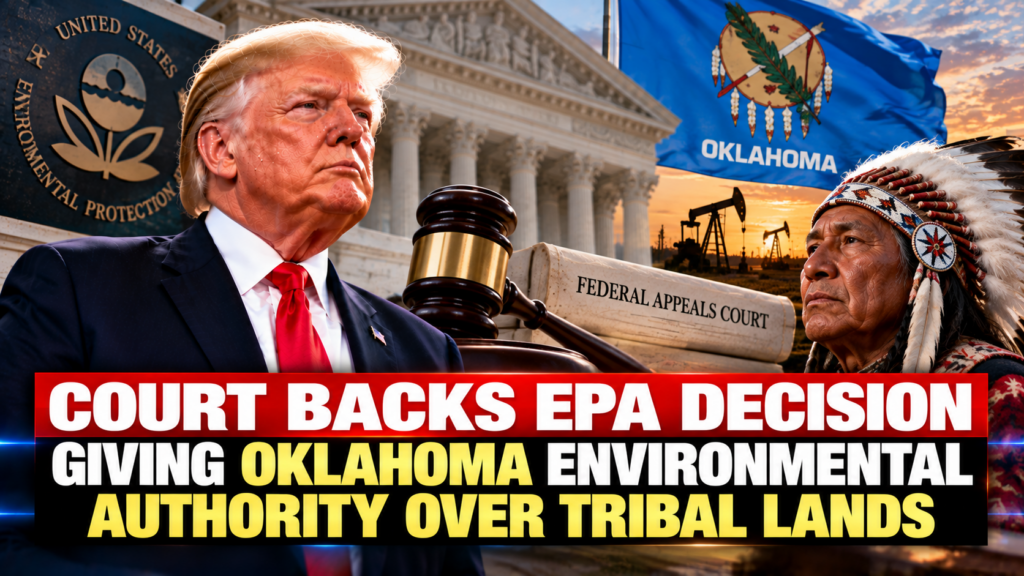
A divided federal appeals court has upheld the U.S. Environmental Protection Agency’s decision to allow Oklahoma to administer certain environmental regulations on tribal lands, delivering a legal setback to the Pawnee Nation of Oklahoma. The October 16, 2026, ruling supports the Trump administration’s position that federal law permits Oklahoma to exercise environmental regulatory authority in covered areas of Indian country.
According to a report by Reuters, a panel of the 10th U.S. Circuit Court of Appeals ruled that the EPA properly relied on a provision enacted by Congress in 2005, commonly known as the “Midnight Rider.” The decision centers on the balance between state environmental oversight, federal law, and tribal sovereignty.
What Happened
The 10th Circuit ruled in favor of the EPA in a legal challenge brought by the Pawnee Nation. The tribe had contested the agency’s approval of Oklahoma’s request to extend certain state-administered environmental regulatory programs into areas of Indian country.
The dispute traces back to a 2005 provision in federal transportation legislation that allows Oklahoma to administer certain environmental programs on tribal lands with EPA approval. The provision remained largely unused for years before Oklahoma sought to invoke it following the U.S. Supreme Court’s 2020 decision in McGirt v. Oklahoma.
In McGirt, the Supreme Court recognized that much of eastern Oklahoma remained within the boundaries of a reservation for purposes of federal criminal law. The decision prompted renewed disputes over the extent of state authority in areas recognized as Indian country.
The EPA initially approved Oklahoma’s request in 2020, later withdrew that approval to allow additional tribal consultation, and approved the request again in 2025. The agency subsequently removed conditions that had required tribal engagement, prompting the Pawnee Nation’s legal challenge.
Key Details of the Court Ruling
What the “Midnight Rider” Provision Does
The provision, formally part of the Safe, Accountable, Flexible, Efficient Transportation Equity Act: A Legacy for Users, gives Oklahoma a specific route to administer certain EPA-approved environmental programs in covered areas of Indian country.
The 10th Circuit majority concluded that the provision remained in effect and required the EPA to approve a qualifying state request without adding conditions beyond those authorized by the statute.
The court rejected the Pawnee Nation’s challenge and upheld the agency’s interpretation of the law. The ruling concerns the legal authority to administer environmental programs in covered areas, rather than a blanket transfer of every aspect of tribal governance to the state.
Why the Pawnee Nation Challenged the EPA
The Pawnee Nation argued that the EPA should not have approved Oklahoma’s request without conditions protecting tribal interests. The dispute included whether the 2005 provision remained legally effective and whether the agency could impose requirements intended to safeguard tribal sovereignty.
The tribe challenged the EPA’s decision through a petition for judicial review. The appeals court rejected the petition, leaving the agency’s approval in place.
The outcome represents a setback for the Pawnee Nation’s effort to preserve conditions on Oklahoma’s environmental regulatory authority.
Political and Legal Impact
State Authority Versus Tribal Sovereignty
The ruling highlights a longstanding legal tension over who can regulate environmental issues on tribal lands. Tribal nations have sought to preserve their authority over their territories, while Oklahoma has pursued expanded state regulatory powers under the federal provision.
The majority’s interpretation places significant weight on the wording of the 2005 law, concluding that the EPA must approve qualifying requests from Oklahoma. The decision limits the agency’s ability to impose additional conditions when the statutory requirements are met.
However, the ruling does not eliminate the broader legal and political debate over tribal sovereignty. The extent of state authority on tribal lands remains an important issue involving federal statutes, tribal rights, and the responsibilities of environmental regulators.
A Divided Appeals Court
The decision was not unanimous. The dissenting judge argued that the statute did not clearly prevent the EPA from imposing conditions designed to protect tribal sovereignty. In that view, the agency should retain some ability to require safeguards when approving state environmental programs that affect tribal lands.
The disagreement reflects competing interpretations of the provision and the extent to which federal agencies can protect tribal interests when implementing environmental laws.
The court’s majority and dissent therefore differed not only over the EPA’s specific decision but also over how much discretion the agency retains when applying the statute.
What Happens Next
The Pawnee Nation has suffered a legal setback, and the EPA’s approval of Oklahoma’s regulatory authority remains in place following the appeals court decision. The tribe may consider its further legal options, although the ruling does not establish what steps it will take next.
Environmental regulation in Oklahoma’s Indian country will continue to depend on the scope of the programs covered by the EPA’s approval and the applicable federal legal framework. The ruling also leaves broader questions about state-tribal cooperation and tribal sovereignty at the center of the debate.
Ultimately, the decision reinforces Oklahoma’s authority under the specific 2005 provision while underscoring the continuing legal disputes over environmental governance on tribal lands. Its wider significance lies in how courts interpret federal laws that define the relationship between state regulators, federal agencies, and tribal nations.
Related Reading
- USDA Urges States to Review Wolf Management Policies After Trump Executive Order
- Trump Pardons Two Alaska Mechanics Convicted of Clean Air Act Violations
The 10th Circuit upheld the EPA’s approval allowing Oklahoma to administer certain environmental programs in covered areas of Indian country.
The Pawnee Nation argued that the EPA should not have approved Oklahoma’s request without conditions designed to protect tribal sovereignty.