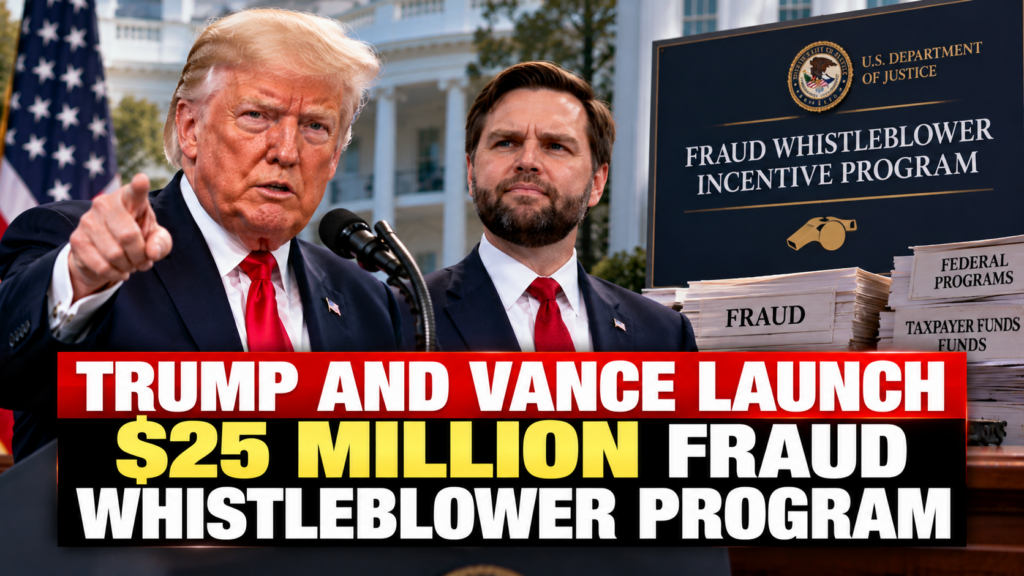
President Donald Trump and Vice President JD Vance are launching a $25 million fraud whistleblower program to encourage Americans to report suspected fraud involving federal programs and taxpayer funds. The initiative, called the Fraud Whistleblower Incentive Program (WHIP), offers eligible tipsters up to $30,000 when their information leads to a fraud conviction or a significant federal enforcement action.
According to a report by Fox News, the Justice Department will administer the program, with tips submitted through the government’s fraud reporting website, fraud.gov. The initiative expands the Trump administration’s broader campaign to identify fraud, strengthen oversight, and prevent the misuse of public funds.
What Happened
The White House announced the $25 million Fraud Whistleblower Incentive Program as part of its ongoing effort to combat fraud across federal programs. Trump and Vance are promoting the initiative as a way to involve the public in identifying wrongdoing and helping federal authorities pursue cases.
Under the program, people who provide information about suspected fraud may qualify for a financial reward if their tips lead to a successful conviction or a significant federal enforcement action. Simply submitting an allegation does not automatically qualify someone for payment.
The program will be administered by the Department of Justice, while the public will be able to submit tips through fraud.gov. The White House has positioned the initiative as another tool for investigating suspected abuses involving taxpayer money.
Key Details of the Fraud Whistleblower Program
How the $25 Million Program Works
The Fraud Whistleblower Incentive Program establishes a financial incentive for people who provide useful information about suspected federal fraud.
Key details include:
- Total program funding: $25 million.
- Maximum reward: Up to $30,000 for eligible whistleblowers.
- Administering agency: The U.S. Department of Justice.
- Tip submission website: fraud.gov.
- Eligibility requirement: Information must lead to a successful fraud conviction or a significant federal enforcement action.
The reward structure is intended to encourage reports that can help authorities take meaningful enforcement action, rather than simply increasing the number of unverified allegations submitted to the government.
Why the Administration Is Introducing WHIP
The new program builds on the administration’s existing anti-fraud efforts. Trump established the Task Force to Eliminate Fraud in March 2026, with Vance serving as its chairman.
The task force was directed to coordinate work across federal agencies to uncover fraud, strengthen eligibility checks, and prevent improper payments. The whistleblower initiative adds a public reporting and financial reward component to that broader strategy.
By encouraging people to share information, the administration hopes to identify suspected misuse of federal benefits and other government funds that might otherwise be difficult for investigators to uncover.
Political and Economic Impact
The fraud whistleblower program puts additional emphasis on government accountability and the protection of taxpayer money. If tips produce successful investigations and enforcement actions, the initiative could help federal agencies identify schemes involving public programs.
However, the program’s $25 million allocation does not itself establish how much money the government will ultimately recover or save. Those outcomes will depend on the quality of tips, the cases investigators pursue, and whether the resulting enforcement actions recover funds or prevent future losses.
The initiative also gives the administration another visible policy tool to demonstrate its commitment to tackling alleged waste and fraud in federal spending. Its long-term effectiveness will depend on whether it produces credible, actionable information and measurable results.
Reactions and Previous Fraud Investigations
Nick Shirley and the Minnesota Fraud Case
The announcement comes amid continued attention to alleged fraud involving public assistance programs in Minnesota.
During the planned announcement, Trump was expected to present a $10,000 check to Nick Shirley, a conservative online content creator whose video alleged fraud involving Somali-run childcare centers in Minnesota. The case has drawn national attention as the administration expands its anti-fraud campaign.
Fox News reported that prosecutors said Fahima Mahamud stole more than $4.6 million through false childcare assistance claims and an additional $850,000 through a federal child nutrition program connected to the Feeding Our Future scandal. Mahamud’s guilty plea was cited in discussions surrounding the allegations and Shirley’s reporting.
The case illustrates the administration’s stated interest in using investigations and public information to expose suspected fraud. However, allegations involving specific individuals or organizations must be assessed through verified evidence and legal proceedings.
A Wider Federal Crackdown
The whistleblower initiative is part of a broader series of actions targeting suspected fraud in government programs. The administration has also pursued reviews of health insurance enrollment and other areas of federal spending.
These efforts place Vice President Vance’s fraud task force at the center of the administration’s campaign to tighten oversight. The new reward program gives members of the public a more direct role in identifying potential cases for federal investigators.
What Happens Next
The Justice Department will administer the Fraud Whistleblower Incentive Program, and the public can submit information through fraud.gov. For a reward to be available, a tip must meet the program’s stated outcome requirements, including leading to a successful conviction or a significant federal enforcement action.
The key measure of success will be whether the initiative generates reliable information that supports enforcement and helps protect public funds. Its $25 million allocation and rewards of up to $30,000 establish the program’s financial framework, but its actual impact will become clearer as cases develop.
Ultimately, the Trump and Vance fraud whistleblower program represents a new public-facing component of the administration’s anti-fraud strategy. Its effectiveness will depend on credible reporting, fair investigations, and demonstrable results in reducing fraud involving federal resources.
Related Reading
- Trump Accounts Reach Nearly 70 Million American Children
- Supreme Court to Hear Trump Administration’s Fight Over DOGE Records
The Fraud Whistleblower Incentive Program is a $25 million initiative that rewards eligible individuals for tips leading to fraud convictions or significant federal enforcement actions.
Eligible whistleblowers may receive up to $30,000 for information that meets the program’s requirements. Submitting an allegation alone does not qualify for a reward.