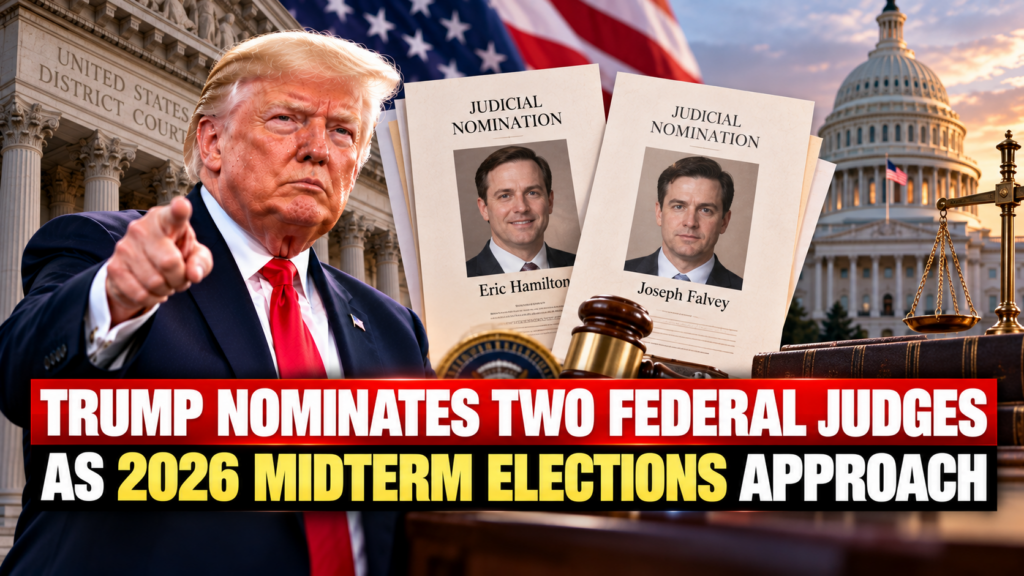
President Donald Trump has nominated two U.S. Department of Justice lawyers, Eric Hamilton and Joseph Falvey, for federal district court judgeships as Republicans prepare to accelerate judicial confirmations ahead of the November 3, 2026, midterm elections. The nominations could help shape the federal judiciary for years, particularly as control of the Senate remains a key political uncertainty.
According to a report by Reuters, Hamilton is nominated for a lifetime judgeship in Nebraska, while Falvey is nominated for the U.S. District Court for the Northern District of Indiana. The announcements come as Senate Republicans plan additional nomination hearings in November and seek to confirm as many of Trump’s judicial nominees as possible before the current Congress ends.
What Happened
Trump announced the two nominations on October 19, 2026, adding to his efforts to appoint federal judges during his second term. Both nominees have worked within the federal legal system, although their professional backgrounds differ.
Hamilton serves as deputy assistant attorney general in the Justice Department’s Civil Division and previously served as Nebraska’s solicitor general. Falvey is a federal prosecutor in Indiana and previously clerked for Chief Justice John Roberts of the U.S. Supreme Court.
The nominations arrive less than three weeks before the midterm elections. Republicans are concerned that a change in Senate control could make it more difficult for Trump to secure confirmation of additional judicial nominees.
Key Details of Trump’s Judicial Nominations
Eric Hamilton Nominated for Nebraska Federal Court
Hamilton currently works in the Justice Department’s Federal Programs Branch, where he has helped defend major Trump administration policies in court.
According to Reuters, those policies have included global tariffs, efforts to restrict birthright citizenship, deployments of National Guard troops to cities including Los Angeles, and the administration’s effort to dismantle the U.S. Department of Education.
Trump praised Hamilton’s work defending the administration’s agenda. Before joining the Justice Department, Hamilton served as Nebraska’s solicitor general.
If confirmed by the Senate, Hamilton would receive a lifetime appointment to the U.S. District Court for the District of Nebraska.
Joseph Falvey Nominated for Indiana Federal Court
Falvey has been nominated for a judgeship on the U.S. District Court for the Northern District of Indiana, where he currently serves as a federal prosecutor.
His previous legal experience includes clerking for Chief Justice John Roberts, as well as Judge Thomas Griffith of the U.S. Court of Appeals for the District of Columbia Circuit and Judge Dabney Friedrich of the U.S. District Court for the District of Columbia.
The nomination places another experienced federal legal professional among Trump’s judicial picks. Falvey would still need Senate confirmation before officially taking the federal judgeship.
Senate Republicans Prepare for a Confirmation Push
The nominations come as Senate Republicans prepare to accelerate confirmation proceedings following the November 3 midterm elections.
The Republican-led Senate Judiciary Committee has scheduled judicial nomination hearings for November 10 and November 18. The plan is to move nominees through the process and secure as many confirmations as possible before the current Congress adjourns.
The timing is politically significant. If Democrats win control of the Senate, they could take over committee leadership in January 2027 and make it harder for Trump to advance his judicial appointments.
The confirmation process therefore remains closely tied to the election outcome. Although the nominations have been announced, neither Hamilton nor Falvey becomes a federal judge automatically. Both must complete the required Senate confirmation process.
Political and Legal Impact
Long-Term Influence on the Federal Judiciary
Federal judges can shape how laws and executive actions are interpreted, making judicial appointments an important part of a president’s long-term policy legacy. Lifetime appointments mean that the effects of a nomination can extend well beyond the administration that selected the judge.
Trump has already secured 234 judicial confirmations during his first term. Since returning to the White House in January 2025, the Republican-led Senate has confirmed another 56 judges, including 10 to federal appeals courts, Reuters reported.
These appointments have contributed to a broader conservative shift in the federal judiciary, including the current 6-3 conservative majority on the Supreme Court.
Why the Midterm Elections Matter
The November 2026 elections could affect the pace of future judicial confirmations. If Republicans retain control of the Senate, Trump may have a clearer path to advancing additional nominees. A Democratic takeover could complicate that process once the new Congress convenes.
The nominations of Hamilton and Falvey illustrate how judicial appointments have become part of the political calculations surrounding the midterms. The immediate question is whether the Senate can confirm the nominees before the current Congress ends, while the longer-term issue is how the election will influence Trump’s remaining judicial agenda.
What Happens Next
Hamilton and Falvey are expected to be considered during the Senate Judiciary Committee’s scheduled November hearings. Their nominations must then proceed through the Senate confirmation process before either can take office.
The outcome of the midterm elections will help determine the political environment for subsequent nominations. With judicial appointments carrying long-term consequences for federal law and government policy, the Senate’s handling of these candidates could become an important part of the transition into the next Congress.
Trump’s latest judicial nominations underscore the administration’s continued focus on reshaping the federal courts. Whether the president can maintain that pace will depend partly on Senate control and the time available to complete confirmations before the current Congress concludes.
Related Reading
- Trump Pardons Two Alaska Mechanics Convicted of Clean Air Act Violations
- Trump Launches Committee Probe Into Federal Reserve Governor Lisa Cook
Trump nominated Eric Hamilton for a federal judgeship in Nebraska and Joseph Falvey for the U.S. District Court for the Northern District of Indiana
If Democrats gain control of the Senate, confirming Trump’s future judicial nominees could become more difficult after the new Congress begins in January 2027.