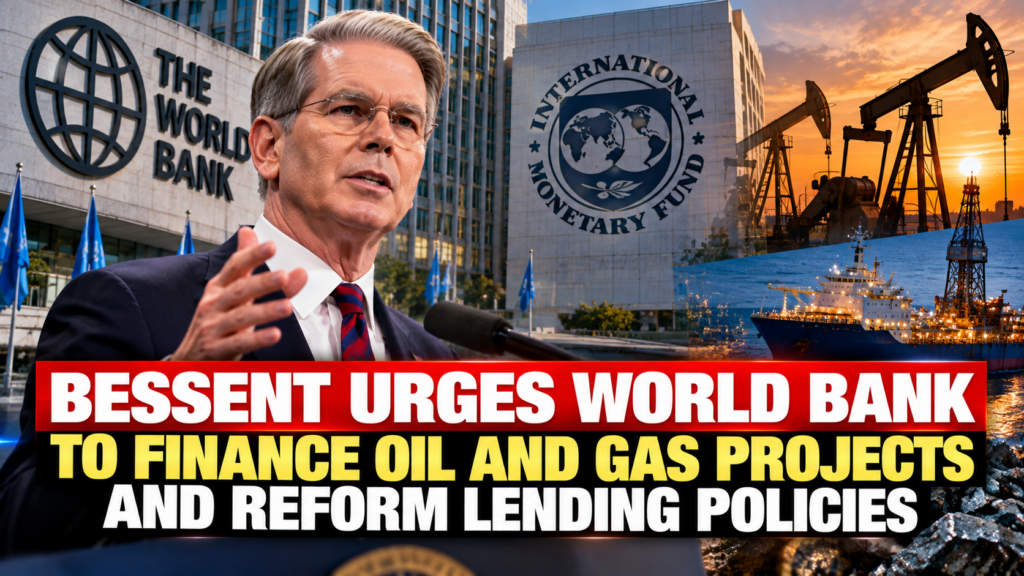
U.S. Treasury Secretary Scott Bessent has called for major World Bank reforms, including lifting restrictions on financing upstream oil and gas projects, supporting deep-sea mining for critical minerals, and changing procurement policies. The proposals, delivered to the World Bank and International Monetary Fund (IMF) in October 2026, reflect the Trump administration’s effort to align international financial institutions more closely with U.S. energy and economic priorities.
According to a report by Reuters, Bessent also urged the IMF to do more to address global economic imbalances associated with what the United States describes as non-market policies, a criticism widely understood as directed at China.
What Happened
Bessent outlined the proposals in a statement sent late on October 14 to the steering committees of the World Bank and IMF. The statement called for changes to energy financing, critical mineral development, procurement rules, and international economic surveillance.
A central demand is that the World Bank adopt what Bessent described as a technology-neutral approach to energy. That would mean removing restrictions on financing upstream oil and natural gas projects and assessing proposals on their individual merits rather than excluding them categorically.
The U.S. Treasury also announced an initial contribution to a new World Bank-administered Nuclear Energy Assistance Trust Fund. The fund is intended to help countries prepare for future nuclear power investments.
The proposals form part of a wider push by the Trump administration to reshape the priorities of multilateral financial institutions around energy security, mineral supply chains, and U.S. economic interests.
Key Details of Bessent’s World Bank Reform Proposals
1. Ending Restrictions on Upstream Oil and Gas Financing
Bessent wants the World Bank to remove constraints on financing upstream oil and gas projects, which involve activities such as exploration and production.
He argued that the bank should not categorically exclude these projects before assessing their development potential. The proposal would represent a significant shift in the institution’s approach to fossil fuel financing if adopted.
The administration’s position is that countries should have greater flexibility to choose energy sources based on their development needs, rather than having access to financing limited by broad restrictions.
2. Expanding Deep-Sea Mining for Critical Minerals
The U.S. Treasury also called for the World Bank to support the development and processing of critical minerals, including through deep-sea mining.
Critical minerals are important inputs for technologies, manufacturing, and energy systems. The administration wants the bank to help expand supply capacity and provide technical knowledge and guidance in deep-sea mining, a developing sector.
The proposal reflects Washington’s interest in strengthening access to strategic resources and reducing vulnerabilities in mineral supply chains.
3. Supporting Nuclear Energy Investments
The United States announced an initial contribution to the new Nuclear Energy Assistance Trust Fund administered by the World Bank.
The fund is designed to help countries lay the groundwork for future nuclear power investments. The announcement signals that the administration wants international development financing to support nuclear energy alongside oil and natural gas.
The statement did not specify the amount of the initial U.S. contribution.
4. Reforming World Bank Procurement Policies
Bessent called for changes to the World Bank’s procurement policies, arguing that the rules should promote competition and quality rather than encourage subsidies or reward industrial policies that distort markets.
He also called for wealthier countries, including China and Poland, to graduate more quickly from World Bank borrowing.
These proposals could affect how development projects are procured and how access to financing is distributed among countries at different stages of economic development.
Bessent Calls for Stronger IMF Action on Global Imbalances
The proposals extend beyond the World Bank. Bessent also urged the IMF to strengthen its analysis of global economic imbalances, including the effects of non-market policies and exchange-rate practices.
The U.S. statement argued that the IMF should more actively address policies that create economic distortions and negative spillover effects across countries. The criticism was widely interpreted as referring to China and U.S. concerns about its economic policies.
The administration’s position is that the IMF must more forcefully address these issues to maintain its relevance in the international financial system.
Political and Economic Impact
A Push to Reshape International Development Finance
The proposals would shift the emphasis of international development finance toward a broader range of energy investments, including fossil fuels and nuclear power, as well as strategic mineral extraction.
For countries seeking funding, changes to World Bank policies could affect which projects are eligible for support. Expanded financing for upstream oil and gas could create additional options for energy-producing countries, while greater attention to critical minerals could support projects aimed at securing industrial supply chains.
However, Bessent’s statement outlines U.S. policy demands, not reforms that the World Bank or IMF has already adopted. Any institutional changes would depend on the relevant decision-making processes within those organizations.
Potential Tensions With Other Development Priorities
The proposals also raise questions about how international lenders should balance energy access, economic development, environmental considerations, and long-term financial sustainability.
Supporters of a technology-neutral approach argue that countries should be able to choose energy sources suited to their circumstances. Critics of expanded fossil fuel financing may raise concerns about the climate implications of supporting new oil and gas production.
The statement does not resolve these competing priorities. Instead, it signals the Trump administration’s preference for broader financing options and a stronger emphasis on national economic interests.
What Happens Next
The World Bank and IMF would need to consider the proposals through their respective institutional processes. Bessent’s statement does not establish a timeline for adopting the requested changes, and it does not mean that restrictions on oil and gas financing have already been lifted.
The U.S. contribution to the Nuclear Energy Assistance Trust Fund is a separate concrete step announced alongside the broader reform agenda. Further details about the fund’s implementation and the other proposed changes will determine how much the initiatives affect lending decisions.
Bessent’s demands highlight the Trump administration’s intention to influence global development finance, energy investment, and economic oversight. The broader outcome will depend on whether the World Bank and IMF agree to change their policies and how those changes balance national priorities with the institutions’ wider development objectives.
Related Reading
- Trump Diesel Relief Could Save Drivers Up to $100 Per Fill
- USDA Urges States to Review Wolf Management Policies After Trump Executive Order
Bessent wants the bank to lift restrictions on upstream oil and gas financing, support deep-sea mining, and reform procurement policies.
He urged the IMF to strengthen its analysis of global economic imbalances, including the effects of non-market policies and exchange-rate practices.