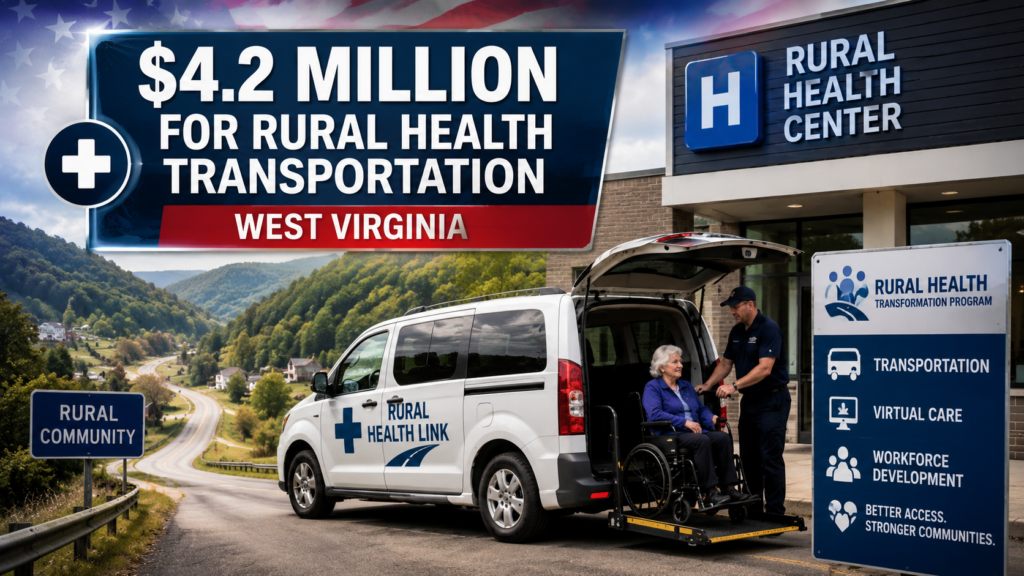
The Trump administration is directing an additional $4.2 million toward West Virginia rural health transportation, expanding medical transportation capacity and helping residents in rural communities reach health care services. The funding is part of the federal Rural Health Transformation Program and will support West Virginia’s Rural Health Link initiative.
What Happened
The Trump administration announced the $4.2 million investment on August 20, 2026, to expand transportation options for patients across rural West Virginia.
According to a report by WV News, the federal funding will increase medical transportation capacity, expand service availability and improve geographic coverage for patients who face difficulties traveling to medical appointments.
The Centers for Medicare & Medicaid Services confirmed the same $4.2 million investment, saying the funding will be used through the Rural Health Link initiative to remove transportation barriers and improve access to care regardless of a patient’s ZIP code.
Rural Health Funding Reaches Nearly $199 Million
West Virginia’s Broader Federal Award
The transportation investment is one part of a much larger federal commitment to West Virginia.
The state received approximately $199 million for fiscal year 2026 through the Rural Health Transformation Program, with nearly $167 million in programming announced across multiple statewide projects.
The federal program was created to help states develop rural health systems that are more accessible, sustainable and responsive to local conditions. The program provides $50 billion nationally over five years.
West Virginia officials have used the funding to pursue transportation, virtual care, workforce development and other health system improvements.
Why Transportation Matters for Rural Patients
West Virginia’s mountainous geography can create significant challenges for residents trying to reach hospitals, clinics and other health providers.
The state’s Department of Health has separately announced two transportation-related funding opportunities totaling about $4.2 million through the Rural Health Link initiative. Those opportunities include EMS Collaboratives and Public Transportation Collaboratives designed to improve coordination between transportation providers and health care organizations.
The EMS component is intended to support alternative destination models, allowing emergency medical services to connect some patients with appropriate primary care, urgent care, behavioral health providers or federally qualified health centers rather than automatically taking every patient to an emergency department.
The public transportation component is focused on establishing regional networks for non-emergency medical transportation across multiple counties.
Together, the programs aim to improve reliability, coordination and geographic coverage for rural patients.
Trump Administration Highlights Rural Health Goals
Health and Human Services Secretary Robert F. Kennedy Jr. said the administration wants federal resources directed toward rural communities to strengthen the health workforce, modernize infrastructure and bring care closer to patients.
CMS Administrator Dr. Mehmet Oz said the investment is intended to put patients first while helping rural communities develop more sustainable approaches to health care delivery.
West Virginia Gov. Patrick Morrisey also emphasized transportation as a major barrier to health care access, saying too many residents struggle to receive care because of where they live or because reliable transportation is unavailable.
The transportation focus fits into a broader administration strategy of investing in infrastructure and access. Separate federal initiatives involving Trump administration rail investment plans also emphasize the role of transportation infrastructure in improving connectivity and economic opportunity.
Additional Health Projects in West Virginia
The $4.2 million transportation funding is only one component of the state’s broader rural health transformation package.
$14 Million for Virtual Care
A separate $14 million initiative is expanding virtual care and remote patient monitoring across West Virginia hospitals and health care providers.
The technology is intended to help doctors and patients monitor chronic conditions such as diabetes, hypertension and obesity without requiring as many in-person appointments.
For residents who live far from medical facilities, virtual services can complement transportation improvements by reducing the number of visits that require physical travel.
$10.5 Million for Workforce Grants
Another $10.5 million is being directed toward Health to Prosperity workforce grants focused on chronic health conditions and substance use disorder.
The programs are designed to connect clinical care, community support organizations and employers, with the goal of improving health outcomes while supporting workforce participation.
The combination of transportation, telehealth and workforce initiatives reflects an effort to address multiple barriers to rural health simultaneously.
Congressional Support for the Investment
Several West Virginia Republicans in Congress praised the federal investment.
Sen. Shelley Moore Capito said the transportation allocation represents one part of the state’s nearly $199 million federal award and should help residents access care closer to home.
Sen. Jim Justice said rural residents should not have to travel for hours to obtain quality health care.
Rep. Carol Miller highlighted West Virginia’s difficult terrain, while Rep. Riley Moore said the broader Rural Health Transformation Program can strengthen access to care throughout the state.
The administration and West Virginia officials have presented the funding as a practical investment in communities where geography and transportation can directly affect access to medical services.
Rural Health and Emergency Preparedness
The investment also has implications for the resilience of rural communities during emergencies.
More coordinated transportation networks can help connect patients to care when normal access is disrupted, while stronger communication and regional coordination can support broader emergency response efforts.
Those issues overlap with the administration’s wider focus on disaster and emergency management, including FEMA emergency management efforts that seek to strengthen federal and local preparedness.
Although the West Virginia funding is primarily focused on routine access to health care, improved transportation networks can provide additional capacity during public emergencies.
What Happens Next
The immediate priority is to turn the federal funding into functioning transportation networks and partnerships that rural patients can actually use.
West Virginia’s Public Transportation Collaboratives and EMS Collaboratives are designed to build new partnerships, improve coordination, strengthen transportation infrastructure and establish clearer performance measures.
The state is also continuing to roll out other Rural Health Transformation Program initiatives involving virtual care, scheduling, workforce development and chronic disease management.
The broader West Virginia rural health investment represents an effort to address a basic but persistent problem: patients cannot benefit from medical services they cannot reach. By combining transportation improvements with telehealth, workforce programs and stronger coordination, the Trump administration and West Virginia officials are seeking to make health care more accessible while building a more sustainable rural health system.
The administration announced $4.2 million to expand medical transportation and improve access to health care.
West Virginia received approximately $199 million for fiscal year 2026 through the Rural Health Transformation Program.