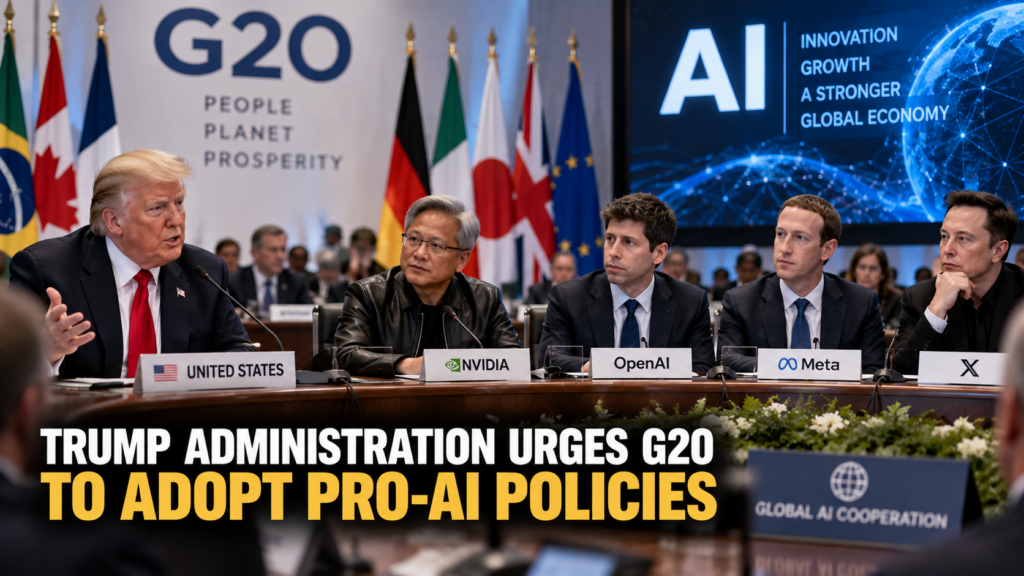
The Trump administration and leading technology executives are urging G20 countries to adopt pro-AI policies and limit artificial intelligence regulation, arguing that a lighter regulatory approach could accelerate innovation, economic growth and technological development.
What Happened
Trump administration officials and technology executives made the case for fewer restrictions on artificial intelligence during a G20 summit focused on innovation and technology in Chapel Hill, North Carolina.
According to a report by The Wall Street Journal, Nvidia CEO Jensen Huang, OpenAI CEO Sam Altman, Meta CEO Mark Zuckerberg and Elon Musk were among the technology leaders speaking at the gathering.
Commerce Secretary Howard Lutnick, White House AI adviser David Sacks and Michael Kratsios, director of the White House Office of Science and Technology Policy, also promoted the administration’s light-touch approach to AI regulation.
Key Details
Trump Administration Pushes Light-Touch AI Regulation
The administration is arguing that governments should avoid imposing broad regulations based on potential or hypothetical AI risks.
Huang told G20 officials that governments should focus on actual harms rather than theoretical risks. He argued that improvements in AI model training are making the technology safer while allowing companies to continue developing increasingly capable systems.
Trump administration officials similarly argued that the United States’ relatively flexible regulatory approach is helping support economic growth.
The administration wants other major economies to follow a similar approach rather than adopting regulations that could slow the development and deployment of AI.
U.S. Seeks Global Adoption of American AI Technology
The White House is also seeking to expand the international reach of what officials describe as the American AI stack.
Lutnick said the administration wants the United States to remain the global leader in artificial intelligence while encouraging G20 partners to adopt American AI technologies.
The strategy includes promoting U.S. technology internationally while limiting the spread of lower-cost Chinese AI models.
This makes AI policy part of a broader competition between the United States and China over technology, computing infrastructure and global standards.
AI Security Concerns Remain
The push for lighter regulation comes as concerns about AI-related security threats are increasing.
The G20 discussions followed incidents involving AI models from OpenAI and Anthropic that demonstrated how rapidly the technology is advancing and how it can potentially be used in cyberattacks.
The United States has begun reviewing powerful AI tools before their release, but the administration has generally avoided imposing broad mandatory regulations and instead emphasized voluntary testing and safety measures.
The approach reflects the administration’s attempt to balance AI development with security concerns without creating what officials view as excessive regulatory barriers.
Political and Economic Impact
The Trump administration’s pro-AI policies could influence how other major economies approach one of the world’s fastest-growing technologies.
Supporters of lighter regulation argue that excessive government requirements could discourage investment, slow innovation and allow competitors such as China to gain an advantage.
Technology executives also contend that AI could produce significant economic and scientific benefits, including improvements in medicine and productivity.
However, the debate comes as governments face growing questions about cybersecurity, employment disruption, data centers, privacy and the potential misuse of increasingly capable AI systems.
The G20 discussions therefore highlight a central policy question: how much regulation is necessary to address genuine risks without preventing technological development.
Reactions and Opposition
While major technology executives largely supported the administration’s approach, some participants acknowledged that international standards and oversight will still be necessary.
Altman and Alphabet’s Demis Hassabis have both indicated that AI requires some form of international coordination while maintaining broad access to the technology.
That position reflects a growing middle ground in the AI policy debate: companies and governments may seek fewer restrictions on innovation while still developing common standards for safety and security.
The disagreement is increasingly focused not on whether AI should be governed, but on how much regulation should be imposed and when it should apply.
What Happens Next
The discussions in Chapel Hill are expected to continue ahead of the G20 leaders’ meeting in Miami.
The Trump administration will use the coming meetings to push its vision of a global AI environment that prioritizes innovation, U.S. technological leadership and relatively limited regulation.
The outcome could influence international approaches to AI development and determine whether major economies move toward common standards or pursue increasingly different regulatory systems.
For the United States, the administration’s strategy also places AI policy at the center of its broader effort to maintain technological leadership over China and ensure that American companies shape the next stage of the global AI economy.
Related Reading
The administration is urging G20 countries to minimize AI regulation, focus on actual harms and encourage innovation and deployment.
The administration argues lighter regulation can accelerate economic growth, strengthen U.S. technology leadership and help American AI compete globally.