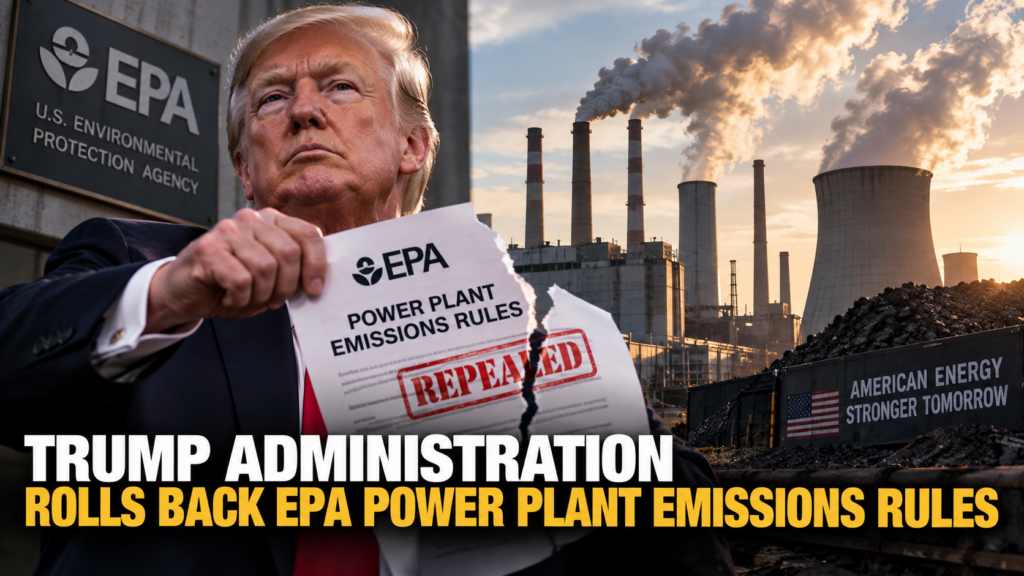
The Trump administration has finalized the repeal of federal rules limiting greenhouse gas emissions from coal- and natural gas-fired power plants, marking a major reversal of Biden-era climate policy. The EPA announced the power plant emissions rules rollback on September 14 during a G20 energy ministers meeting in Houston, Texas.
According to a report by CNN report, EPA Administrator Lee Zeldin said the move would reduce regulatory costs and support the expansion of American energy production.
The repeal is part of President Donald Trump’s broader effort to dismantle federal climate regulations and expand fossil-fuel production. Reuters and the Associated Press separately confirmed the EPA’s action and the administration’s plans to restrict future federal regulation of greenhouse gas emissions from power plants.
What Happened
The Environmental Protection Agency has repealed carbon-emissions standards finalized under former President Joe Biden in 2024. Those standards targeted emissions from existing coal-fired plants and newly built natural gas plants.
Under the Biden rules, affected facilities would have faced requirements to substantially reduce carbon dioxide emissions, including through carbon-capture technology. The administration had projected that the standards could prevent roughly 1 billion metric tons of greenhouse gas emissions by 2047.
The Trump administration argues that the regulations imposed excessive costs on the power sector and could make it more difficult to maintain reliable electricity supplies as demand increases.
EPA officials said repealing the rules would eliminate more than $300 billion in projected industry costs and give utilities greater flexibility in deciding how to operate their facilities.
Why the Power Plant Emissions Rules Matter
The electricity sector is responsible for nearly one-quarter of US greenhouse gas pollution, making it the nation’s second-largest source of climate pollution after transportation.
Power-sector emissions also increased by about 4% last year, according to figures cited by Reuters. The Trump administration has argued that additional coal-fired generation could help address rising electricity demand from data centers, manufacturing and other energy-intensive industries.
The administration has particularly emphasized coal as a reliable domestic energy source.
EPA Administrator Lee Zeldin has framed the rollback as part of an effort to reduce regulatory barriers and encourage new generating capacity.
However, critics argue that coal-fired electricity can be more expensive than natural gas and renewable sources, meaning the rollback does not necessarily guarantee lower electricity prices for consumers.
EPA Seeks to Limit Future Climate Regulation
The administration’s action goes beyond repealing the Biden-era standards.
The EPA has also proposed withdrawing remaining federal greenhouse-gas requirements for power plants and argued that the agency lacks authority under the Clean Air Act to regulate greenhouse gas emissions from the power sector.
If finalized, that separate proposal could make it significantly harder for a future administration to establish similar federal climate regulations for power plants.
The proposal follows another major Trump administration decision earlier this year to revoke the EPA’s longstanding scientific finding that greenhouse gases pose a threat to public health and welfare. That finding had served as a major legal foundation for federal climate regulation.
Environmental Groups Prepare Legal Challenges
Environmental and public-health organizations have strongly criticized the repeal and are expected to challenge it in court.
Critics argue that eliminating the power plant emissions rules could increase greenhouse gas pollution and impose additional health and environmental costs on communities.
The Associated Press reported that the repeal is expected to face immediate legal challenges once the rule takes effect.
Environmental groups have also argued that the administration is underestimating the economic consequences of increased pollution, including health impacts and climate-related disasters.
The rollback comes after a summer marked by extreme heat, wildfires and flooding across parts of the United States, intensifying the political debate over the federal government’s role in addressing climate change.
Trump Administration’s Energy Strategy
The repeal fits into a much broader energy strategy under Trump.
The administration has moved to encourage fossil-fuel production while reversing regulations designed to accelerate the transition toward lower-emission energy sources.
Trump officials have also taken steps to keep some aging coal-fired plants operating beyond planned retirement dates and have supported additional investment in coal infrastructure.
The administration says these policies are necessary to strengthen the US electricity grid and prevent energy shortages as electricity demand rises.
Coal, however, has faced long-term competition from cheaper natural gas and renewable energy sources. Reuters reported that the administration’s policy could increase coal-fired electricity generation even as the fuel has continued to lose market share.
What Happens Next
The repeal is likely to trigger a new legal battle over the EPA’s authority to regulate greenhouse gas emissions.
Utilities will also have to navigate a changing regulatory environment while state governments continue to enforce their own emissions requirements. The Edison Electric Institute, representing major investor-owned utilities, welcomed the repeal while emphasizing the importance of regulatory certainty for the industry.
The separate proposal to prevent future federal regulation of power-plant greenhouse gases could become an even more consequential legal and political fight if the EPA moves to finalize it.
The rollback therefore represents more than a reversal of one Biden administration regulation. It could reshape the federal government’s approach to power-sector emissions for years, while leaving states, utilities, environmental groups and future administrations to determine how much climate regulation remains possible.
Related Reading
- Trump Administration Moves to Change Federal Protections for Gray Wolves
- Trump Grants Clemency to 30 People, White House Says
The Trump EPA repealed Biden-era standards limiting greenhouse gas emissions from coal-fired and new natural gas power plants.
The administration says the rules impose excessive costs, restrict energy production and could undermine electricity reliability as US demand increases.