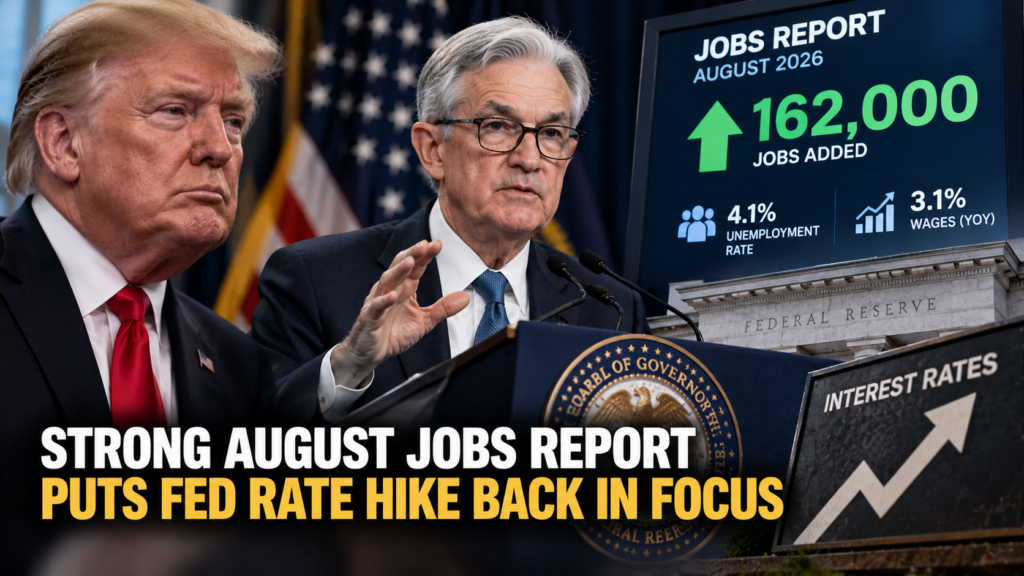
A stronger-than-expected August jobs report has revived expectations that the Federal Reserve could raise interest rates at its September meeting, even as President Donald Trump continues pressing the central bank to cut borrowing costs. The latest employment data has put the Fed rate hike debate back at the center of U.S. economic policy.
According to a report by Reuters, employers added 162,000 jobs in August, nearly three times the number economists had expected, while labor-force participation increased and the unemployment rate remained at 4.1%.
What Happened
The August employment report strengthened the case for the Federal Reserve to consider raising interest rates this month. The Fed is scheduled to meet September 15-16, with upcoming inflation data expected to play a major role in determining whether policymakers tighten monetary policy.
The jobs report showed nonfarm payrolls rising by 162,000 in August. Labor-force participation increased to 61.6%, driven by about 300,000 additional people moving from outside the labor force directly into employment.
The unemployment rate held at 4.1%, while average hourly earnings increased 3.1% from a year earlier, a pace Reuters reported as consistent with the Fed’s 2% inflation target.
Key Details
Rate Hike Expectations Rise
Financial markets reacted to the stronger employment figures by increasing bets on a September rate hike.
Short-term interest-rate futures indicated about a 62% probability of a rate increase at the September meeting, up from approximately 55% before the jobs report.
The report came after Federal Reserve Chair Kevin Warsh recently adopted a more hawkish tone, saying the central bank needed confidence that inflation was moving back toward its 2% target at a sufficient pace.
Inflation has remained above the Fed’s 2% target for more than five years, making price data especially important for the central bank’s next decision.
Inflation Data Could Decide the Outcome
Despite the strong jobs numbers, the employment report alone is unlikely to determine the Fed’s decision.
The central bank is expected to closely examine upcoming consumer price index and producer price index figures. If inflation remains elevated, the data could reinforce the case for a rate increase. If price pressures continue to moderate, policymakers could instead keep rates unchanged.
Fed Governor Christopher Waller said he would support holding rates in the 3.50%-3.75% range if upcoming inflation data confirms that price pressures are easing.
Trump’s Pressure on the Federal Reserve
The possibility of a rate hike comes as Trump continues to demand lower interest rates.
Following the jobs report, Trump argued that high rates put the United States at an economic disadvantage and called for the Federal Reserve to reduce borrowing costs.
He also threatened to stop trading with countries with which the United States runs trade deficits if they did not accept lower rates, an approach that Reuters noted could create significant risks for global economic growth.
Trump’s pressure creates an additional challenge for the Federal Reserve, which is expected to make monetary-policy decisions based on employment, inflation and broader economic conditions rather than political demands.
Political and Economic Impact
A Fed rate hike would mark a significant shift in expectations after markets had increasingly focused on the possibility of lower rates.
The strong labor market gives policymakers more room to prioritize inflation control, particularly if upcoming price data shows that inflation remains above target.
At the same time, higher rates can increase borrowing costs for households, businesses and the federal government. That creates a difficult policy balance as the administration seeks stronger economic growth while the Fed attempts to keep inflation under control.
The debate also comes ahead of the November elections, when Trump’s Republican Party is defending narrow majorities in Congress.
What Happens Next
The next major test will be the inflation data released before the Fed’s September 15-16 meeting. Those figures could determine whether the strong August jobs report translates into an actual rate increase.
For now, markets have moved toward expecting tighter monetary policy. But Fed officials remain divided, meaning the inflation figures will be critical in determining whether the Federal Reserve follows through with a hike or keeps rates unchanged.
Conclusion
The August jobs report has significantly strengthened the case for a Fed rate hike, but the final decision will depend heavily on inflation data. With employment showing renewed strength and Trump demanding lower borrowing costs, the Federal Reserve faces an increasingly consequential choice over the direction of U.S. monetary policy.
Related Reading
Trump Administration Expands Drug Pricing Deals to Lower Prescription Costs
Trump Announces U.S. Push for Control of Venezuela Oil Reserves
A stronger-than-expected August jobs report increased expectations that the Federal Reserve could raise interest rates at its September meeting.
The Federal Reserve is scheduled to meet September 15-16, with upcoming inflation data expected to heavily influence the decision.