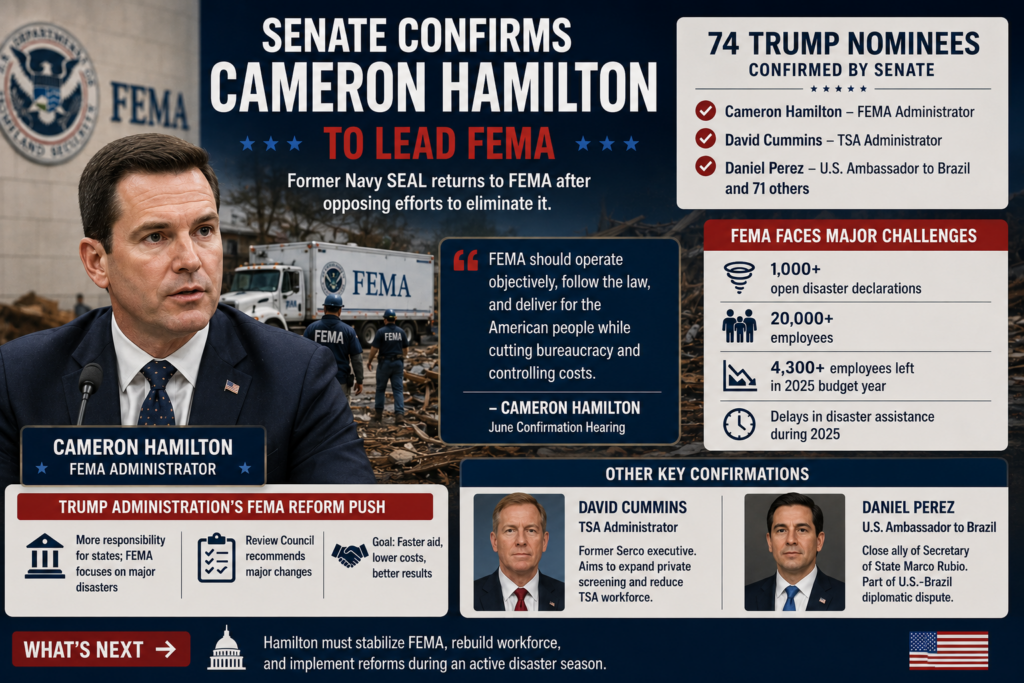
The U.S. Senate has confirmed Cameron Hamilton as administrator of the Federal Emergency Management Agency (FEMA), returning the former Navy SEAL to an agency he previously led temporarily before being fired after opposing efforts to eliminate it. The confirmation came as part of a broader Senate vote approving 74 Trump administration nominees.
According to a report by News4Jax, Hamilton now faces the challenge of stabilizing FEMA while implementing major changes to the federal disaster-response system under President Donald Trump.
What Happened With Cameron Hamilton and FEMA?
Hamilton’s confirmation marks a notable return to FEMA. Trump initially appointed him to temporarily lead the agency in January 2025, but Hamilton was fired after publicly opposing the idea of eliminating FEMA.
During a congressional hearing in May 2025, Hamilton said he did not believe eliminating FEMA was in the best interests of Americans. He was dismissed the following day.
His return now suggests the Trump administration may have moved away from its earlier threat to abolish FEMA, although the administration continues to pursue substantial reforms to the agency and the broader federal disaster-response system.
Hamilton told senators during his June confirmation hearing that FEMA should operate objectively and consistently while following the law. At the same time, he argued that the agency faces excessive bureaucracy and needs to find a better balance between providing assistance and controlling costs.
FEMA Faces Major Challenges
Hamilton takes over FEMA during a difficult period for the agency.
FEMA is managing more than 1,000 open disaster declarations while the United States faces destructive wildfires and flooding during a busy summer disaster season. The agency also has more than 20,000 employees and has experienced significant workforce losses.
More than 4,300 employees left FEMA during the 2025 budget year, including more than 1,500 through voluntary reductions. A Government Accountability Office report said the departures resulted in a loss of institutional knowledge and experienced personnel.
The agency also experienced disruptions to grant programs and delays in disaster assistance during Kristi Noem’s tenure as secretary of the Department of Homeland Security.
Since taking over from Noem in March, Homeland Security Secretary Markwayne Mullin has reversed some of those changes, including rehiring some employees and eliminating a rule that required approval from the secretary’s office for expenses above $100,000.
Trump Administration Pushes FEMA Reform
The Trump administration continues to advocate for a significant restructuring of how disaster relief is delivered.
Mullin has described FEMA as “bloated” and said greater responsibility should return to state governments, with FEMA focusing on the most severe disasters rather than responding to every storm.
A FEMA Review Council appointed by Trump also recommended major changes to the way the federal government assists states, tribes and territories after disasters.
Some of those proposals could accelerate disaster assistance, but they could also reduce the amount and frequency of federal support available to communities. Several of the recommended changes would require congressional approval.
The debate over federal disaster policy comes as the administration faces broader questions about how federal agencies should be restructured. For additional context on Trump’s broader approach to government personnel and institutions, see the latest developments involving Trump’s White House counsel.
Democrats Raise Concerns Over Disaster Relief
The administration’s approach to FEMA has also drawn criticism from Democrats, who have accused Trump of politicizing disaster assistance.
An Associated Press analysis in July found that Trump had approved 80% of disaster requests from Republican governors compared with about 60% of requests from Democratic governors.
Hamilton has sought to distance his leadership approach from partisan considerations, pledging that FEMA would be fair and consistent when evaluating disaster claims and requests.
His confirmation has nevertheless placed him at the center of a larger political debate over the federal government’s responsibility during natural disasters.
The administration’s changes also come alongside other Trump policies affecting federal agencies and government programs, including changes to Head Start under the Trump administration.
Senate Confirms 74 Trump Nominees
Hamilton was one of 74 Trump administration nominees approved by the Senate in the same group of votes.
Among those confirmed were David Cummins, Trump’s choice to lead the Transportation Security Administration, and Daniel Perez, Trump’s nominee for U.S. ambassador to Brazil.
Cummins is a former senior vice president at government contractor Serco, which operates air traffic control towers at dozens of U.S. airports. His appointment comes as the administration seeks to expand private airport screening and reduce the TSA workforce.
The TSA has also faced significant operational challenges following a partial government shutdown that left employees working without pay and contributed to resignations among airport security officers.
Daniel Perez Confirmation Adds to Brazil Dispute
The Senate also confirmed Perez as the next U.S. ambassador to Brazil.
Perez is a former speaker of the Florida House of Representatives and a close associate of Secretary of State Marco Rubio. His appointment has become part of a diplomatic dispute between the Trump administration and Brazilian President Luiz Inácio Lula da Silva’s government.
The State Department previously said Brazil’s refusal to accept Perez’s appointment was a key reason the United States revoked the visa of Brazil’s ambassador to Washington.
Under international diplomatic practice, a host country must approve a proposed ambassador before that diplomat can officially take up the post.
What Happens Next for FEMA?
Hamilton’s immediate challenge will be to restore stability at FEMA while implementing the Trump administration’s vision for a smaller and more streamlined federal disaster-response system.
Emergency management officials have expressed support for Hamilton’s return. Pete Gaynor, who led FEMA during Trump’s first term, said he expects Hamilton to move quickly to simplify the recovery process and reduce bureaucratic obstacles for disaster survivors, states and local governments.
At the same time, Hamilton will have to navigate skepticism among some FEMA employees over decisions made during his previous tenure, including the cancellation of a multibillion-dollar resilience grant program.
The Senate confirmation therefore represents more than a personnel decision. Cameron Hamilton’s return to FEMA places him at the center of Trump’s effort to reshape federal disaster response while the agency faces staffing losses, political scrutiny and an active disaster season.
Cameron Hamilton is a former Navy SEAL who previously served as FEMA’s temporary leader in 2025 before being fired after opposing efforts to eliminate the agency.
The Senate confirmed Hamilton as FEMA administrator as the Trump administration pursues major reforms to federal disaster response and seeks to stabilize the agency.