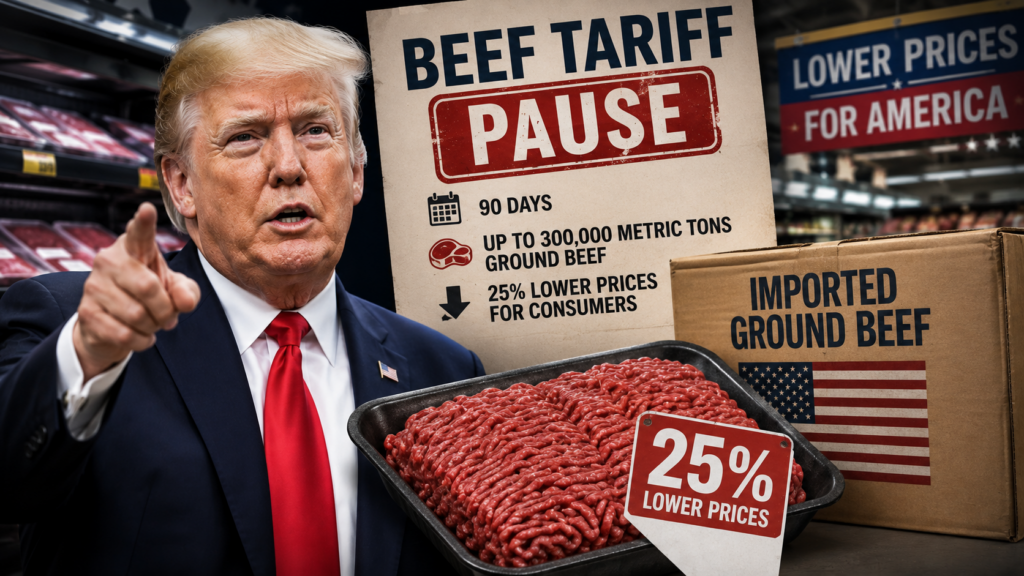
President Donald Trump is temporarily waiving higher beef tariffs on ground beef imports in an effort to bring down historically high prices for American consumers. The administration will allow up to 300,000 metric tons of ground beef to enter the United States over the next 90 days without the applicable out-of-quota tariff, while Trump says participating beef will be sold at 25% below current market prices.
What Happened
Trump announced the temporary tariff relief on August 21, saying the measure would increase the availability of ground beef while American ranchers work to rebuild the nation’s cattle herd.
According to a report by CBS News, the policy allows up to 300,000 metric tons of ground beef into the country for 90 days with no out-of-quota tariff.
Trump said foreign suppliers had committed to selling the beef at 25% below current market prices. The administration has not identified the countries or exporters involved in the agreement.
The White House is expected to formalize the policy through an executive order. ABC News reported that the order was expected within two weeks.
Why Trump Is Pausing Higher Beef Tariffs
Beef Prices Remain Elevated
The move comes as beef prices continue to rise faster than many other food categories.
CBS News reported that ground beef averaged $6.89 per pound in July, up 57% from five years earlier. Federal inflation data cited by the network showed ground beef prices were up 9% year over year in July, while steak prices increased 9.6%.
The U.S. cattle herd has also fallen sharply. The nation’s beef-cow herd stood at 28.5 million head in July, a record low for that month, according to figures cited by CBS.
Drought has reduced available pasture in some areas, increasing feed costs and putting additional pressure on ranchers and the domestic beef supply.
A Short-Term Supply Measure
The administration has characterized the tariff waiver as a temporary measure intended to fill a supply gap.
The White House says it is simultaneously working with American ranchers to expand domestic beef production and rebuild the national herd.
Trump described the arrangement as a way to lower prices now while giving the domestic cattle industry time to recover.
How the Beef Tariff Waiver Works
The temporary policy affects higher tariffs that apply when imports exceed existing quota limits.
Under the agreement, up to 300,000 metric tons of ground beef can enter the U.S. during the 90-day period without the additional out-of-quota tariff.
Trump has said the imported beef will be sold at a 25% discount from current market prices, although the administration has not yet provided details on how that discount will be enforced or passed through the supply chain.
The policy is expected to remain in place beyond the 2026 midterm elections, putting consumer food prices directly into the political spotlight.
Economists Question Whether Imports Can Lower Prices
The beef tariffs decision has drawn skepticism from some economists and agricultural analysts.
Reuters reported that the additional 300,000 metric tons represents only a small portion of total U.S. beef consumption. Some economists therefore question whether the temporary increase in imports will be large enough to significantly affect prices at the grocery-store level.
The U.S. cattle supply problem is also structural. Years of drought, higher feed costs and a shrinking herd mean that rebuilding domestic production will take time.
As a result, additional imports may increase available supply in the short term without solving the underlying shortage.
Ranchers Push Back
Cattle Industry Warns of Producer Harm
The temporary tariff relief has frustrated cattle producers and some Republican lawmakers who argue that increased imports could undermine American ranchers.
The National Cattlemen’s Beef Association has opposed policies that could increase foreign beef supplies at the expense of domestic producers. Reuters reported that cattle groups warned the move could slow herd rebuilding and reduce prices received by American ranchers.
Several Republican lawmakers from cattle-producing states have also criticized the policy.
Montana Sen. Tim Sheehy said the move could make it more difficult for American ranchers to rebuild the domestic herd. Nebraska Sen. Pete Ricketts similarly warned that increased imports could hurt farmers and ranchers in his state.
The criticism highlights a difficult policy balance for the administration: consumers want lower prices, while ranchers need adequate returns to justify expanding production.
Trump’s Broader Tariff Strategy
The decision represents a notable adjustment to the administration’s broader tariff strategy.
Trump has frequently used tariffs to encourage domestic production and protect U.S. industries, but the beef decision shows that the administration is also willing to temporarily reduce trade barriers when officials believe tariffs are contributing to higher consumer prices.
The approach differs from policies such as Trump administration drone tariffs, which are intended to strengthen domestic production and address strategic supply-chain concerns.
The administration’s economic agenda also includes long-term investments in domestic infrastructure, including Trump administration rail investment plans that aim to strengthen transportation capacity and economic connectivity.
Political Impact Ahead of the Midterms
Food affordability remains an important issue for American voters heading into the 2026 midterm elections.
The 90-day tariff waiver extends beyond the election, meaning the administration will have an opportunity to point to the policy as evidence of an effort to address grocery costs.
Whether consumers actually see meaningful reductions in ground beef prices will be the key test.
If prices remain high despite additional imports, the administration could face criticism from consumers. If prices fall, Trump could argue that the temporary tariff adjustment helped provide immediate relief while domestic cattle production recovers.
What Happens Next
The next step is formal implementation of the 90-day tariff waiver and further clarification about the foreign suppliers participating in the agreement.
The administration will also need to monitor whether the imported beef reaches consumers at the promised discount and whether additional supplies affect wholesale and retail prices.
Meanwhile, ranchers will continue watching cattle prices, herd-rebuilding conditions and the broader supply outlook.
The beef tariffs decision underscores the competing pressures facing the Trump administration as it tries to lower consumer prices without weakening American agriculture. The temporary import expansion may provide additional supply, but the longer-term solution depends on rebuilding the U.S. cattle herd and increasing domestic production. Whether Trump’s short-term approach can deliver meaningful savings without creating new problems for American ranchers will determine the ultimate impact of the policy.
Up to 300,000 metric tons can enter over 90 days without the higher out-of-quota tariff.
The administration says the move will increase supply and help lower high beef prices while the U.S. cattle herd recovers.