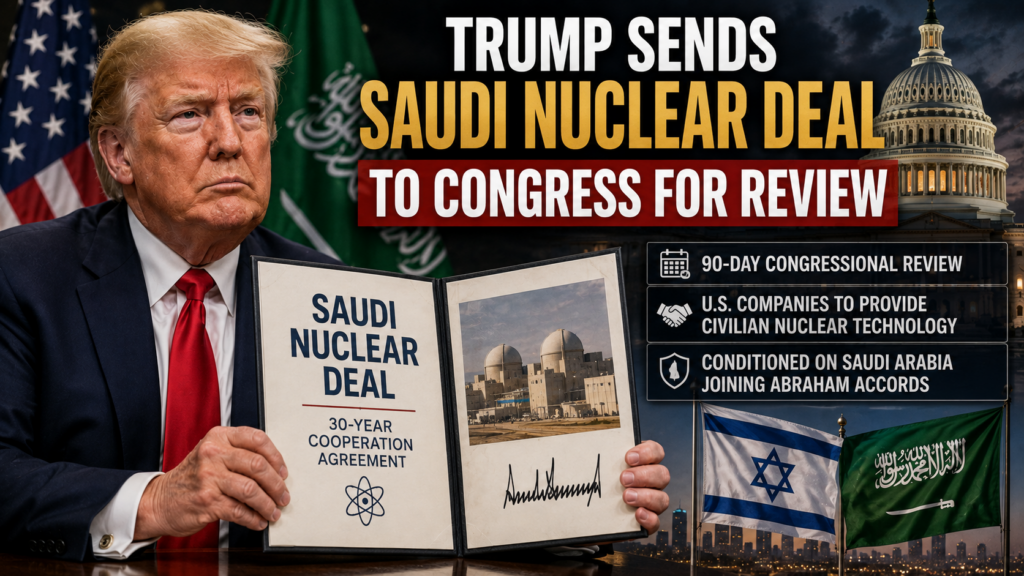
President Donald Trump has sent a proposed Saudi nuclear deal to Congress for review, starting a mandatory 90-session-day review of a 30-year agreement that would allow U.S. companies to provide civilian nuclear technology to Saudi Arabia.
According to a report by CNBC, the agreement would support Saudi Arabia’s civilian nuclear program and potentially lead to construction of AP1000 reactors, while Trump has said the pact will proceed only if Riyadh joins the Abraham Accords and normalizes relations with Israel.
What Happened
The Trump administration submitted the proposed nuclear cooperation agreement to Congress on Monday, August 24, beginning the review process required under the Atomic Energy Act.
The agreement was reached in July and would establish a framework for U.S. companies to export civilian nuclear technology to Saudi Arabia.
The proposed arrangement is expected to benefit Westinghouse, which would supply AP1000 reactor technology. Westinghouse is jointly owned by Canada-based Cameco and Brookfield Asset Management.
Trump has separately made clear that Saudi Arabia’s participation in the Abraham Accords is a condition for moving forward with the agreement.
Key Details of the Saudi Nuclear Deal
30-Year Nuclear Cooperation Agreement
The proposed accord would remain in effect for 30 years and facilitate U.S. participation in Saudi Arabia’s nuclear energy development.
The plan includes potential construction of AP1000 reactors, with the project potentially worth tens of billions of dollars.
Congress now has 90 days of continuous session to review the agreement. Unless lawmakers formally object, the accord can proceed under the statutory review framework.
Trump could veto a congressional rejection, meaning lawmakers would need a two-thirds majority to override such a veto.
The Israel Normalization Condition
Trump has tied the nuclear agreement to Saudi Arabia joining the Abraham Accords, the U.S.-brokered framework for normalizing relations between Israel and Arab and Muslim-majority countries.
The condition adds a major diplomatic component to what would otherwise be a civilian nuclear energy agreement.
Saudi Arabia, however, has maintained that normalization with Israel depends on a credible path toward the establishment of an independent Palestinian state. That position has hardened since the Gaza war began in 2023.
The diplomatic dispute creates uncertainty over whether the nuclear agreement can ultimately move forward on the terms Trump has outlined.
Proliferation Concerns
The nuclear agreement has drawn criticism from nonproliferation experts and some Democratic lawmakers because it does not include a permanent prohibition on uranium enrichment or nuclear waste reprocessing.
Both activities can be used in civilian nuclear programs but can also provide pathways toward developing material needed for a nuclear weapon.
The United Arab Emirates accepted restrictions on enrichment and reprocessing in its 2009 civil nuclear agreement with the United States, a framework often described as the “gold standard” for nonproliferation safeguards.
The Saudi agreement instead proposes a U.S.-built and operated enrichment facility that would initially undergo a two-year feasibility study.
Matthew Kroenig, a senior fellow at the Atlantic Council, said in July that he expected the study could ultimately recommend that Saudi Arabia rely on imported nuclear fuel-cycle services rather than developing its own enrichment capability.
Experts Warn of Wider Nuclear Risks
Nonproliferation experts have expressed concern that weakening restrictions on enrichment or reprocessing could establish a precedent in a region already facing severe security tensions.
Erin Dumbacher, a Stanton nuclear security senior fellow at the Council on Foreign Relations, said the approach differs from the stricter nonproliferation measures the United States has traditionally required in civilian nuclear cooperation agreements.
The concern is that expanded access to nuclear materials without comparable safeguards could increase the possibility of proliferation, accidents and security incidents.
Saudi Arabia has also previously indicated that it could seek a nuclear weapons capability if Iran develops one, adding another layer of strategic concern to the agreement.
The issue comes against the backdrop of heightened U.S. pressure on Tehran, including U.S. sanctions policy toward Iran.
Political and Economic Impact
The agreement could deepen U.S.-Saudi strategic and economic ties while creating a substantial commercial opportunity for American nuclear companies.
For Saudi Arabia, civilian nuclear power could help diversify its energy system and support long-term economic development.
For Washington, the agreement offers an opportunity to expand U.S. influence over Saudi Arabia’s nuclear infrastructure and strengthen bilateral relations with a key Middle Eastern partner.
But the political risks are considerable.
Democratic lawmakers and arms-control advocates are likely to scrutinize whether the agreement provides sufficient safeguards against the possibility that civilian nuclear technology could eventually contribute to a weapons program.
The debate could also become intertwined with broader U.S. policy toward nuclear proliferation and international security. Washington has increasingly used economic and legal measures against actors it considers threats to U.S. interests, including recent U.S. sanctions targeting international actors.
Saudi Arabia, Israel and Iran
The agreement sits at the intersection of three major Middle Eastern policy issues: Saudi-Israeli normalization, Iran’s nuclear ambitions and the future of civilian nuclear energy in the region.
Saudi Arabia has sought security and strategic benefits from closer cooperation with Washington, while also demanding progress on Palestinian statehood before establishing formal relations with Israel.
At the same time, Riyadh has warned that it would pursue its own nuclear weapons capability if Iran obtains one.
That dynamic has raised concerns that a Saudi civilian nuclear program could become part of a wider regional nuclear competition if safeguards are not sufficiently strong.
What Happens Next
Congress now has 90 continuous session days to review the proposed agreement.
Lawmakers can object through the process provided under the Atomic Energy Act. If Congress rejects the agreement, Trump could veto the congressional resolution, requiring a two-thirds majority to override him.
The administration will therefore face pressure to explain how the agreement would prevent nuclear proliferation while still allowing Saudi Arabia to develop civilian nuclear power.
The two-year feasibility study on enrichment will also be closely watched because its findings could determine whether Saudi Arabia eventually receives a domestic fuel-cycle capability.
Broader Implications
The Saudi nuclear deal represents a major test of Trump’s strategy of combining energy cooperation with broader Middle Eastern diplomacy.
A successful agreement could create a long-term U.S. commercial role in Saudi Arabia’s nuclear sector and deepen the strategic relationship between Washington and Riyadh. But questions over uranium enrichment, nuclear reprocessing and Saudi-Israeli normalization could complicate the pact before Congress completes its review.
The outcome could influence not only U.S.-Saudi relations but also the future of nuclear nonproliferation standards across the Middle East. As Congress considers the agreement, lawmakers will have to weigh economic opportunities and strategic alliances against the risks of expanding sensitive nuclear capabilities in an already volatile region.
It is a proposed 30-year U.S.-Saudi civil nuclear agreement that would allow U.S. companies to provide nuclear technology and support reactor development.
Critics say the pact does not permanently prohibit uranium enrichment or nuclear reprocessing, raising concerns about future nuclear proliferation.