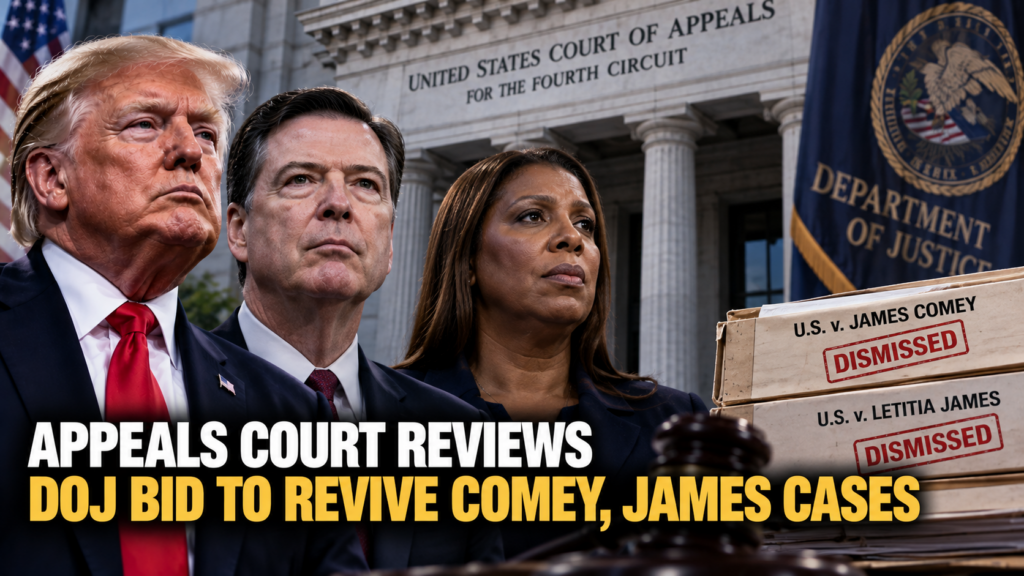
The U.S. Court of Appeals for the Fourth Circuit on Tuesday considered the Justice Department’s effort to revive criminal cases against former FBI Director James Comey and New York Attorney General Letitia James, putting the legality of a Trump administration prosecutor’s appointment at the center of the dispute.
According to a report by Reuters, the Justice Department is asking the appeals court to reverse a lower-court decision that dismissed both cases after finding that prosecutor Lindsey Halligan had not been lawfully appointed as interim U.S. attorney.
What Happened
The cases against Comey and James were dismissed last year after U.S. District Judge Cameron McGowan Currie ruled that Halligan’s appointment as interim U.S. attorney for the Eastern District of Virginia violated federal law. The Justice Department is now challenging that ruling before the Fourth Circuit in Richmond, Virginia.
The appellate dispute is focused primarily on whether former Attorney General Pam Bondi had authority to appoint Halligan after Eric Siebert, the previous U.S. attorney, had already served the statutory period allowed for an interim appointment.
The issue is significant because federal law generally requires U.S. attorneys to receive Senate confirmation, while allowing the attorney general to temporarily fill vacancies under specified circumstances.
The Cases Against Comey and James
Comey was indicted on allegations that he lied to Congress about whether he had authorized leaks to news organizations. He has denied wrongdoing.
James was charged with bank fraud over allegations that she misrepresented her use of a Virginia property. She has also denied wrongdoing.
Both defendants have argued that the prosecutions were retaliatory and connected to President Donald Trump’s broader disputes with them. Reuters reported that the arguments over those claims had not been resolved when the cases were dismissed on the appointment issue.
Trump previously fired Comey as FBI director during his first presidential term while Comey was overseeing an investigation into possible ties between Trump’s 2016 campaign and Russia. James, meanwhile, successfully pursued a civil fraud case against Trump and his family business after his first term.
Why Lindsey Halligan’s Appointment Matters
Halligan, a Trump ally and former personal lawyer, was installed after Siebert declined to move forward with the prosecutions. According to reporting from The Washington Post, Halligan had no previous prosecutorial experience and obtained the indictments after appearing before grand juries herself.
The lower court concluded that Halligan could not lawfully serve another interim term because Siebert had already completed the permitted period in the position.
The Justice Department disputes that interpretation and argues that its authority to make temporary U.S. attorney appointments is broader than the lower court determined.
Broader DOJ Appointment Dispute
The Comey and James cases are part of a wider legal dispute over the Trump administration’s use of temporary U.S. attorneys.
Federal courts have questioned similar appointments in several jurisdictions, including New Jersey, Nevada, Los Angeles, New Mexico and Albany, New York. Some of those decisions have already been upheld on appeal.
The Justice Department has argued that allowing those rulings to stand could affect temporary leadership arrangements at numerous U.S. attorney’s offices around the country.
The department also recently asked the Supreme Court to consider a related dispute involving the appointment of Sigal Chattah as interim U.S. attorney in Nevada.
What Happens Next
The Fourth Circuit is expected to issue its ruling after reviewing the arguments presented by the Justice Department and attorneys for Comey and James. The decision could influence how the administration and future presidents use temporary U.S. attorney appointments without Senate confirmation.
Even if the Justice Department succeeds, however, that would not necessarily mean the Virginia prosecutions would proceed to trial. The lower court previously determined that the statute of limitations had expired on the Comey case, an issue the Justice Department disputes. Other unresolved legal challenges to both prosecutions could also remain.
The appeals court’s handling of the DOJ Comey James cases therefore extends beyond the two defendants. The ruling could help define the limits of executive authority over temporary federal prosecutors and shape how appointment disputes are handled across the Justice Department.
Related Reading
Trump Moves to Reshape Mail-In Voting Rules Ahead of 2026 Elections
Kushner Says Trump Seeks Long-Term Peace in Ukraine
The cases were dismissed after a judge ruled that prosecutor Lindsey Halligan had not been lawfully appointed as interim U.S. attorney.
The Fourth Circuit is reviewing whether the Justice Department had legal authority to appoint Halligan and whether the cases should be revived.