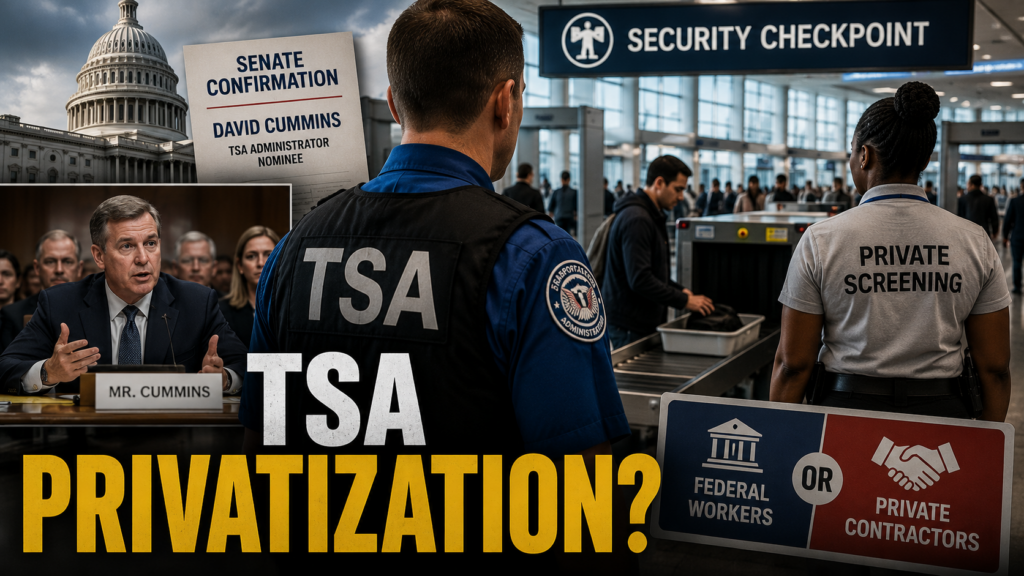
Transportation Security Administration (TSA) employees are raising concerns about the future of airport security screening as President Donald Trump’s nominee to lead the agency faces Senate confirmation. Workers are seeking assurances that proposals to expand private airport screening will not threaten federal jobs or alter the TSA’s role in securing U.S. airports.
According to a report by WBUR, TSA workers in New England are asking for greater clarity from nominee David Cummins regarding the administration’s plans to expand private security screening under TSA oversight.
What Happened?
David Cummins, President Trump’s nominee to lead the Transportation Security Administration, recently appeared before a Senate committee where lawmakers questioned him about the future of airport security operations.
Cummins previously served as a senior vice president at government contractor Serco and has experience working in the private sector.
His nomination has drawn attention because the Trump administration has expressed support for expanding the Screening Partnership Program (SPP), which allows airports to contract with private companies to conduct passenger screening while remaining under TSA supervision.
Although the program has existed since 2004, only a small number of U.S. airports currently participate.
TSA Workers Want More Clarity
Union leaders representing TSA employees say they remain uncertain about how expanded privatization could affect the federal workforce.
Mike Gayzagian, president of AFGE Local 2617, which represents TSA workers across New England, said employees want clearer commitments from Cummins before the Senate completes his confirmation process.
While Cummins told senators that the existing Screening Partnership Program is “pro-worker” and would not threaten current TSA employees, union representatives remain skeptical that workforce protections will remain unchanged if privatization expands.
Workers argue that any significant increase in private screening contracts could eventually reduce opportunities for federal security officers.
Why the Trump Administration Supports Privatization
Supporters of expanding private screening argue that contracting security operations can improve operational flexibility while maintaining federal oversight.
Under the Screening Partnership Program, private companies perform passenger screening using TSA standards, procedures, and supervision.
Advocates also point to previous federal government shutdowns, during which TSA employees continued working without immediate pay. Some policymakers believe greater reliance on private contractors could help airports avoid staffing disruptions during future funding lapses.
The proposal aligns with broader Trump administration efforts to reform federal operations, including new federal employee discipline rules aimed at increasing management flexibility across government agencies.
Political and Operational Impact
Airport security remains one of the federal government’s most visible public safety responsibilities, making any proposed structural changes politically significant.
Supporters argue that expanding private participation could improve efficiency without reducing security standards because TSA would continue setting screening requirements and overseeing contractor performance.
Critics, however, worry that greater privatization could weaken workforce stability, reduce employee morale, and gradually shift responsibility away from experienced federal personnel.
The debate comes as the administration continues reviewing several homeland security initiatives, including Trump’s election security measures designed to strengthen national security and critical infrastructure protections.
What Happens Next?
David Cummins’ Senate confirmation process will continue in the coming weeks, with lawmakers expected to further examine his plans for the TSA and the future of airport screening.
If confirmed, Cummins will oversee an agency responsible for protecting millions of airline passengers each day while balancing workforce concerns, operational efficiency, and national security priorities.
For now, TSA employees are seeking more definitive answers about whether expanded privatization will remain limited or become a larger part of the administration’s long-term strategy for airport security.
They worry that expanding private airport screening could eventually reduce federal TSA jobs despite assurances that current employees will be protected.
It is a federal program allowing airports to hire private security contractors while TSA continues to regulate, oversee, and enforce screening standards.