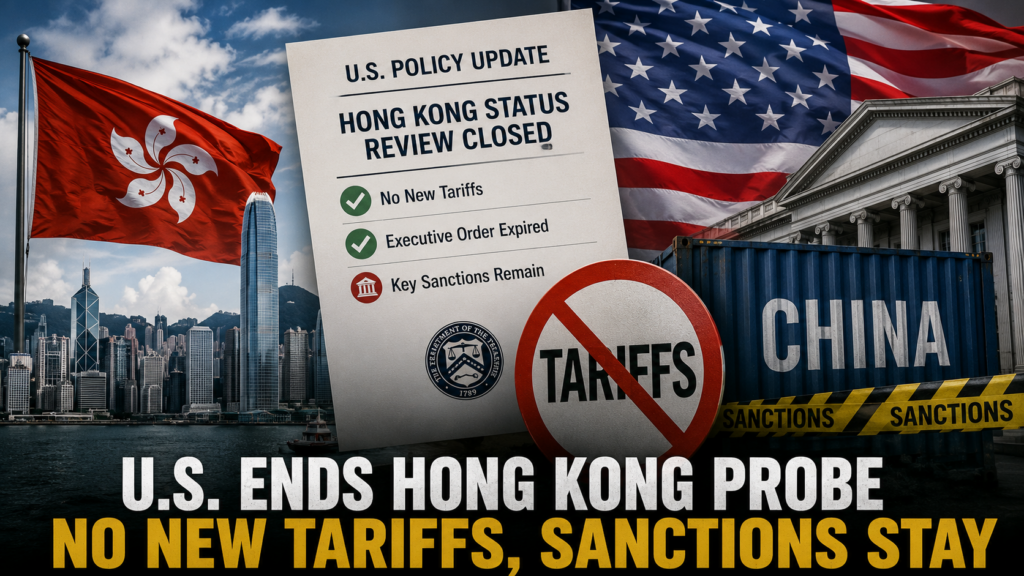
The United States has ended a long-running review of Hong Kong’s special legal status by allowing a Trump-era executive order to expire without imposing additional tariffs. While the move partially restores aspects of Hong Kong’s status, the U.S. will continue enforcing major sanctions and legal restrictions related to China’s actions in the territory.
According to a report by The Japan Times, citing Reuters, the decision has been welcomed by China as a positive step in improving U.S.-China relations following recent trade negotiations.
What Happened?
The U.S. Treasury Department announced that it would not renew the national emergency declared under an executive order signed by President Donald Trump on July 14, 2020.
The order was originally introduced after Beijing imposed the Hong Kong National Security Law, which Washington argued undermined the city’s autonomy. It suspended Hong Kong’s special treatment under U.S. law and authorized sanctions against officials involved in implementing the security legislation.
Although the executive order has now expired, the Treasury Department clarified that key sanctions remain in place through other federal laws.
Key Details of the Policy Change
The Treasury said the expiration of the executive order does not affect restrictions imposed under the Hong Kong Human Rights and Democracy Act of 2019 or the Hong Kong Autonomy Act of 2020.
Officials explained that many of the measures under the executive order duplicated sanctions already authorized under those laws. As a result, 38 of the 49 individuals previously sanctioned under the executive order will continue facing U.S. sanctions.
According to the Treasury, allowing the order to lapse is part of a broader sanctions modernization effort aimed at making enforcement more efficient while avoiding overlapping penalties.
Hong Kong’s Special Status
Before 2020, Hong Kong enjoyed special economic and trade treatment separate from mainland China under U.S. law.
That status reflected the “one country, two systems” framework established when Britain transferred Hong Kong to Chinese sovereignty in 1997. It allowed the territory to maintain separate customs treatment and distinct economic privileges despite being part of China.
Following Beijing’s implementation of the National Security Law in 2020, the Trump administration revoked many of those privileges, citing concerns that Hong Kong no longer maintained sufficient autonomy.
The latest decision partially reverses that approach by ending the national emergency declaration while preserving many existing sanctions.
China Welcomes the Decision
China’s Ministry of Commerce praised Washington’s decision, describing it as a constructive step toward improving bilateral relations.
Chinese officials said the policy adjustment aligns with understandings reached during recent trade negotiations between Beijing and Washington.
The ministry also urged the United States to respect China’s sovereignty over Hong Kong, restore normal economic and trade exchanges with the territory, and continue strengthening overall U.S.-China relations.
The announcement follows recent diplomatic engagement between President Donald Trump and Chinese President Xi Jinping, who met in Beijing earlier this year. Trump has also invited Xi to visit the White House in September.
The development comes as the administration continues shaping broader trade policy, including airplane import tariffs affecting international commerce.
Political and Economic Impact
The expiration of the executive order does not immediately restore Hong Kong’s previous trade advantages, as many tariffs and export controls remain in place under separate legal authorities.
Businesses trading with Hong Kong are therefore unlikely to see immediate changes to customs treatment or technology export restrictions.
Supporters of the National Security Law argue it restored stability after the large-scale protests of 2019. Critics maintain the law significantly reduced civil liberties and political freedoms that were promised when Hong Kong returned to Chinese rule.
The policy shift also reflects ongoing efforts by the Trump administration to recalibrate international relations while maintaining pressure in areas considered critical to national security. Similar efforts have been evident in Trump’s election security measures, which emphasize safeguarding U.S. strategic interests.
What Happens Next?
Although the national emergency has ended, the United States continues to enforce substantial sanctions against individuals linked to Hong Kong’s security crackdown.
Future changes to Hong Kong’s economic status will likely depend on broader U.S.-China diplomatic relations, trade negotiations, and developments surrounding the territory’s governance.
For now, the decision represents a limited policy adjustment rather than a full restoration of Hong Kong’s previous special status, signaling that Washington remains committed to balancing diplomatic engagement with continued sanctions enforcement.
No. The United States allowed one executive order to expire but kept major sanctions and legal restrictions in place under other federal laws.
China said the move represents a positive step for U.S.-China relations and encouraged further restoration of normal trade and economic exchanges.