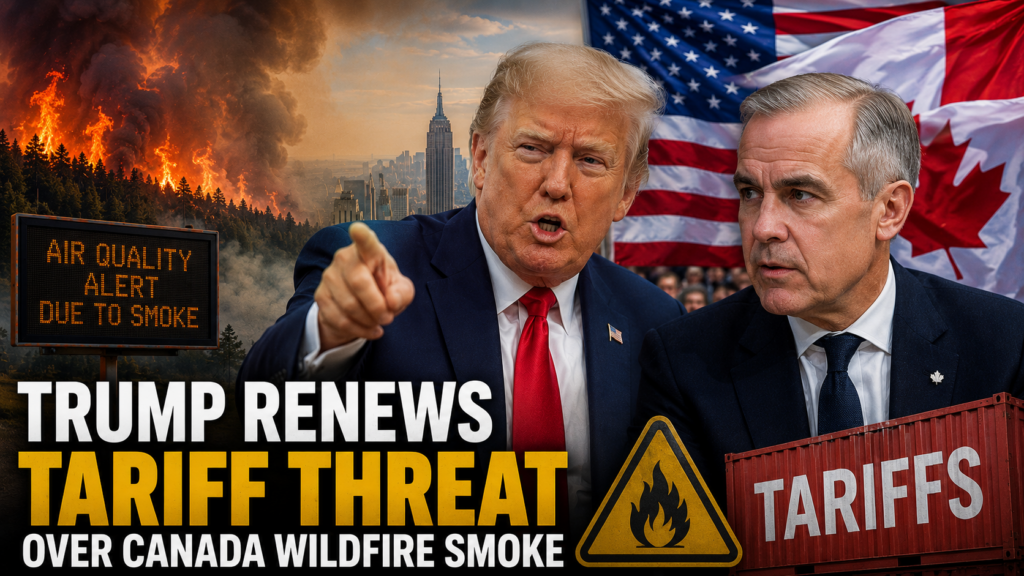
President Donald Trump has again threatened tariffs against Canada over wildfire smoke drifting into the United States, despite meeting Canadian Prime Minister Mark Carney during the FIFA World Cup final in New Jersey. Trump said the ongoing fires are harming U.S. air quality and suggested Canada could face financial consequences if the problem continues.
According to a report by CTV News, Trump reiterated his criticism of Canada’s wildfire management after attending the World Cup final alongside Carney and other world leaders.
What Happened?
After watching the FIFA World Cup final with Prime Minister Mark Carney on Sunday, Trump spoke with reporters at Joint Base Andrews, where he again criticized the impact of Canadian wildfire smoke on the United States.
Trump said he maintains a good relationship with Carney but argued that Canada must do more to stop the wildfires.
He claimed smoke from the fires has “poisoned” American air and suggested the United States could seek damages from Canada or impose tariffs if the situation continues.
Although Trump did not outline a legal mechanism for such tariffs, his remarks echoed similar statements made earlier this month.
Canadian Wildfires Continue to Affect U.S. Air Quality
Smoke from wildfires burning across Canada has triggered air quality alerts in several U.S. states, including Michigan, Ohio, Illinois, Indiana, and New York.
The fires have also affected parts of Ontario, prompting public health warnings and reducing air quality across large portions of North America.
Last week, Trump accused Canada of “wilful negligence,” arguing that inadequate forest management and insufficient debris removal have contributed to worsening wildfire conditions that affect both countries.
The comments come as the administration continues to examine trade-related policies, including airplane import tariffs that have drawn attention from U.S. trading partners.
Canada’s Response
Prime Minister Mark Carney has downplayed Trump’s criticism, saying Canada continues investing in clean energy and wildfire resilience while suggesting the United States is moving in the opposite direction on climate-related policies.
Ontario Premier Doug Ford also rejected Trump’s comments, reminding Americans that Canada has repeatedly provided emergency assistance during major U.S. natural disasters.
Ford pointed to Canada’s support for California during its devastating wildfires last year, saying neighboring countries should cooperate during emergencies rather than exchange threats.
He emphasized that Canada would continue assisting the United States when needed, regardless of political disagreements.
Political and Trade Implications
Trump’s latest remarks add another layer of uncertainty to U.S.-Canada trade relations.
While no new tariffs have been announced, the comments suggest wildfire management could become part of broader discussions surrounding cross-border economic and environmental issues.
Legal experts note that it remains unclear what authority the administration could use to impose tariffs based solely on transboundary wildfire smoke.
The dispute also comes as the Trump administration continues implementing broader domestic and trade initiatives, including Trump’s election security measures that emphasize protecting national interests and critical infrastructure.
What Happens Next?
Canadian wildfire season remains active, meaning smoke could continue affecting air quality across parts of the United States throughout the summer.
Whether the Trump administration follows through on its tariff threat remains uncertain, especially given the lack of a clearly defined legal basis for such action.
For now, both governments continue balancing diplomatic engagement with ongoing disagreements over wildfire management, environmental policy, and cross-border trade. The issue is likely to remain part of broader discussions between Washington and Ottawa as wildfire conditions evolve.
Trump argued that wildfire smoke from Canada is harming U.S. air quality and suggested Canada could face tariffs or financial penalties.
Prime Minister Mark Carney defended Canada’s environmental efforts, while Ontario Premier Doug Ford emphasized Canada’s history of helping the U.S. during natural disasters.