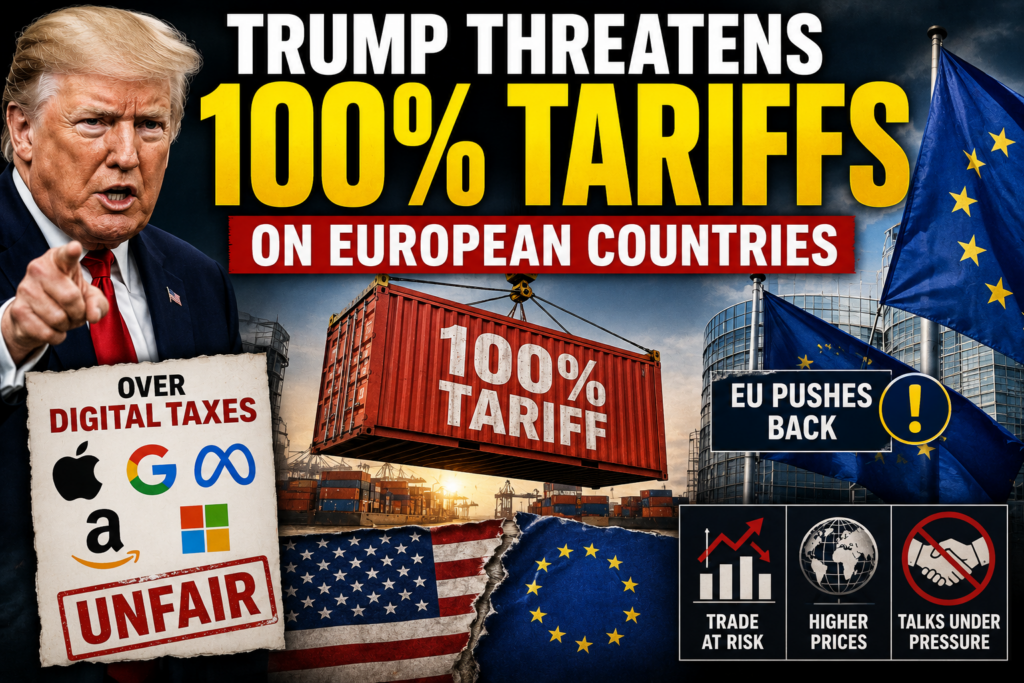
President Donald Trump has warned that the United States will impose a 100% tariff on imports from any European country that introduces or expands digital services taxes targeting American technology companies. The warning marks the latest escalation in Trump’s trade agenda as the U.S. and European Union continue negotiating broader economic agreements. According to a report by Euractiv, Trump said any country adopting such taxes would face immediate tariffs that would override existing trade agreements.
What Happened
President Trump announced on Truth Social that countries imposing digital services taxes on U.S. technology companies would be met with an immediate 100% tariff on all goods exported to the United States.
The president argued that several European nations are moving closer to implementing or expanding taxes on American digital businesses, calling the measures unfair to U.S. companies. Trump also stated that the proposed tariffs would supersede any previous trade agreements with the affected country.
The announcement adds another layer of uncertainty to U.S.-EU trade relations as both sides continue negotiating economic policies following months of tariff disputes.
Why Digital Services Taxes Have Become a Trade Dispute
Several European countries have introduced digital services taxes aimed at large multinational technology companies that generate significant revenue from users within their borders.
France, Spain, and Italy currently impose a 3% digital services tax on qualifying companies, while the United Kingdom applies a 2% levy to large online platforms, search engines, and digital marketplaces that meet specific revenue thresholds.
Many of the companies affected by these taxes, including Apple, Google, Meta, Amazon, and Microsoft, are headquartered in the United States. Trump has repeatedly argued that these taxes unfairly target American businesses and reduce their global competitiveness.
European Union Responds
European Union officials quickly rejected Trump’s latest tariff threat.
A spokesperson for the European Commission said digital services taxes are legitimate domestic tax policies that apply to all qualifying companies regardless of where they are headquartered. The EU also warned that it would respond decisively if the United States imposed new tariffs targeting member states.
The statement highlights the possibility of another round of retaliatory trade measures if both sides fail to resolve the dispute through ongoing negotiations.
Economic and Political Impact
The proposed 100% tariff could significantly increase trade tensions between the United States and the European Union, one of America’s largest trading partners.
Businesses on both sides of the Atlantic could face higher import costs, supply chain disruptions, and greater uncertainty if additional tariffs are implemented. Technology companies may also find themselves at the center of broader disagreements over taxation, digital regulation, and international trade policy.
The announcement comes as the Trump administration continues pursuing an aggressive trade strategy designed to protect American industries and pressure foreign governments during negotiations.
Readers interested in the administration’s broader economic agenda can also explore Trump’s economic approval rating and how economic policies continue to shape public opinion.
Trade Negotiations Continue
Trump’s warning arrives just days before an important July 4 deadline tied to ongoing U.S.-EU trade discussions.
Earlier this year, the United States and the European Union reached a trade agreement that capped most tariffs on European imports at 15%. However, digital services taxes were not included in those negotiations and remain one of the most contentious issues between the two economies.
The administration’s latest position suggests digital taxation could become a major obstacle to future trade agreements if neither side is willing to compromise.
As trade policy continues to evolve, other areas of Trump’s international agenda are also drawing attention, including Trump’s Greenland strategy and broader discussions surrounding U.S. geopolitical priorities.
What Happens Next
European governments are expected to continue evaluating digital tax policies while monitoring the White House’s next steps. At the same time, U.S. trade officials are likely to continue negotiations with European counterparts in an effort to avoid another large-scale tariff dispute.
Whether President Trump ultimately follows through on his warning may depend on the outcome of those negotiations and any future decisions by European governments regarding digital taxation.
Conclusion
President Trump’s threat to impose 100% tariffs on European countries adopting digital services taxes underscores the growing importance of technology regulation in global trade policy. As negotiations between the United States and the European Union continue, the dispute highlights the challenges of balancing tax policy, international commerce, and diplomatic relations. Any escalation could have significant consequences for businesses, consumers, and the broader global economy.
Trump argues that digital services taxes unfairly target American technology companies and has warned countries imposing them could face 100% tariffs on exports to the U.S.
France, Spain, Italy, and the United Kingdom have implemented digital services taxes targeting large multinational technology companies that generate revenue within their markets.