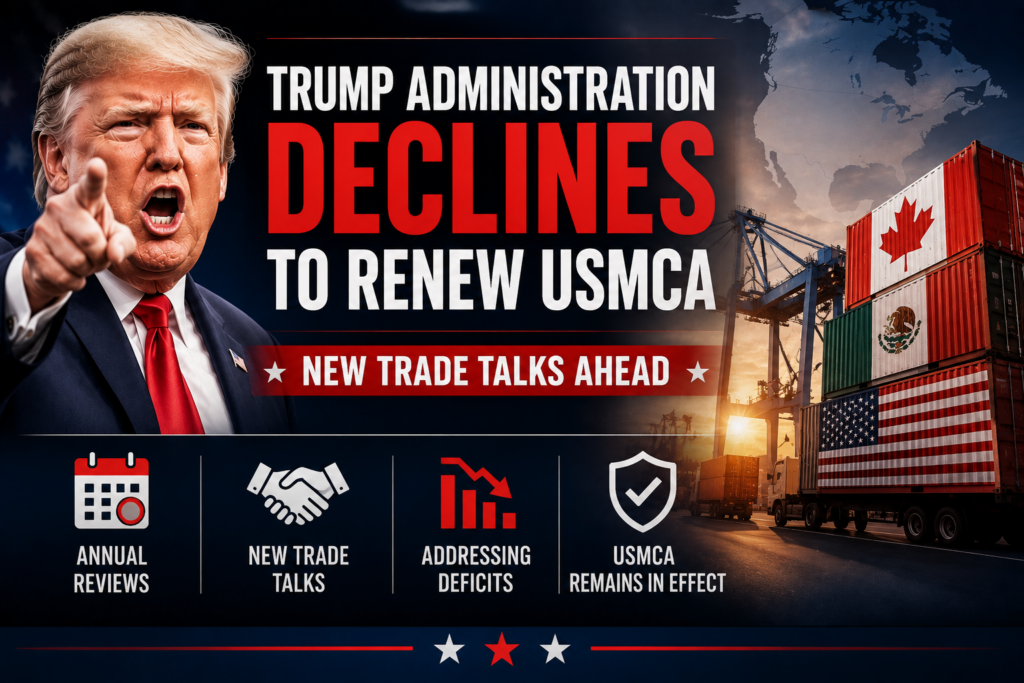
The Trump administration has decided not to renew the United States-Mexico-Canada Agreement (USMCA), opting instead to begin annual reviews that could lead to significant renegotiation of North America’s primary trade pact. The decision comes at the treaty’s first scheduled review deadline and reflects President Donald Trump’s renewed focus on reducing U.S. trade deficits with Canada and Mexico.
According to a report by CNBC, the administration chose not to extend the agreement for another 16-year term, triggering a review process that allows the three countries to negotiate changes while keeping the trade agreement in force.
What Happened
July 1 marked the first review deadline established under the USMCA, the trade agreement negotiated during President Trump’s first term to replace the North American Free Trade Agreement (NAFTA).
Rather than renewing the agreement for another 16 years, the Trump administration announced it would conduct annual reviews, allowing the United States to seek revisions before committing to a longer extension.
A senior administration official said President Trump declined to “rubber stamp” the agreement without addressing what the administration views as unresolved trade issues.
Although the decision means the USMCA remains in effect, it also opens the door to renegotiating key provisions over the coming years.
Why Trump Wants to Renegotiate USMCA
Administration officials said President Trump’s primary concern is the United States’ ongoing trade deficits with Canada and Mexico.
The White House argues that despite the original agreement modernizing North American trade rules, additional reforms are needed to better protect U.S. industries and workers.
U.S. Trade Representative Jamieson Greer said the administration will continue engaging both Canada and Mexico to address what it considers shortcomings in the current agreement.
The decision follows months of escalating trade tensions, including tariffs imposed by the Trump administration on several trading partners as part of its broader effort to reshape global trade relationships.
Readers can also learn more about Trump’s digital tax tariff dispute with Europe, another example of the administration’s evolving international trade strategy.
From “Best Trade Deal” to Renegotiation
When the USMCA took effect in July 2020, President Trump described it as “the fairest, most balanced, and beneficial trade agreement we have ever signed into law.”
However, his position has shifted during his second term.
In June, Trump publicly questioned whether the agreement should be renewed, arguing that Canada and Mexico depend more heavily on access to the U.S. market than the United States depends on them.
He also repeated longstanding concerns about persistent trade imbalances and called for trading partners to offer more favorable terms for American businesses.
Talks With Canada and Mexico Continue
The annual review process creates an opportunity for all three countries to negotiate updates without immediately replacing the existing agreement.
The United States and Mexico have already begun bilateral discussions expected to continue beyond the July 1 deadline.
Negotiations with Canada have not yet formally begun.
Unless one of the three countries withdraws from the agreement, the USMCA will remain in force while annual reviews continue.
Economic and Political Impact
The administration’s decision introduces a new level of uncertainty for businesses that rely on stable North American supply chains.
Manufacturers, agricultural exporters, and automotive companies will closely monitor upcoming negotiations for potential changes involving tariffs, rules of origin, and market access.
Supporters argue renegotiation provides an opportunity to strengthen America’s competitive position and reduce trade deficits.
Critics warn that prolonged uncertainty could discourage investment and complicate cross-border commerce throughout North America.
The administration’s broader economic agenda also includes pursuing new bilateral trade partnerships. Readers may also be interested in Trump’s proposed trade agreement with India as the White House expands negotiations beyond North America.
What Happens Next
The USMCA will remain in effect while annual reviews begin under the agreement’s review mechanism.
The Trump administration is expected to seek revisions addressing trade deficits and other economic priorities, while Canada and Mexico prepare for negotiations over the future of North America’s largest free trade agreement.
The outcome of those discussions could shape regional trade policy for years to come, influencing investment decisions, manufacturing supply chains, and economic cooperation across the United States, Canada, and Mexico.
1. Did the Trump administration end the USMCA?
No. The agreement remains in effect, but the administration declined to renew it for another 16-year term, triggering annual reviews and potential renegotiations.
The administration says it wants to address trade deficits with Canada and Mexico and revise provisions it believes no longer serve U.S. economic interests.