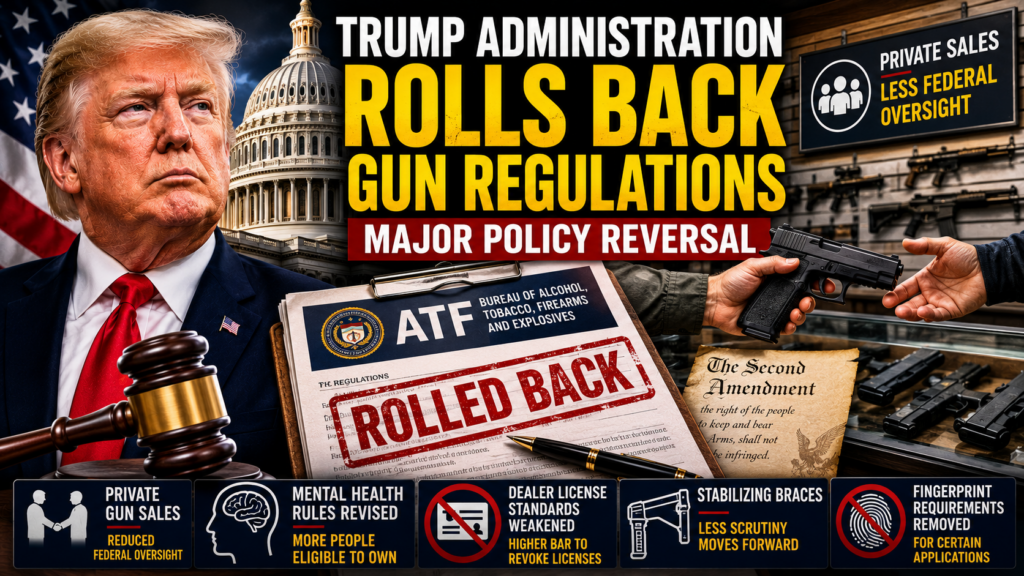
The Trump administration is reversing dozens of federal firearms regulations, including rules governing private gun sales, mental health-related firearm restrictions, and licensing requirements for gun dealers. The sweeping changes mark one of the most significant shifts in federal gun policy since President Donald Trump returned to office and have reignited the national debate over gun rights and public safety.
According to a report by The Philadelphia Inquirer, the administration is eliminating more than three dozen regulations enforced by the Bureau of Alcohol, Tobacco, Firearms and Explosives (ATF), arguing that many Biden-era rules placed unnecessary burdens on lawful gun owners and firearms businesses.
What Happened
The regulatory rollback affects several major firearm policies implemented during the Biden administration following a series of high-profile mass shootings.
Among the proposed changes are:
- Ending enhanced oversight of certain private firearm sales.
- Raising the legal standard required to revoke a federal firearms dealer’s license.
- Restoring firearm eligibility for some individuals previously restricted because of mental health or financial guardianship.
- Eliminating additional scrutiny of stabilizing braces used with firearms.
- Removing fingerprinting requirements for certain firearms-related applications.
The administration says these changes are intended to restore protections for Second Amendment rights while improving regulatory clarity for lawful gun owners and licensed firearms dealers.
Key Changes to Federal Gun Policy
Private Gun Sales Face Less Federal Oversight
One of the most significant proposals would reverse a Biden-era rule expanding background check requirements for gun shows and certain private firearm transactions.
Supporters argue the previous regulation exceeded the federal government’s authority and created confusion for lawful sellers.
Gun control advocates, however, warn that reducing oversight could make it easier for prohibited buyers to obtain firearms through private transactions.
Mental Health Reporting Rules Are Being Revised
The administration is also proposing changes affecting individuals with certain mental health histories.
Under the proposal, individuals who voluntarily received mental health treatment or require financial assistance managing their affairs would no longer automatically lose the ability to purchase firearms.
Those who have been involuntarily committed to a mental health institution would remain prohibited under federal law.
ATF’s own regulatory analysis acknowledged that expanding firearm eligibility could increase public safety risks in some circumstances, including the possibility of violent incidents.
Trump Administration Says Rules Protect Constitutional Rights
The White House said the regulatory changes reflect President Trump’s longstanding commitment to protecting Americans’ Second Amendment rights.
Officials argued that many firearm regulations enacted under former President Joe Biden were implemented through executive agencies instead of Congress.
The administration has also directed federal agencies to review policies that may infringe upon constitutional rights. Earlier this year, the Justice Department announced additional reviews of federal firearm regulations while continuing broader legal initiatives involving constitutional authority and federal enforcement. Readers can also learn more about the administration’s legal agenda in the Supreme Court ruling on Trump’s immigration policy.
Critics Warn About Public Safety Risks
Gun violence prevention organizations strongly criticized the proposed changes.
Kris Brown, president of the Brady Campaign to Prevent Gun Violence, argued the rollback significantly weakens ATF’s oversight capabilities and could reverse years of progress in reducing illegal firearm sales.
Former ATF officials also expressed concern that raising the threshold for revoking firearms dealer licenses may allow businesses with repeated violations to continue operating.
The administration’s own analyses accompanying several proposed rules acknowledged potential public safety concerns, particularly regarding stabilizing braces and expanded firearm eligibility for certain individuals with mental health histories.
Firearms Industry Supports Regulatory Rollback
Firearms manufacturers and gun rights organizations largely welcomed the administration’s actions.
The National Shooting Sports Foundation said the changes provide much-needed regulatory certainty for businesses operating within federal law.
However, some gun rights advocates argue the administration should go even further by eliminating additional federal recordkeeping requirements for licensed firearms dealers.
Broader Shift Across Federal Agencies
The rollback extends beyond the ATF.
Several federal agencies have already modified firearm-related policies, including the Department of Veterans Affairs, which no longer automatically reports certain veterans requiring fiduciaries to the FBI’s background check system.
The Department of Health and Human Services has reduced funding for gun violence research, while the U.S. Postal Service has proposed easing long-standing restrictions on mailing handguns.
These developments reflect the administration’s broader effort to revisit policies enacted during the Biden administration. Readers may also be interested in Trump’s Religious Liberty Commission report, another initiative focused on reviewing federal policies affecting constitutional rights.
What Happens Next
Most of the proposed regulatory changes must complete the federal rulemaking process before taking effect, including public comment periods and final agency approval.
If implemented, the changes would represent one of the most extensive reversals of federal firearms regulations in recent years, reshaping the balance between gun rights, regulatory oversight, and public safety. The proposals are also expected to face legal challenges from gun control organizations and several states that support stricter firearm regulations.
The administration is proposing changes to private firearm sales, dealer licensing rules, mental health-related firearm restrictions, and several ATF enforcement policies.
Supporters say they strengthen Second Amendment rights, while critics argue they could weaken public safety and reduce oversight of firearm sales.