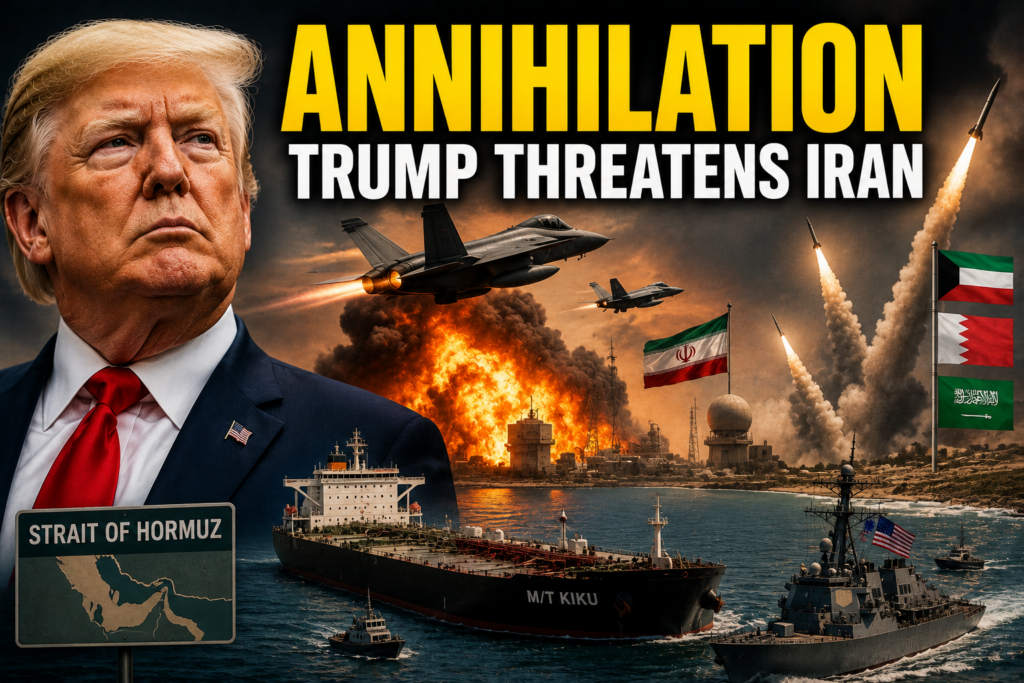
President Donald Trump has renewed his warning that Iran could face complete destruction if attacks on U.S. interests continue, following a new round of American military strikes against Iranian targets. The latest escalation comes after reported attacks on commercial shipping in the Strait of Hormuz and renewed missile and drone launches targeting Kuwait and Bahrain. According to a report by CNBC, the U.S. military launched retaliatory strikes against Iranian military facilities while regional tensions continued to rise despite an interim ceasefire agreement.
What Happened
President Trump announced that U.S. aircraft had struck Iranian missile and drone storage facilities, coastal radar sites, and other military infrastructure after Iran allegedly violated a ceasefire agreement through new attacks on commercial shipping in the Strait of Hormuz.
In a post on Truth Social, Trump warned that if Iran continued its actions, the United States could be forced to “militarily complete the job” it had already begun, adding that the Islamic Republic “will no longer exist” if such action becomes necessary.
The U.S. Central Command later confirmed that American fighter aircraft targeted ten Iranian military locations near the Strait of Hormuz in response to a drone strike on the Panamanian-flagged oil tanker M/T Kiku, which was carrying more than two million barrels of crude oil.
Iran Launches Attacks on Kuwait and Bahrain
Following the U.S. strikes, Iran launched missiles and drones toward Kuwait and Bahrain, according to officials in both Gulf nations.
Kuwait’s military reported that its air defense systems intercepted multiple incoming projectiles, while Bahrain activated air-raid sirens and condemned what it described as repeated Iranian aggression.
The United Arab Emirates, Qatar, and Saudi Arabia also criticized Iran’s actions, describing the attacks as violations of regional sovereignty and threats to international shipping through one of the world’s most important energy corridors.
Despite the renewed violence, U.S. Central Command stated that commercial shipping continued moving through the Strait of Hormuz.
Strait of Hormuz Remains at the Center of the Conflict
The latest military confrontation centers on the Strait of Hormuz, a strategic waterway through which a significant portion of the world’s oil exports passes each day.
According to U.S. military officials, American strikes were launched after a commercial tanker was struck by an Iranian projectile while transiting the strait. Earlier in the week, another cargo vessel operating near Oman was also reportedly targeted during renewed hostilities.
Although shipping traffic has continued, the repeated attacks have heightened concerns over maritime security and regional stability.
Oil Markets React to the Escalation
Despite renewed military action, oil prices declined as markets responded to signs that tanker traffic through the Strait of Hormuz remained largely uninterrupted.
Brent crude settled below $72 per barrel, while West Texas Intermediate crude closed below $70 for the first time since before the conflict began earlier this year.
Analysts suggested that improving shipping conditions helped ease immediate concerns about potential disruptions to global energy supplies.
Readers following the broader economic effects of the administration’s foreign policy can also explore Trump’s economic approval rating and how geopolitical developments continue to influence the U.S. economy.
Ceasefire Under Increasing Pressure
The latest exchange of military strikes comes despite an interim 60-day ceasefire intended to reduce hostilities while U.S. and Iranian officials negotiate a permanent peace agreement.
Both governments have accused the other of violating the ceasefire. U.S. officials argue that Iran’s attacks on commercial shipping justified military retaliation, while Tehran maintains that American strikes represent an escalation of the conflict.
The renewed violence has raised questions about whether diplomatic negotiations can continue while military operations persist.
The administration’s broader foreign policy strategy continues to evolve alongside developments in the Middle East. Readers can also learn more about Trump’s recent cease-fire efforts in the region and how they relate to ongoing diplomatic negotiations.
What Happens Next
The United States and Iran remain formally committed to ongoing negotiations aimed at reaching a permanent peace agreement.
However, continued military exchanges and attacks on commercial shipping could place those talks at risk while increasing pressure on regional allies and international energy markets.
Military officials are expected to continue monitoring security conditions throughout the Strait of Hormuz as diplomatic efforts proceed.
Conclusion
President Trump’s latest warning to Iran marks another significant escalation in an already volatile regional conflict. While both Washington and Tehran remain engaged in peace negotiations, renewed military strikes and attacks on Gulf allies demonstrate how fragile the current ceasefire remains. Future developments will likely shape not only regional security but also global energy markets and broader U.S. foreign policy in the Middle East.
According to U.S. Central Command, the strikes were launched in response to Iranian attacks on commercial shipping and alleged violations of the interim ceasefire agreement.
The Strait of Hormuz is one of the world’s most critical oil shipping routes, making any military conflict in the area significant for global energy markets.