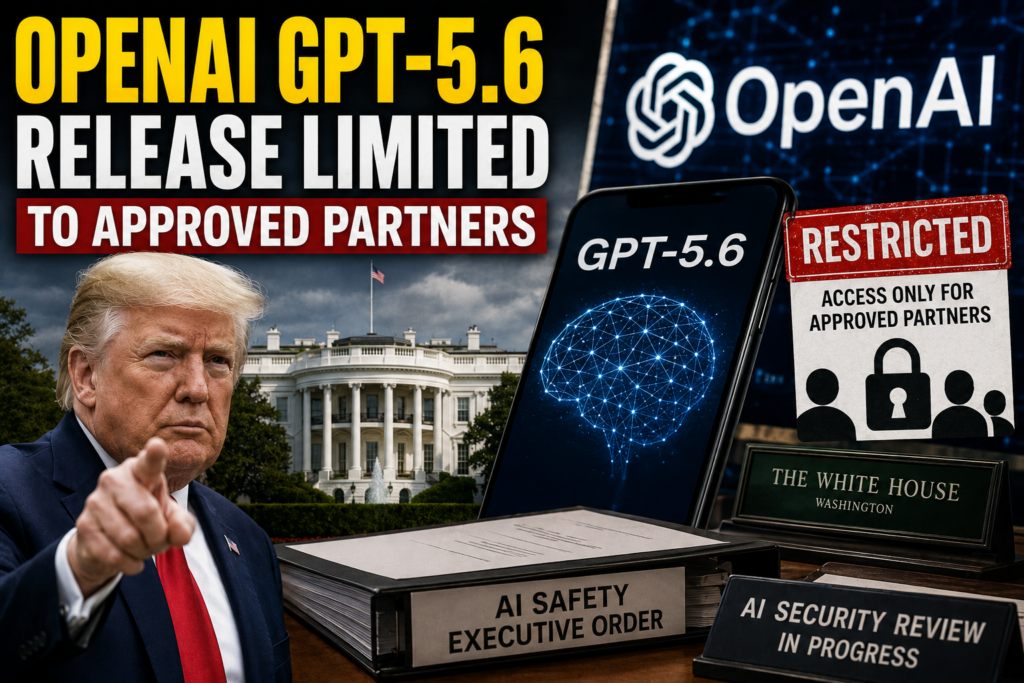
The Trump administration has directed OpenAI to limit the public rollout of its upcoming GPT-5.6 artificial intelligence model, marking one of the most significant federal interventions in advanced AI development to date. Instead of launching broadly, the model will initially be available only to a select group of government-approved companies and organizations. According to a report by Politico, the White House requested the restricted release as officials work to establish a regulatory framework for powerful AI systems.
What Happened
OpenAI’s GPT-5.6 model was originally expected to receive a general public release. However, following discussions with the White House, the Office of Science and Technology Policy, and the Office of the National Cyber Director, the company agreed to limit access during its initial rollout.
The decision comes as federal officials increase scrutiny of advanced artificial intelligence models capable of sophisticated cybersecurity, coding, and automation tasks.
According to individuals familiar with the discussions, OpenAI adjusted its launch strategy at the administration’s request while broader AI oversight policies continue to take shape.
Why the White House Intervened
The administration’s involvement follows growing concerns that increasingly powerful AI models could pose national security and cybersecurity risks if released without sufficient safeguards.
Earlier this month, President Donald Trump signed an executive order establishing a voluntary review process for frontier AI models before public release. Under the order, companies are encouraged to submit qualifying models for government evaluation approximately 30 days before launch.
The policy aims to provide federal agencies with time to assess potential threats involving critical infrastructure, financial systems, and national security.
Anthropic’s Fable 5 Influenced the Decision
The administration’s approach has also been shaped by recent events involving OpenAI competitor Anthropic.
Anthropic temporarily withdrew its Fable 5 model after concerns emerged regarding the effectiveness of its cybersecurity safeguards. The controversy intensified discussions within the federal government about how advanced AI systems should be evaluated before becoming widely available.
OpenAI has previously released specialized models, including GPT-5.5-Cyber, only to selected organizations working in cybersecurity research, demonstrating that restricted deployments are already common for high-risk AI capabilities.
Regulatory Uncertainty Creates Challenges
Although the executive order establishes a framework for reviewing advanced AI systems, many implementation details remain unresolved.
Federal agencies continue working with leading AI developers to determine which models require government review and what evaluation standards should apply. Industry leaders have noted that the absence of finalized rules has created uncertainty for companies developing increasingly capable AI technologies.
Some policymakers and technology experts have called for greater transparency and clearer regulatory guidance to ensure companies understand compliance expectations before releasing new models.
Readers following broader developments involving the Trump administration may also be interested in Trump’s economic approval rating and how policy decisions continue to influence public debate.
Political and Industry Impact
The administration’s actions represent a notable shift in federal AI policy.
While the White House has frequently emphasized innovation and technological leadership, officials now appear increasingly focused on balancing rapid AI development with national security concerns.
The evolving regulatory landscape could affect how technology companies introduce future models, influence investment decisions, and shape America’s competitive position against global AI rivals, particularly China.
Broader policy priorities continue to evolve across the administration, including Trump’s broader geopolitical strategy involving Greenland and other national security initiatives that intersect with emerging technologies.
What Happens Next
OpenAI is expected to continue working with the federal government as officials finalize procedures for evaluating advanced AI systems.
Meanwhile, the administration will spend the coming weeks developing more detailed guidance defining which AI models require review and how agencies will assess potential cybersecurity and national security risks before future public releases.
The outcome of those discussions could establish a long-term framework for regulating frontier artificial intelligence in the United States.
Conclusion
The Trump administration’s decision to limit OpenAI’s GPT-5.6 rollout signals a new phase in federal oversight of artificial intelligence. As AI capabilities continue advancing rapidly, policymakers are seeking ways to balance innovation with security while establishing clearer rules for companies developing increasingly powerful technologies. The evolving framework could shape not only OpenAI’s future releases but also the broader direction of AI regulation in the United States.
The administration requested a restricted rollout while federal agencies develop procedures to evaluate advanced AI models for potential cybersecurity and national security risks.
OpenAI plans to make GPT-5.6 available only to a limited group of government-approved companies and organizations during its initial launch