An america past president is any person who has held the office of President of the United States and no longer serves, a group that includes every officeholder from George Washington through the most recent predecessor of the sitting president. The nation has had individuals serve as president across more presidencies than there have been people, because Grover Cleveland served two nonconsecutive terms and Donald Trump has now done the same. This guide organizes those administrations by era, explains how historians judge their legacies, and shows where to find primary records.
Who Are the Former Presidents of America?
The former presidents of America are all of the men who have held the office since 1789, from George Washington to Joe Biden, the most recent president to leave office before Donald Trump returned for a second term.
The list is long, so grouping it by era makes it easier to follow. Each period below is defined by the dominant national challenge its presidents faced.
| Era | Presidents | Defining issue |
|---|---|---|
| Founding and early republic (1789-1829) | Washington, J. Adams, Jefferson, Madison, Monroe, J.Q. Adams | Building institutions, westward expansion |
| Jacksonian era (1829-1861) | Jackson, Van Buren, W.H. Harrison, Tyler, Polk, Taylor, Fillmore, Pierce, Buchanan | Democratic expansion, slavery debates |
| Civil War and Reconstruction (1861-1877) | Lincoln, A. Johnson, Grant | Union, emancipation, rebuilding |
| Gilded Age and Progressive era (1877-1921) | Hayes through Wilson | Industrialization, reform, World War I |
| Interwar and World War II (1921-1945) | Harding, Coolidge, Hoover, F. Roosevelt | Depression, New Deal, global war |
| Cold War (1945-1989) | Truman through Reagan | Containment, civil rights, Vietnam |
| Modern era (1989-present) | G.H.W. Bush through Biden, Trump | Globalization, terrorism, polarization |
For a verified chronological list with exact years in office, the George W. Bush White House archive maintains a reliable reference. The Biden White House archive offers brief biographical profiles for each officeholder.
Who Were the Last 10 U.S. Presidents?
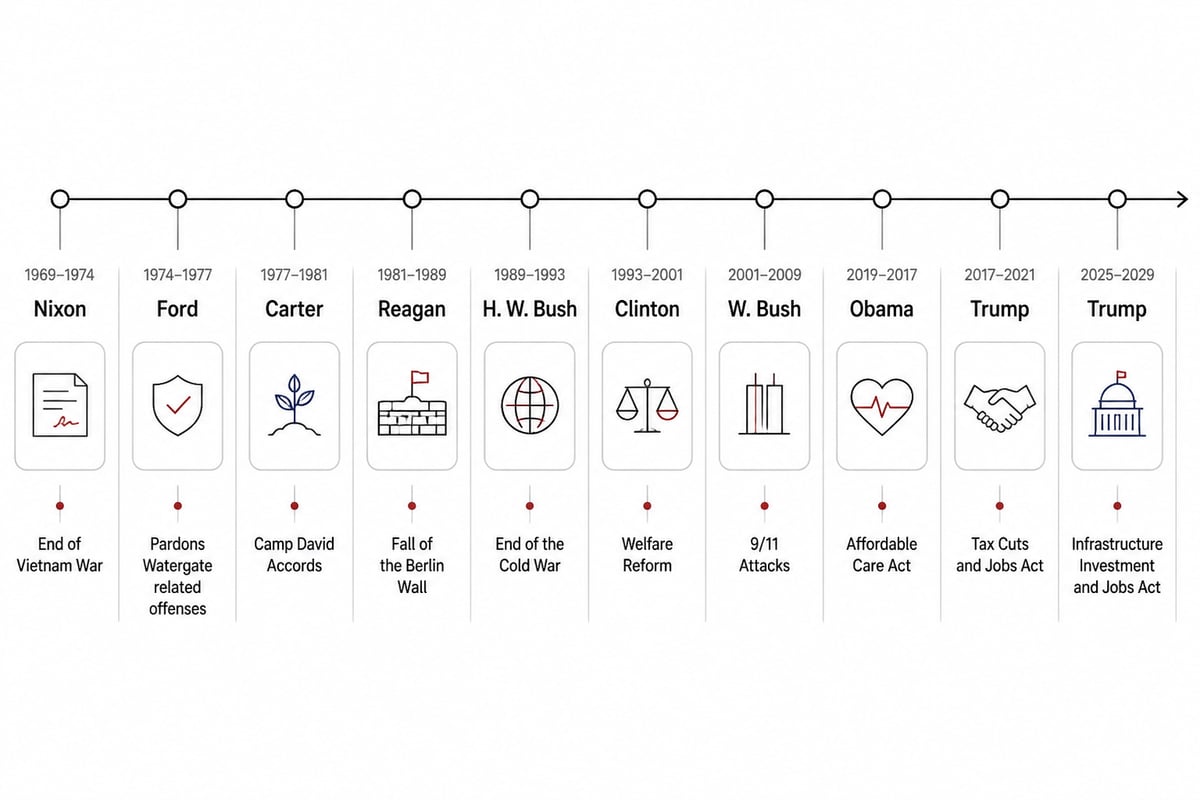
The last 10 U.S. presidents, counting from the most recent, are Joe Biden, Donald Trump, Barack Obama, George W. Bush, Bill Clinton, George H.W. Bush, Ronald Reagan, Jimmy Carter, Gerald Ford and Richard Nixon.
Trump appears once in this count even though he holds two separate terms, one from 2017 to 2021 and a second beginning in 2025. If you count by presidencies rather than individuals, the ten most recent run from Trump's second term back through Clinton. Readers who want a shorter reference can consult our breakdown of the past 5 presidents of the USA.
Here is a compact summary of each, with the years served:
- Joe Biden (2021-2025): Pandemic recovery legislation, infrastructure investment and the withdrawal from Afghanistan's aftermath.
- Donald Trump (2017-2021, 2025-present): Tax reform, judicial appointments, tariffs and an "America First" foreign policy.
- Barack Obama (2009-2017): The Affordable Care Act, the response to the 2008 financial crisis and the first Black president.
- George W. Bush (2001-2009): The response to September 11, wars in Afghanistan and Iraq, and the creation of the Department of Homeland Security.
- Bill Clinton (1993-2001): A budget surplus, welfare reform and the second impeachment of a president in U.S. history.
- George H.W. Bush (1989-1993): The end of the Cold War and the Gulf War coalition.
- Ronald Reagan (1981-1989): Tax cuts, deregulation and a military buildup that shaped the final phase of the Cold War.
- Jimmy Carter (1977-1981): The Camp David Accords and a period of high inflation and energy shortages.
- Gerald Ford (1974-1977): Assumed office after Nixon's resignation and issued a controversial pardon.
- Richard Nixon (1969-1974): Opening relations with China, the Environmental Protection Agency and resignation amid Watergate.
Who Are the Past 8 Presidents?
The past 8 presidents, from most recent backward, are Joe Biden, Donald Trump, Barack Obama, George W. Bush, Bill Clinton, George H.W. Bush, Ronald Reagan and Jimmy Carter.
These eight cover roughly five decades, from the late 1970s to the present, and they span the full arc of modern American politics: the post-Watergate reset, the Reagan realignment, the post-Cold War order, the war on terror and the current era of sharp partisan division. Three of them, Carter, Bush senior and Clinton, have died or left public life in ways that make their records easier to assess at a distance, while Biden's and Trump's legacies are still being written in real time.
This group matters for daily news readers because many current disputes trace directly to their decisions. Tariff policy, immigration enforcement, executive orders and Supreme Court appointments all have roots in these administrations. Our coverage of Trump executive orders impacting America in 2026 shows how recent actions build on, or reverse, earlier ones.
Who Are the 17 Presidents of the US?
The first 17 presidents of the United States, in order, are Washington, John Adams, Jefferson, Madison, Monroe, John Quincy Adams, Jackson, Van Buren, William Henry Harrison, Tyler, Polk, Taylor, Fillmore, Pierce, Buchanan, Lincoln and Andrew Johnson.
This stretch covers the nation's formation through the end of the Civil War and the opening of Reconstruction. It includes the founding generation, the first transfers of power between rival parties and the escalating sectional crisis over slavery.
A few details are worth remembering from this group:
- William Henry Harrison served the shortest term in history, dying in office in 1841 shortly after taking it.
- John Quincy Adams was the son of a former president, John Adams, as George W. Bush later was of George H.W. Bush.
- Abraham Lincoln led the Union through the Civil War and issued the Emancipation Proclamation, and he was assassinated in April 1865.
- Andrew Johnson became the first president to be impeached by the House of Representatives, in 1868.
How Historians Rank America's Past Presidents
Historians rank past presidents by surveying scholars on leadership, crisis management, moral authority and long-term impact, and the results tend to place Lincoln, Washington and Franklin Roosevelt at the top.
The 2024 Presidential Greatness Project survey included political science scholars and researchers who had published relevant peer-reviewed work, according to a Bleeding Heartland analysis of the results. A survey of scholars is more informative than a casual poll, which can swing widely based on personal politics.
Several patterns show up consistently across scholarly surveys:
- Crisis leadership earns the top spots. Presidents who guided the country through existential threats, such as the Civil War, the Depression and World War II, rank highest.
- Failures cluster before the Civil War and in Reconstruction. Buchanan, Pierce and Andrew Johnson routinely land at the bottom for their handling of slavery and its aftermath.
- Recent presidents move over time. Rankings for Truman and Eisenhower improved significantly after decades of reassessment, which suggests that current verdicts on Obama, Trump and Biden remain provisional.
A useful habit for any reader is to separate three questions: how effective a president was, how popular he was while in office, and how history judges the long-term consequences. Those three measures often point in different directions.

Why Presidential Legacies Keep Changing
Presidential legacies change because new documents become available, later events reframe earlier decisions, and each generation applies different standards to the same record.
Truman left office in 1953 with low approval ratings and has since been reassessed by many historians as a strong president. Ulysses S. Grant, long dismissed because of scandals in his administration, has been reassessed upward for his enforcement of civil rights during Reconstruction. Going the other direction, some presidents once admired for expansionist policies are now judged more critically for their treatment of Native Americans or their positions on slavery.
For news readers, this has a practical lesson. Early verdicts on a sitting or recent president reflect partisan loyalty as much as evidence. Public attitudes also shift with the issues dominating the moment, a pattern visible in our reporting on the top political issues Americans care about in 2026.
What Presidential Libraries Preserve About Each Administration
Presidential libraries preserve the papers, recordings, photographs and artifacts of individual administrations, and they are the main source for researching an america past president in depth.
The scale of these holdings is considerable. According to the National Archives, presidential libraries hold more than 600 million pages of textual materials, nearly 20 million photographs, over 20 million feet of film, nearly 100,000 hours of recordings, and more than 500 terabytes of electronic data. The system also contains nearly 800,000 objects given to presidents, their families and administrations.
The system has a defined history and legal structure:
- The first library: Franklin D. Roosevelt's was dedicated on June 30, 1941, according to the National Archives FAQ.
- The formal framework: The Presidential Libraries Act of 1955 established a public-private partnership for preserving and providing access to presidential archives.
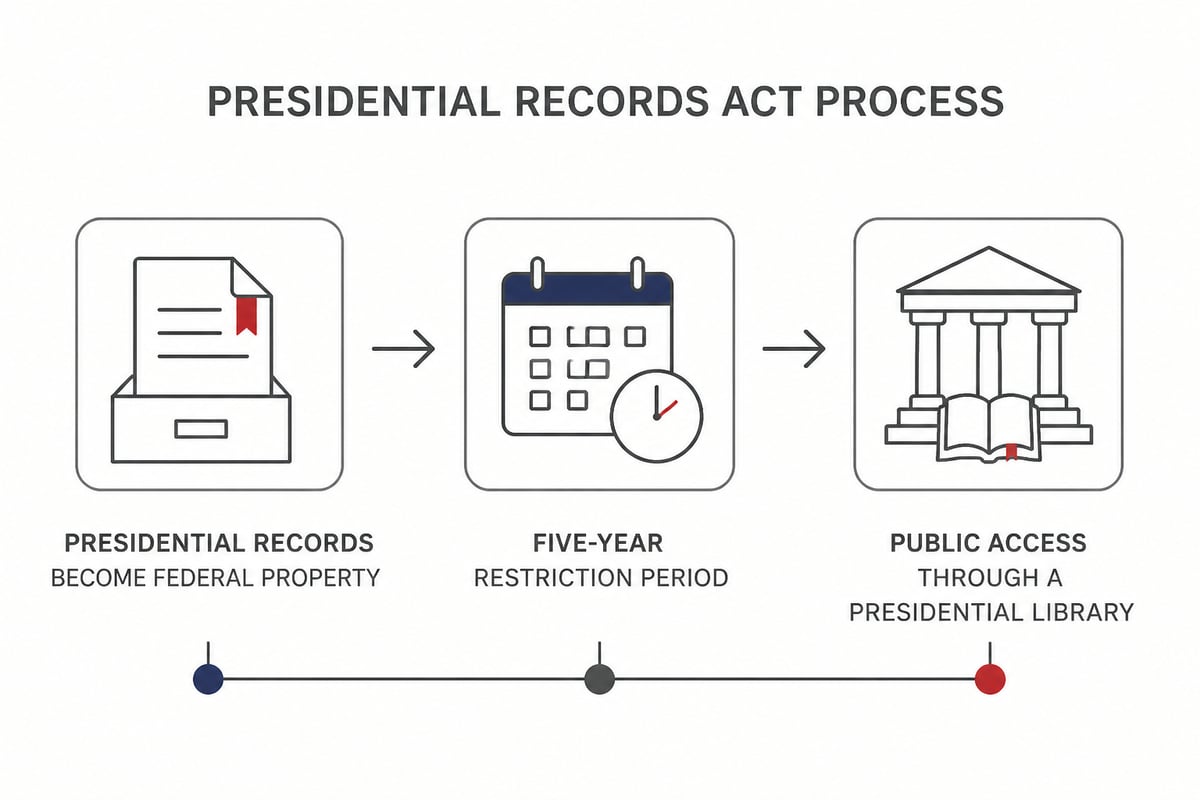
- The records law: The Presidential Records Act makes presidential records federal property, and those records are generally exempt from public release for five years after an administration ends.
That five-year window explains why documents about a recent president emerge slowly. Journalists and researchers often file Freedom of Information Act requests once the restriction period ends, and new material can alter the public understanding of an administration years later.
How to Research an America Past President
To research an america past president effectively, start with official archives for primary documents, then compare them against scholarly biographies and contemporaneous news coverage.
A reliable research sequence looks like this:
- Confirm the basics. Check dates, party, vice president and succession against an official chronological list.
- Read primary sources. Speeches, executive orders, signing statements and correspondence are available through presidential libraries and the National Archives.
- Check contemporary reporting. Newspapers from the period show how decisions were understood at the time, before hindsight shaped the story.
- Consult scholarly assessments. Academic surveys and biographies provide context and counterarguments.
- Note the records timeline. Remember that recent administrations may have sealed or unprocessed material.
Context also matters when comparing presidents across eras. A tariff debate in 2026 echoes earlier fights over trade, and our analysis of tariffs and American manufacturing shows how long-running that argument has been. Likewise, today's arguments over the proper scope of executive power are easier to evaluate against the record of past administrations.
Presidents Who Served Nonconsecutive Terms and Other Records
A handful of presidents hold distinctive places in the record, and the nonconsecutive-term category is the clearest example of how counting the office can confuse readers.
Grover Cleveland was the first president to serve two nonconsecutive terms, which is why he is counted as both the 22nd and 24th president. Donald Trump became the second, serving as the 45th president and then returning as the 47th. This is the reason the nation has had 45 individuals in 47 presidencies.
Other records are worth knowing:
- Longest tenure: Franklin D. Roosevelt won four elections and served from 1933 until his death in 1945. The 22nd Amendment now limits presidents to two elected terms.
- Shortest tenure: William Henry Harrison, who died in office shortly after his inauguration.
- Resignation: Richard Nixon is the only president to resign.
- Impeachment: Andrew Johnson, Bill Clinton and Donald Trump (twice) were impeached by the House, and none was removed by the Senate.
- Succession from the vice presidency: Several vice presidents have taken office after a president's death or resignation.
These benchmarks give useful context when reading about the current president, since many news stories compare today's events to the historical record. For a view of the present office, see our explainer on the current president of America.
FAQ
Is Joe Biden a former president?
Yes. Joe Biden served as the 46th president from January 2021 to January 2025 and is a former president. Donald Trump succeeded him and now serves as the 47th president.
How many former presidents are still living?
The number changes as former presidents pass away, so check a current source for the latest count. Living former presidents typically receive lifetime Secret Service protection, a pension and funding for office staff under the Former Presidents Act.
Where can I find a complete list of presidents in order?
Official White House archives publish chronological lists with years in office, and the National Archives provides records for each administration. Numbering can confuse readers because Cleveland and Trump each served two separate terms and carry two numbers.
Pick one president from the list above and read a few primary documents from that administration through the National Archives, since firsthand sources sharpen your read of today's headlines. U.S. Presidential Report publishes daily, non-partisan coverage of current and past presidents, elections, Congress and federal policy, and you can Start Your Own Political Club by following our reporting and bringing informed discussion of the presidency to your own community.