The United States has had 47 presidents in 45 individuals' worth of service, counted from George Washington in 1789 to Donald J. Trump, who is listed as the 47th president and began his current term in 2025. The numbering exceeds the headcount because Grover Cleveland served two non-consecutive terms and is counted twice. This guide lists all presidents of the United States in order, then explains the patterns, records, and turning points that give the list its meaning.
Who Are All 47 Presidents in Order?
The 47 presidents, in order of service, run from George Washington (1st) to Donald J. Trump (47th), and the list below groups them by era with party affiliation and years in office.
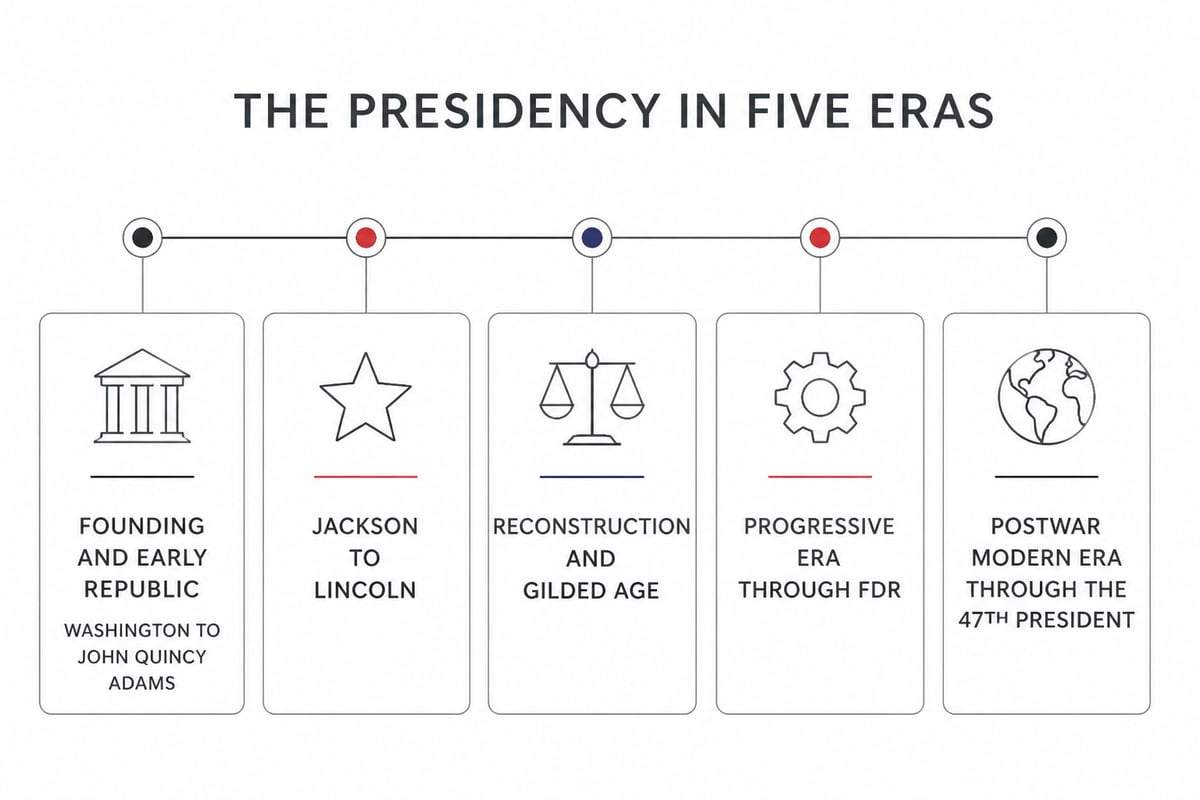
The founding and early republic (1789 to 1829)
- George Washington (no party), 1789 to 1797
- John Adams (Federalist), 1797 to 1801
- Thomas Jefferson (Democratic-Republican), 1801 to 1809
- James Madison (Democratic-Republican), 1809 to 1817
- James Monroe (Democratic-Republican), 1817 to 1825
- John Quincy Adams (Democratic-Republican), 1825 to 1829
Jacksonian democracy through the Civil War (1829 to 1865)
- Andrew Jackson (Democratic), 1829 to 1837
- Martin Van Buren (Democratic), 1837 to 1841
- William Henry Harrison (Whig), 1841
- John Tyler (Whig, later without a party), 1841 to 1845
- James K. Polk (Democratic), 1845 to 1849
- Zachary Taylor (Whig), 1849 to 1850
- Millard Fillmore (Whig), 1850 to 1853
- Franklin Pierce (Democratic), 1853 to 1857
- James Buchanan (Democratic), 1857 to 1861
- Abraham Lincoln (Republican), 1861 to 1865
Reconstruction and the Gilded Age (1865 to 1901)
- Andrew Johnson (National Union/Democratic), 1865 to 1869
- Ulysses S. Grant (Republican), 1869 to 1877
- Rutherford B. Hayes (Republican), 1877 to 1881
- James A. Garfield (Republican), 1881
- Chester A. Arthur (Republican), 1881 to 1885
- Grover Cleveland (Democratic), 1885 to 1889
- Benjamin Harrison (Republican), 1889 to 1893
- Grover Cleveland (Democratic), 1893 to 1897
- William McKinley (Republican), 1897 to 1901
The Progressive Era through World War II (1901 to 1945)
- Theodore Roosevelt (Republican), 1901 to 1909
- William Howard Taft (Republican), 1909 to 1913
- Woodrow Wilson (Democratic), 1913 to 1921
- Warren G. Harding (Republican), 1921 to 1923
- Calvin Coolidge (Republican), 1923 to 1929
- Herbert Hoover (Republican), 1929 to 1933
- Franklin D. Roosevelt (Democratic), 1933 to 1945
The postwar and modern era (1945 to present)
- Harry S. Truman (Democratic), 1945 to 1953
- Dwight D. Eisenhower (Republican), 1953 to 1961
- John F. Kennedy (Democratic), 1961 to 1963
- Lyndon B. Johnson (Democratic), 1963 to 1969
- Richard Nixon (Republican), 1969 to 1974
- Gerald R. Ford (Republican), 1974 to 1977
- Jimmy Carter (Democratic), 1977 to 1981
- Ronald Reagan (Republican), 1981 to 1989
- George H. W. Bush (Republican), 1989 to 1993
- Bill Clinton (Democratic), 1993 to 2001
- George W. Bush (Republican), 2001 to 2009
- Barack Obama (Democratic), 2009 to 2017
- Donald J. Trump (Republican), 2017 to 2021
- Joe Biden (Democratic), 2021 to 2025
- Donald J. Trump (Republican), 2025 to present
Note that Trump appears at 45 and 47. The White House lists Donald J. Trump as the 47th president, serving from 2025 to the present, and also records his first term from 2017 to 2021. Cleveland follows the same logic: the White House lists him as both the 22nd and 24th president, reflecting his non-consecutive terms.
Why Are There 47 Presidents but Fewer Individual People?
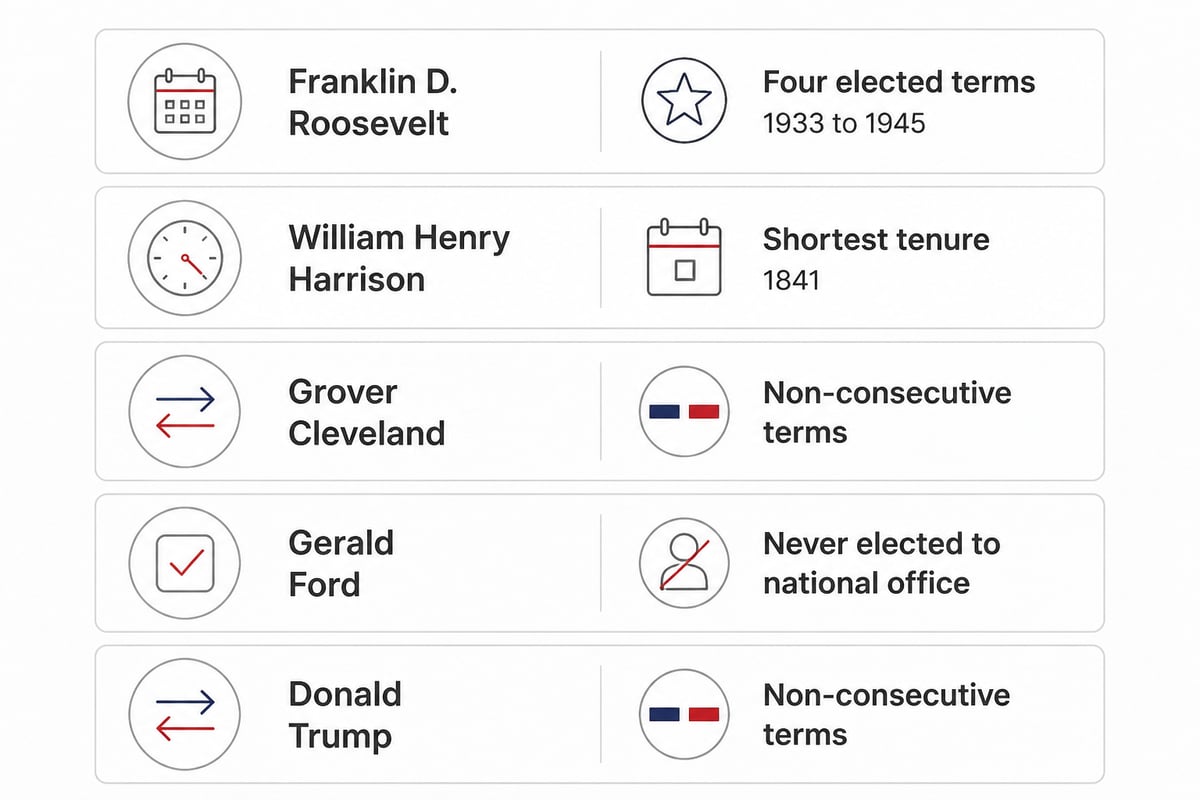
There are 47 presidencies but 45 different men, because two presidents each served non-consecutive terms and are numbered twice. Grover Cleveland won in 1884, lost his reelection bid in 1888, and returned to win in 1892, which makes him the 22nd and 24th president. Donald Trump followed the same path: he won in 2016, lost in 2020, and won again in 2024, which makes him the 45th and 47th president.
The numbering rule is simple. Each time a person begins a new presidency after a break, the count advances by one. A president who serves two consecutive terms, such as Barack Obama, holds a single number. The White House biography of Barack Obama identifies him as the 44th president and summarizes his background and presidency.
For readers tracking the current officeholder, the site's page on the current United States president covers the latest developments.
How Do the Presidents Break Down by Political Party?
Republicans and Democrats have each held the office many times, alongside a handful of presidents elected under parties that no longer exist, including the Federalist, Democratic-Republican, and Whig parties.
Several points explain why the party picture is more varied than it first appears:
- Washington belonged to no party. He warned against factional politics in his farewell address.
- The first party system was short. John Adams was the only Federalist president, and the Democratic-Republican line ended with John Quincy Adams.
- The Whigs elected four presidents between 1841 and 1853, but two of them, William Henry Harrison and Zachary Taylor, died in office, and John Tyler broke with the party soon after taking over.
- Republican dominance followed the Civil War. From Lincoln's election in 1860 through 1932, Republicans held the White House for all but 16 years.
- Modern alternation is frequent. Since 1953, the White House has changed party hands in most election cycles, a pattern that shapes how Congress and the courts respond to each administration.
For a deeper look, see this breakdown of US presidents by political party and the overview of conservative presidents.
Who Were the Last 10 Presidents of the USA?
The most recent presidents, counting the 47th presidency, run from Donald Trump back through Joe Biden, Barack Obama, George W. Bush, Bill Clinton, George H. W. Bush, Ronald Reagan, Jimmy Carter, and Gerald Ford.
| Order | President | Years | Party |
|---|---|---|---|
| 47 | Donald J. Trump | 2025 to present | Republican |
| 46 | Joe Biden | 2021 to 2025 | Democratic |
| 45 | Donald J. Trump | 2017 to 2021 | Republican |
| 44 | Barack Obama | 2009 to 2017 | Democratic |
| 43 | George W. Bush | 2001 to 2009 | Republican |
| 42 | Bill Clinton | 1993 to 2001 | Democratic |
| 41 | George H. W. Bush | 1989 to 1993 | Republican |
| 40 | Ronald Reagan | 1981 to 1989 | Republican |
| 39 | Jimmy Carter | 1977 to 1981 | Democratic |
| 38 | Gerald R. Ford | 1974 to 1977 | Republican |
Two entries deserve a closer look. Ronald Reagan, the 40th president, served from 1981 to 1989 and was reelected in 1984. George H. W. Bush, the 41st president, served from 1989 to 1993 and sought a second term but did not win it. Readers who want narrative coverage of these years can use the site's pages on the most recent US presidents and the past five presidents of the USA.
Which Presidents Hold Notable Records?
Several presidents hold records that remain unmatched, and each one reflects a specific moment in American history.
Longest and shortest tenures
Franklin D. Roosevelt, the 32nd president, served from 1933 to 1945 and was the only president elected to four terms. The 22nd Amendment, ratified in 1951, now limits a president to two elected terms. At the other end, William Henry Harrison served only about a month in 1841 before dying in office, the shortest tenure on record.
Presidents who took office through succession
Several presidents assumed the office after the death or resignation of their predecessor. Theodore Roosevelt, the 26th president, served from 1901 to 1909 and became president after William McKinley's assassination. Gerald Ford is unique among them: he became president after Richard Nixon's resignation in 1974 and was never elected to either the presidency or the vice presidency.
Firsts that changed the office
- John Adams was the second president and had previously been the first vice president, serving from 1797 to 1801. He was also the first president to live in the executive mansion in Washington.
- Dwight D. Eisenhower, the 34th president, served from 1953 to 1961, and Alaska and Hawaii became states during his presidency.
- Barack Obama became the first African American president in 2009.
How Many Presidents Came From Each State and Region?
Virginia and Ohio are among the leading states for presidential birthplaces, and the geography of the office has shifted from the Southern and Mid-Atlantic states toward the Midwest and West over time. Virginia produced several of the earliest presidents, and Ohio produced several of the Gilded Age presidents.
The pattern shows how regional power moved. Early presidents came from the original colonies, the Gilded Age favored the Midwest, and the late twentieth century brought presidents from Texas, California, Georgia, and Arkansas, along with a Hawaii-born president in Obama. The page on presidents from each state gives the full state-by-state tally, which is useful for anyone tracking how home-state politics influence national campaigns.
What Is the Typical Path to the Presidency?
Most presidents arrived through a short list of prior offices, and the list has changed little over two centuries. The common routes are:
- Vice president: Many presidents held the vice presidency first, including Adams, Jefferson, Van Buren, Theodore Roosevelt, Truman, Johnson, Nixon, Ford, Bush, and Biden.
- Governor: Governors form the largest group in the modern era, including Franklin Roosevelt, Carter, Reagan, Clinton, and George W. Bush.
- Military command: Washington, Jackson, Taylor, Grant, and Eisenhower all rose through the military.
- Senator or representative: Kennedy, Obama, and many nineteenth-century presidents moved up from Congress.
- Outside politics: Eisenhower's career in the Army and Trump's career in business and entertainment illustrate how a presidency can follow a career outside elected office.
This matters for readers who follow the daily news, because a president's earlier career often predicts how the administration works with Congress, handles executive authority, and approaches the courts. The ongoing legal challenges to executive authority in 2026 are one current example of those relationships under pressure.
How Do Historians Rank the Presidents?
Historians and political scientists rank presidents through periodic surveys, and Lincoln, Washington, and Franklin Roosevelt appear near the top of most of them. Rankings weigh crisis leadership, economic management, moral authority, and lasting institutional impact. Presidents who guided the nation through existential tests, such as the founding, the Civil War, and the Depression and World War II, tend to rank highest.
Public opinion offers a different measure. Approval ratings reflect a president's standing during a term, while historical rankings often revise reputations decades later. Truman left office with low approval and now ranks well above average. The analysis of presidents with the highest approval ratings compares the two lenses, and the ranking of the most powerful US presidents looks at how each used executive authority.
Where Do Presidents Live and Work?
Presidents have lived and worked in the White House, the executive mansion at 1600 Pennsylvania Avenue in Washington, D.C., since the early republic. Washington himself never lived there; he oversaw its planning. The building has been rebuilt, expanded, and renovated by nearly every administration since.
Current construction at the complex remains a news topic, including the White House ballroom project.
How to Use a Presidents List in Your Own Research
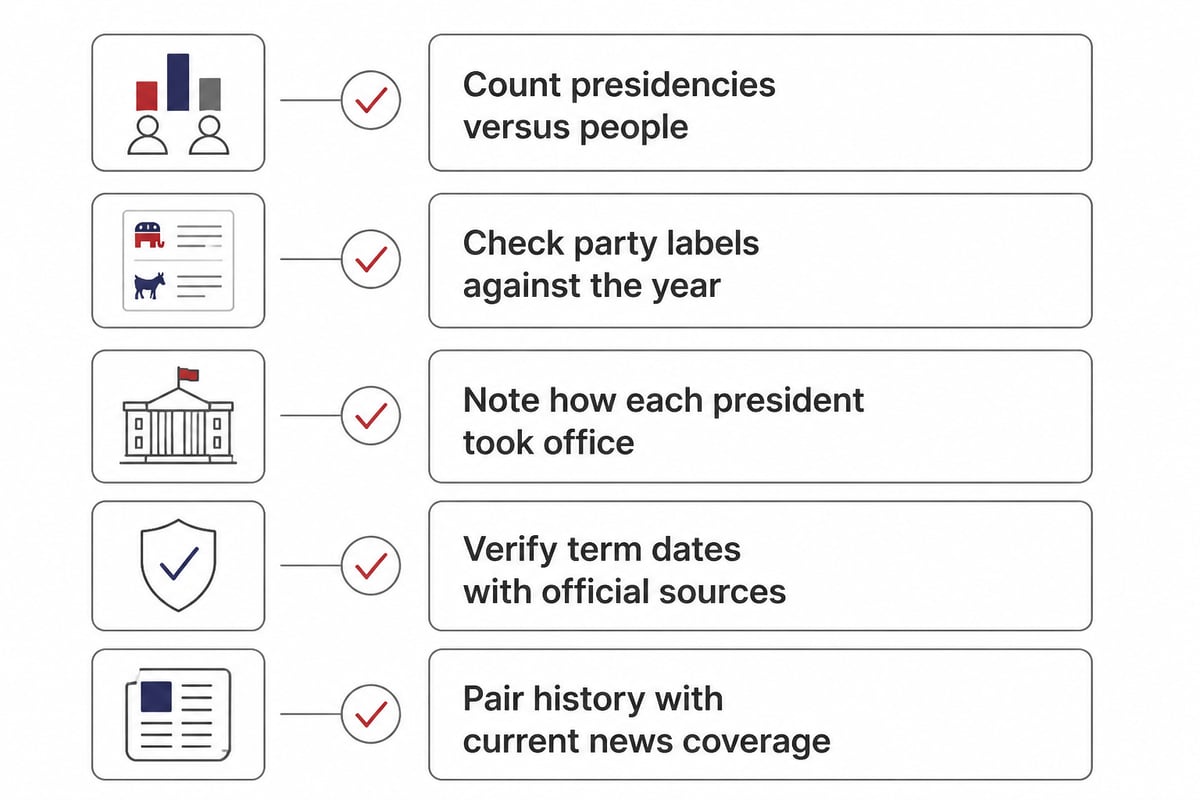
A presidents list is most useful when paired with context, and a few habits make it more reliable for research, teaching, or fact-checking.
- Count presidencies and people separately. Say "47th president" for the number and "45 individuals" for the headcount to avoid errors.
- Check the party label against the year. Parties shifted names and platforms, so a "Democratic" president in 1830 does not map neatly onto the modern party.
- Note the succession type. Elected, succeeded, and appointed-to-the-vice-presidency paths affect how historians read a term.
- Verify dates against primary sources. Official biographies from the White House provide consistent term dates.
- Pair the list with current coverage. The history of the office explains today's arguments over executive power, elections, and federal policy.
The same discipline applies to election questions. Readers following the rules that decide who joins this list can compare mail-in ballot policies and in-person voting rules for 2026 and track the election law challenge status for 2026.
FAQ
What is Bill Clinton's net worth?
Net worth figures for Bill Clinton vary by source and are estimates, since no official public filing states a total. Treat any single number as an approximation and check its source and date.
What was John F. Kennedy's IQ?
No verified IQ score for John F. Kennedy exists in the historical record, and figures that circulate online are unsourced estimates. His standing rests on documented achievements in office, including his handling of the Cuban Missile Crisis in 1962.
Pick one president from the list above whose term you know least about and read a primary-source biography before checking how the news covers today's office. U.S. Presidential Report publishes non-partisan coverage of current and past presidents, elections, and federal policy, so you can follow the history and the headlines in one place. If you want to turn that interest into shared discussion, Start Your Own Political Club with the latest presidential news as your starting point.