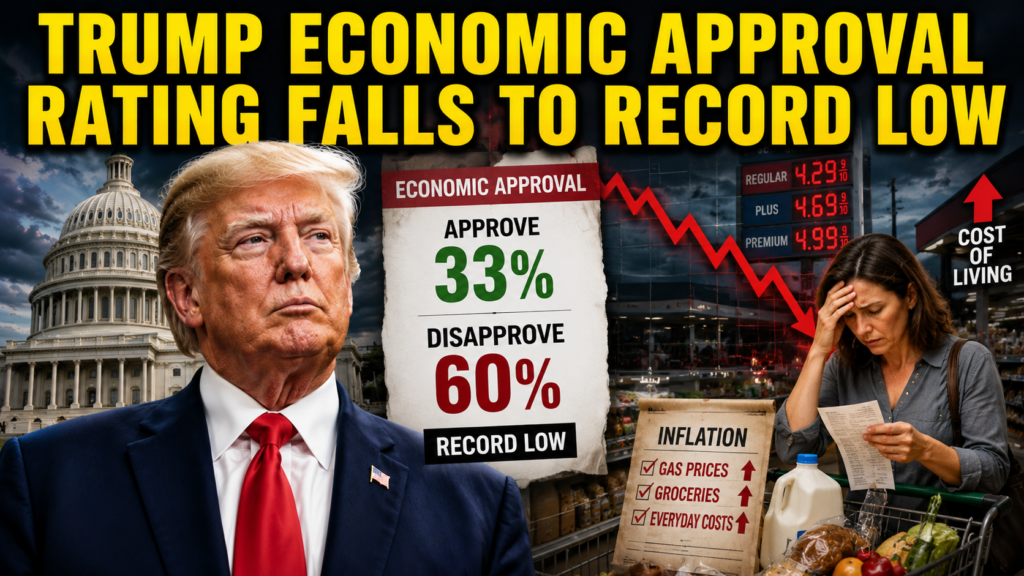
President Donald Trump’s economic approval rating has dropped to its lowest level on record, according to a new national survey, highlighting growing voter concerns over inflation, gas prices, and household affordability. The latest findings suggest that economic issues, once considered one of Trump’s strongest political advantages, are becoming a growing challenge during his second term.
What Happened
According to a report by PBS NewsHour, only 33% of Americans approve of Trump’s handling of the economy, while 60% disapprove.
The survey, conducted jointly by PBS News, NPR, and the Marist Poll, marks the lowest economic approval rating recorded for Trump since Marist began tracking the issue in 2019.
The findings come as Americans continue to face elevated living costs despite some recent easing in fuel prices.
Key Findings From the Poll
Economic Approval Reaches New Low
The poll found that Trump’s economic approval rating has fallen below levels seen during both his first and second terms.
By comparison, approximately half of Americans approved of Trump’s handling of the economy near the end of his first presidency in December 2020.
While 77% of voters who supported Trump in the 2024 election continue to approve of his economic performance, some traditionally supportive demographics appear less satisfied.
Notably, a majority of white voters without a college degree—one of Trump’s strongest voting blocs—expressed disapproval of his economic management.
Gas Prices Remain a Major Concern
One of the biggest drivers behind the decline appears to be continued frustration over fuel costs.
The poll found that 78% of Americans say gas prices have affected their household budgets.
Although average gas prices have declined from recent highs, they remain significantly above year-ago levels in many parts of the country.
Analysts cited in the report noted that consumers often respond more strongly to higher costs experienced over time than to short-term price declines.
Rising Cost of Living Pressures Households
Beyond fuel expenses, respondents also pointed to grocery prices and broader affordability concerns.
Lee Miringoff, director of the Marist Institute for Public Opinion, said many voters increasingly associate ongoing cost-of-living challenges with the current administration.
As a result, economic frustrations are beginning to affect public perceptions of Trump’s overall job performance.
Political and Economic Impact
The latest poll highlights a potential political vulnerability for the administration heading into future election cycles.
Trump’s economic message played a central role in his return to the White House. However, the new data suggests that concerns about inflation and consumer costs may be eroding confidence among independent voters and some traditional Republican constituencies.
The survey also showed Trump’s overall job approval rating falling to 36%, the lowest level recorded during his second term.
Readers interested in broader political trends can also review Trump approval ratings and major Washington projects and recent analysis of Trump midterm election polling trends.
Americans Adjust Summer Travel Plans
Travel Demand Remains Strong
Despite economic concerns, many Americans still plan to travel this summer.
The poll found that 55% of adults expect to take a vacation, a figure largely unchanged from recent years.
However, 66% reported that costs have influenced their summer plans.
Travelers are increasingly choosing shorter trips, budget-friendly accommodations, and alternative spending strategies to offset higher expenses.
Income Differences Remain Significant
The survey found a notable gap between higher- and lower-income households.
Among Americans earning at least $50,000 annually, 63% plan to take a vacation this summer. By contrast, only 39% of those earning below that threshold reported similar plans.
For many lower-income households, travel costs remain the primary obstacle.
What Happens Next
Economic conditions will likely remain a central factor influencing public opinion over the coming months.
Policymakers, businesses, and financial analysts will continue monitoring inflation trends, fuel prices, consumer spending, and employment data to assess whether public confidence rebounds.
The administration may also face increasing pressure to demonstrate progress on affordability issues that continue to impact household budgets across the country.
Conclusion
The latest PBS News/NPR/Marist survey shows Trump’s economic approval rating at its lowest level since polling began, underscoring persistent voter concerns about inflation, gas prices, and overall affordability. While many Americans continue to support the president’s broader agenda, economic challenges remain a critical issue that could shape both public sentiment and future political outcomes. Whether improving fuel prices and easing inflation can reverse the trend remains one of the most closely watched questions facing the administration.
The latest PBS News/NPR/Marist poll found that 33% of Americans approve of Trump’s handling of the economy.
Many voters cite rising living costs, fuel prices, and affordability concerns as key reasons for their dissatisfaction.