A US presidential term lasts four years, and under the Twenty-Second Amendment no person may be elected president more than twice. In practice, that caps most presidents at eight years in office, though a narrow succession rule can stretch the maximum to ten. This guide explains how the limit works, where it came from, and how it applies to real situations that political readers ask about.
How Long Is a US Presidential Term?
A presidential term is four years, beginning at noon on January 20 following the election and ending at noon on January 20 four years later. The Constitution sets the length in Article II, while the Twenty-Second Amendment, added in the twentieth century, controls how many times one person may win the office.
The two-term expectation is older than the amendment. George Washington declined a third term in 1796, and that precedent held as an unwritten custom for roughly 150 years. Franklin D. Roosevelt broke it by winning four elections between 1932 and 1944, and the amendment followed as a direct response.
For readers tracking the current administration, the practical question is usually whether a sitting president can run again. The answer depends on how many times that person has already been elected, not simply how many years they have served.
What the Twenty-Second Amendment Says
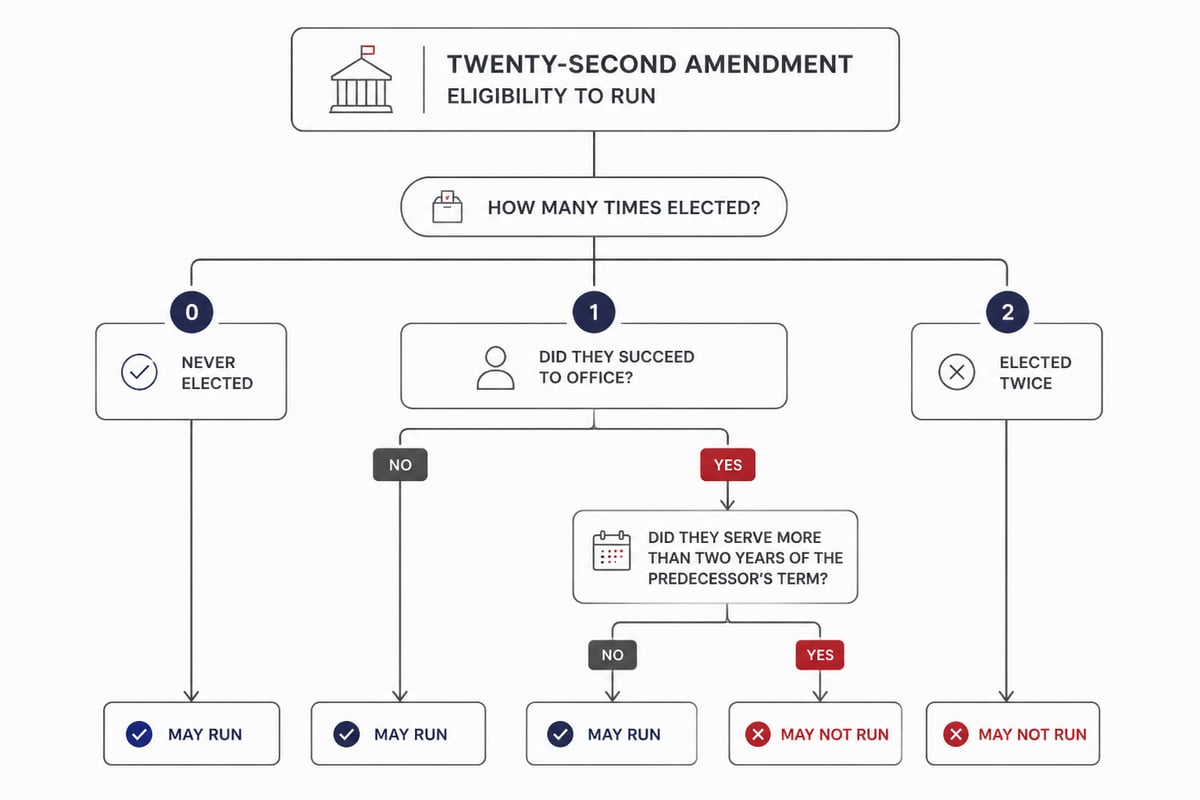
The Twenty-Second Amendment has two sections, and only the first sets the rules for eligibility. In plain terms, it works like this:
- Two elections maximum. The amendment limits a person to being elected president no more than twice.
- A cap for successors. A person who succeeds to the office and serves more than two years of another president's term may be elected president only once.
- Delayed effect. The amendment did not apply to the president in office when Congress proposed it, which was Harry Truman.
- State ratification. Section 2 requires ratification by three-fourths of the states within seven years of submission.
The wording matters. The text restricts being elected, not serving. That distinction produces the succession rules covered below. For a section-by-section summary of the language, Congress.gov's overview of the amendment’s sections and effect is a reliable primary reference.
Why the Limit Exists: A Short History
The amendment exists because voters and lawmakers worried that open-ended service concentrated too much power in one office. Washington's retirement after two terms created a norm that later presidents mostly respected, including Thomas Jefferson, who cited the risk of a lifetime presidency when he declined a third term.
Roosevelt's four consecutive victories ended that tradition in practice. After World War II, a Republican-led Congress proposed the amendment in the late 1940s, and the states took until early 1951 to finish the job. The Twenty-Second Amendment was ratified on February 27, 1951, after Minnesota became the 36th state to approve it.
Historians often note the political irony. The measure was driven largely by Republicans reacting to Roosevelt, yet it later constrained presidents of both parties.
The 10-Year Maximum and Succession Rules
The longest a person can hold the presidency is ten years, and only through a specific succession scenario. A vice president who takes over mid-term and serves two years or less of the predecessor's term may be elected to two full terms, allowing up to 10 years in office, according to Encyclopaedia Britannica.
The rule splits into two cases:
- Succeeds with more than two years remaining in the term. Because less than half the term was served by the predecessor, the successor may still be elected twice, for a total of up to ten years.
- Succeeds after serving more than two years of the term. The successor may be elected only once, which caps total service at just under eight years.
Lyndon Johnson is the standard example. He took office after John F. Kennedy's assassination in November 1963, serving less than two years of the remaining term. Because that was under two years, he was technically eligible to be elected twice more, though he chose not to seek reelection in 1968.
Gerald Ford is a useful contrast. He succeeded Richard Nixon in August 1974 with more than two years left in the term, which would have limited him to one election of his own. He ran in 1976 and lost to Jimmy Carter.
Presidents Who Served the Most and Least Time
Franklin D. Roosevelt remains the only president elected more than twice, serving from 1933 until his death in April 1945. Most other presidents have served eight years or fewer, and several served far less.
| Category | Example | Detail |
|---|---|---|
| Longest service | Franklin D. Roosevelt | Elected four times, 1932 to 1944 |
| Two full elected terms | Dwight Eisenhower, Ronald Reagan, Barack Obama | Left office after two elected terms |
| One-term presidents | Jimmy Carter, George H. W. Bush | Lost reelection bids |
| Succeeded after a death | Lyndon Johnson | Eligible for up to two elections |
The amendment has never been the reason a president lost power by defeat, but it has shaped late-term politics. Second-term presidents are often described as lame ducks, because everyone in Washington knows they cannot run again. That reality affects negotiations with Congress, the pace of executive orders, and the focus on judicial appointments. Readers interested in how authority shifts across administrations can compare executive powers in 2026 and 2024.

Can a Former President Become Vice President?
This is one of the most debated gray areas, and the answer is unsettled in practice because no one has tested it. The Twelfth Amendment says that no person constitutionally ineligible to the office of president shall be eligible to that of vice president. Some scholars read that to bar a twice-elected president from the vice presidency, while others argue the Twenty-Second Amendment limits only election to the presidency, not service.
The scenario matters because the vice president can succeed to the presidency. A twice-elected former president who became vice president and then inherited the office through succession would raise a direct constitutional conflict. Courts have never resolved it, and any such attempt would almost certainly end up before the Supreme Court. For context on how the justices handle questions like this, see Supreme Court powers explained.

Term Limits for the President Versus Congress
The presidency is the only federal office with a constitutional term limit. Members of the House and Senate can serve indefinitely as long as voters keep reelecting them, and the Supreme Court ruled in 1995 that states cannot impose their own term limits on federal legislators.
That contrast fuels ongoing debate. Supporters of limits argue that rotation reduces entrenchment and corruption, while opponents say experience matters and voters already hold the power to remove incumbents. Britannica's pro and con discussion of congressional term limits lays out both arguments, and its broader reference on term limits places the presidential rule in historical context.
Governors and state legislators vary widely. Many states cap governors at two terms, while others impose no limit at all, so the presidential rule is one design among several in American government.
Can the Twenty-Second Amendment Be Changed?
Yes, but only through the same amendment process that created it. Repeal or revision would require a two-thirds vote in both chambers of Congress and ratification by three-fourths of the states, a high bar that few amendments have cleared.
Proposals surface periodically. Resolutions to repeal or modify the limit have been introduced in Congress under presidents of both parties, and none has advanced far. Public support for keeping some form of limit has been a recurring theme in debate, which makes passage unlikely.
Three realistic barriers stand in the way:
- Congressional supermajorities. Two-thirds of the House and Senate must agree, which is rare on any divisive question.
- State ratification. Three-fourths of the states would need to approve, regardless of which party holds the White House.
- Political incentives. Lawmakers of the opposing party have little reason to extend the tenure of a sitting president.
Some commentators have floated indirect theories, such as running a former president for vice president, but those rely on contested readings of the Twelfth Amendment and carry significant legal risk. The most direct route remains a formal amendment.
How Term Limits Shape Current Politics
The two-election cap shapes how parties plan, how presidents govern, and how voters weigh the next race. A president in a second term cannot be a candidate again, so attention turns quickly to successors, and party primaries begin forming well before the final year in office.
The same dynamic affects midterm elections. Second-term presidents have often seen their party lose seats in Congress, and the political fallout shapes legislative priorities for the remaining years. For analysis of how that plays out in the current cycle, read about Trump’s midterm losses and how Senate projections for 2026 compare with the 2024 midterm outlook.
Donald Trump's return is also a useful case study in how the rule counts elections rather than consecutive years. Because his two victories were separated by a term, the question of how many times he has been elected is answered by the ballot count, not by the calendar. Readers can review how that outcome unfolded in Trump’s defeat of Kamala Harris and second-term win. For international readers or those following related commentary in other languages, a site such as EnklereSkilsmisse.no offers a Norwegian-language blog and news site that covers a broader range of topics.
Frequently Asked Questions
Can a president serve more than eight years?
Yes, but only through succession. A vice president who takes over with two years or less remaining in the predecessor's term may be elected twice, for a maximum of ten years in office.
Do the two terms have to be consecutive?
No. The amendment restricts the number of elections a person can win, not the sequence. A president who loses reelection and later wins again counts each victory toward the two-election limit.
Does the limit apply to a president's partial term?
Only when the person succeeded to the office. Serving more than two years of a predecessor's term counts as one election, so that person may be elected only once more.
When did the limit take effect?
The Twenty-Second Amendment took effect with ratification on February 27, 1951. It did not apply to Harry Truman, who was president when Congress proposed it.
Can voters override the limit?
Not through ordinary elections. The only way to change the rule is a constitutional amendment, which requires supermajorities in Congress and ratification by three-fourths of the states.
To keep track of how presidential eligibility, midterm races, and constitutional questions develop, bookmark the politics section and check it regularly for updates. U.S. Presidential Report is a non-partisan news site covering current and past presidents, elections, and federal policy, and its analysis can help you follow these debates with context. If this topic sparks conversation among friends or neighbors, you can Start Your Own Political Club and use the site's reporting as a shared starting point for discussion.