The last 5 American presidents by person are Bill Clinton, George W. Bush, Barack Obama, Donald Trump and Joe Biden, and Trump holds office again after returning in 2025. Counted by presidency rather than by person, Trump appears twice, which is why some lists show six entries and others show five.
This guide gives the dates, party affiliations, signature policies and lasting effects of each administration, along with a few ways to read the record accurately.
Who Are the Last 5 American Presidents?
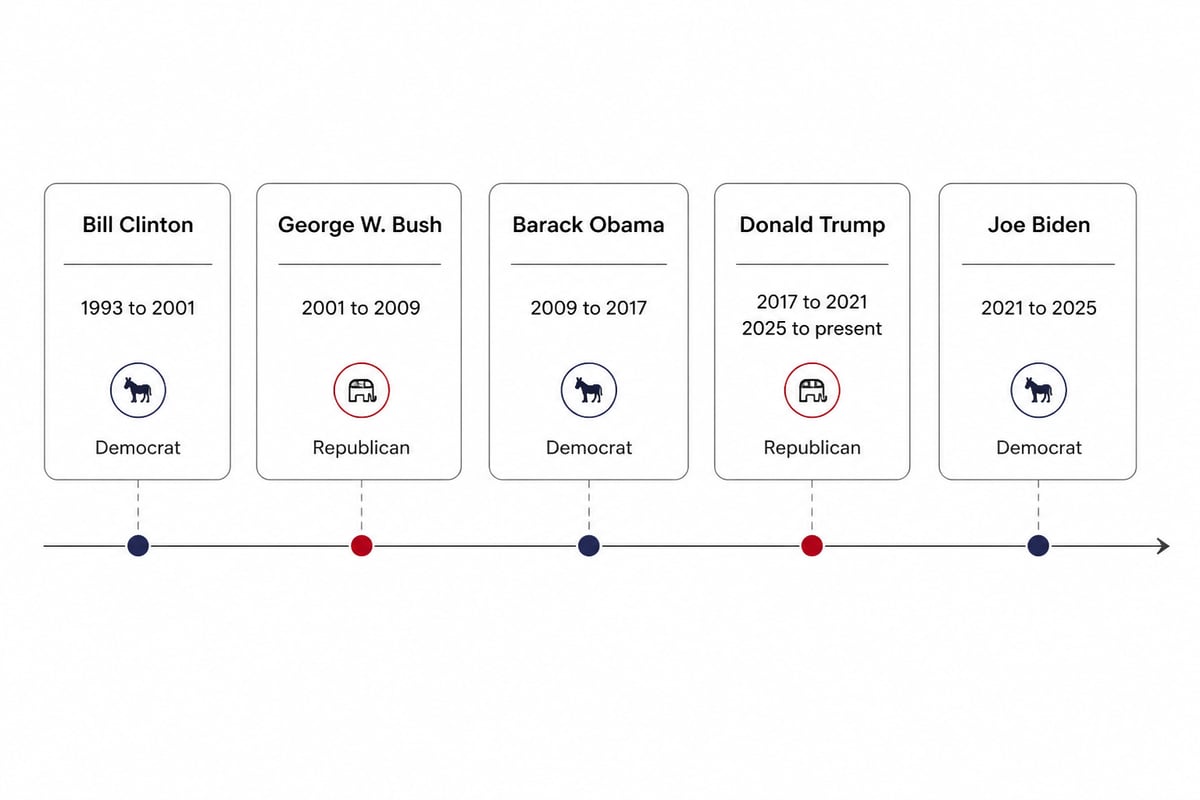
The five most recent presidents, in chronological order, are Clinton, Bush, Obama, Trump and Biden, with Trump's second term currently underway. The table below summarizes each administration using dates confirmed by the U.S. National Archives.
| President | Party | Years in Office | Terms |
|---|---|---|---|
| Bill Clinton | Democratic | 1993 to 2001 | Two |
| George W. Bush | Republican | 2001 to 2009 | Two |
| Barack Obama | Democratic | 2009 to 2017 | Two |
| Donald Trump (first term) | Republican | 2017 to 2021 | One |
| Joe Biden | Democratic | 2021 to 2025 | One |
| Donald Trump (second term) | Republican | 2025 to present | In progress |
Each of these presidents took office on January 20, the date the National Archives records for every transition in this period. For a wider view of the office, the complete list of all U.S. presidents provides context going back to the founding.
What Are the Last Names of the Five Most Recent Presidents?
The last names of the five most recent presidents are Clinton, Bush, Obama, Trump and Biden. Two clarifications keep the answer precise.
- Bush refers to George W. Bush, the 43rd president, not his father, George H. W. Bush, who served from 1989 to 1993.
- Trump appears twice in the sequence because he served nonconsecutive terms, which makes him both the 45th and the 47th president.
Surnames alone can mislead when two presidents share one, so a full name is the safer choice in formal writing. Use "George W. Bush" on first reference, and add the ordinal if the context could still be ambiguous. The sequence also maps neatly onto the calendar. Clinton's two terms ran from 1993 to 2001, Bush's from 2001 to 2009, and Obama's from 2009 to 2017. Trump then served from 2017 to 2021, Biden from 2021 to 2025, and Trump began again in 2025. The National Archives records these transition dates, so the list can be checked against a single authoritative source.
Readers who need a quick reference for each administration can also consult the most recent U.S. presidents page.
Bill Clinton: 1993 to 2001
Bill Clinton, the 42nd president, served two Democratic terms from January 20, 1993, to January 20, 2001, as recorded by the National Archives. His tenure is most associated with sustained economic expansion and a period of federal budget surpluses at the end of the 1990s.
Key developments of the Clinton years include:
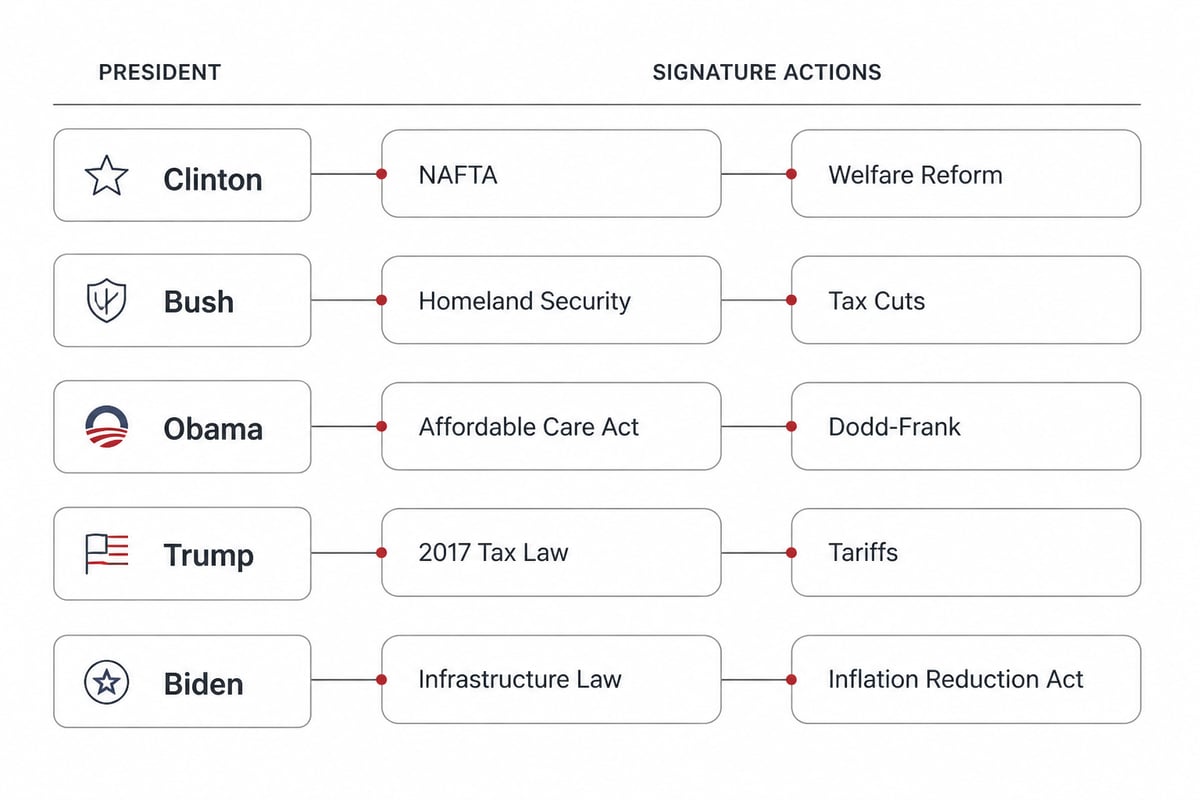
- The North American Free Trade Agreement took effect in 1994.
- The 1996 welfare reform law changed how federal assistance was structured.
- Republicans won control of Congress in 1994, which shaped a divided government for most of his tenure.
- The House impeached him in 1998, and the Senate acquitted him in 1999.
Clinton's legacy remains debated on trade, criminal justice policy and the balance between fiscal discipline and social spending. For the economic record in detail, see the analysis of the best economy under recent presidents.
George W. Bush: 2001 to 2009
George W. Bush, the 43rd president, served two Republican terms from January 20, 2001, to January 20, 2009. His presidency was reshaped within eight months of his inauguration by the September 11, 2001, attacks.
His administration's defining actions were the following:
- Creating the Department of Homeland Security and passing the USA PATRIOT Act.
- Launching military operations in Afghanistan in 2001 and Iraq in 2003.
- Signing the No Child Left Behind Act, which expanded federal testing requirements for schools.
- Enacting major tax cuts in 2001 and 2003.
- Responding to the 2008 financial crisis with the Troubled Asset Relief Program.
Bush's legacy centers on the long-term consequences of the post-9/11 wars, the expansion of executive national security authority and the financial collapse that closed his tenure.
Barack Obama: 2009 to 2017
Barack Obama, the 44th president, served two Democratic terms from January 20, 2009, to January 20, 2017. He was the first African American elected president.
His first two years produced the largest share of his domestic agenda. The American Recovery and Reinvestment Act responded to the recession, the Dodd-Frank Act reformed financial regulation, and the Affordable Care Act, signed in 2010, became his signature achievement. Republicans later gained control of the House in 2010 and the Senate in 2014, which limited major legislation in his final six years.
In foreign policy, his administration ended the U.S. combat mission in Iraq in 2011, authorized the operation that killed Osama bin Laden that same year, and concluded the 2015 Iran nuclear agreement. Executive actions on immigration, including the Deferred Action for Childhood Arrivals program, drew sustained legal challenges. His legacy is closely tied to the ongoing debate over health care policy and the use of executive authority. Readers following that history can explore Obama-era and later health care developments.
Donald Trump: 2017 to 2021 and 2025 to Present
Donald Trump, the 45th and 47th president, served his first term from January 20, 2017, to January 20, 2021, and began his second on January 20, 2025, according to the National Archives. Grover Cleveland is another president who served nonconsecutive terms.
His first term emphasized tax reform, deregulation and judicial appointments, including the Tax Cuts and Jobs Act of 2017. He imposed tariffs on steel, aluminum and a range of Chinese goods, signed the First Step Act on criminal justice, and brokered the Abraham Accords normalizing relations between Israel and several Arab states. He was impeached twice by the House and acquitted both times by the Senate.
His second term has placed trade and border policy at the center of the national debate. For current coverage, see the analysis of whether tariffs are a costly gamble for Americans and the ongoing reporting at Donald Trump news. Supporters point to border enforcement and energy policy, while critics focus on prices and federal spending, and the final judgment on this presidency has not been written.
Joe Biden: 2021 to 2025
Joe Biden, the 46th president, served one Democratic term from January 20, 2021, to January 20, 2025, as documented by the National Archives. He previously served as vice president under Obama and as a U.S. senator from Delaware for 36 years.
His major legislative accomplishments included the following:
- The American Rescue Plan, a pandemic relief package, in 2021.
- The Infrastructure Investment and Jobs Act, which funds roads, bridges and broadband.
- The CHIPS and Science Act, which supported domestic semiconductor manufacturing.
- The Inflation Reduction Act, which addressed health care costs, taxes and climate policy.
His term also included the 2021 withdrawal from Afghanistan, a period of elevated inflation, rising migrant crossings at the southern border, and sustained U.S. support for Ukraine after Russia's 2022 invasion. He ended his reelection campaign in 2024. For a side-by-side look at the last two administrations, read the Trump vs. Biden policies comparison.

Who Were the Last Four and the Last Three Presidents?
The last four presidents are Barack Obama, Donald Trump, Joe Biden and Trump again, which means four distinct terms but only three individuals. Counting by person, the last four presidents are Bush, Obama, Trump and Biden.
The answer depends on whether you count presidencies or people, and the same logic applies to the last three. By person, the last three are Obama, Trump and Biden. By presidency, they are Trump's current second term, Biden and Trump's first term. When citing a figure for a school paper, article or campaign handout, state which counting method you are using.
The dates make the difference concrete. Obama served from January 20, 2009, to January 20, 2017. Trump's first term ran from January 20, 2017, to January 20, 2021, and Biden's from January 20, 2021, to January 20, 2025. Trump's second term began on January 20, 2025. A sentence such as "the last three presidents" therefore changes meaning depending on the reader's assumption. If a handout says "the last four presidents served 16 years combined," check which list it used, because Bush, Obama, Trump and Biden and Obama, Trump, Biden and Trump again can produce different totals. Naming the people, or the years, removes the ambiguity entirely.
How the Last 5 American Presidents Compare
The last 5 American presidents split evenly by party, with Clinton, Obama and Biden as Democrats and Bush and Trump as Republicans. Several patterns emerge from the record.
- Two-term versus one-term: Clinton, Bush and Obama each served two full terms, while Biden served one and Trump's first and current terms are separate.
- Congressional alignment: Most of these presidents governed with a Congress at least partly controlled by the opposing party, which pushed more policy into executive orders and court challenges.
- Crisis shaping: September 11, the 2008 financial crisis, the COVID-19 pandemic and the inflation that followed each redirected an administration's agenda.
The House of Representatives history office publishes which Congresses coincided with each presidency, a useful tool for checking whether a president had a friendly or opposed legislature.
How to Verify and Research Presidential Records
The most reliable way to verify a presidential fact is to check a primary government source, then confirm it against a second one. Dates, vice presidents and congressional context are all documented in public archives.
A practical research routine looks like this:
- Confirm terms and dates against the National Archives.
- Check vice-presidential pairings through the Library of Congress chronological list of presidents.
- Match each administration to the Congresses in session using House history records.
- Use the Federal Depository Library Program guide to the U.S. presidency for speeches, public papers and government documents.
- Distinguish between the number of presidents and the number of presidencies before publishing any ordinal.
This discipline matters for organizers and club leaders who build talking points, voter guides or event materials, since one incorrect date or ordinal can undermine an otherwise strong message.
FAQ
Who are the past presidents of the United States?
There have been presidencies counting Trump's two terms separately, held by fewer individuals, beginning with George Washington. A full roster with dates and parties is available in the list of all U.S. presidents.
Which of the last five presidents served the longest?
Clinton, Bush and Obama each served two full terms. Trump's combined time in office will reach eight years if he completes his current term, while Biden served one term.
Why is Donald Trump counted as both the 45th and 47th president?
Presidents are numbered by presidency, not by person. Because Biden served between Trump's two terms, Trump's second term received a new number.
Start by choosing one current policy issue from the Trump or Biden record and building a one-page fact sheet from primary sources, which is the same groundwork a strong political club or local campaign needs. U.S. Presidential Report publishes non-partisan coverage of current and past presidents, elections and federal policy that you can use as a daily reference, and it is the right place to Start Your Own Political Club with confidence in the facts you bring to your members. For ongoing context, browse the latest presidents in the news.