The relationship between gun rights and Supreme Court cases has become increasingly central to American political discourse, particularly as constitutional interpretations evolve alongside shifting legislative priorities. The Second Amendment's eighteen words have generated decades of legal debate, requiring the nation's highest court to balance individual liberties against public safety concerns. Understanding how gun rights and Supreme Court cases intersect provides essential context for evaluating current and future firearms policy debates that impact presidential administrations and federal governance.
The Foundation of Modern Gun Rights Jurisprudence
The Supreme Court remained relatively silent on Second Amendment questions for most of American history, leaving states and localities substantial latitude in regulating firearms. This changed dramatically in the twenty-first century when the Court began examining gun rights and Supreme Court cases with renewed scrutiny.
District of Columbia v. Heller: The Landmark Decision
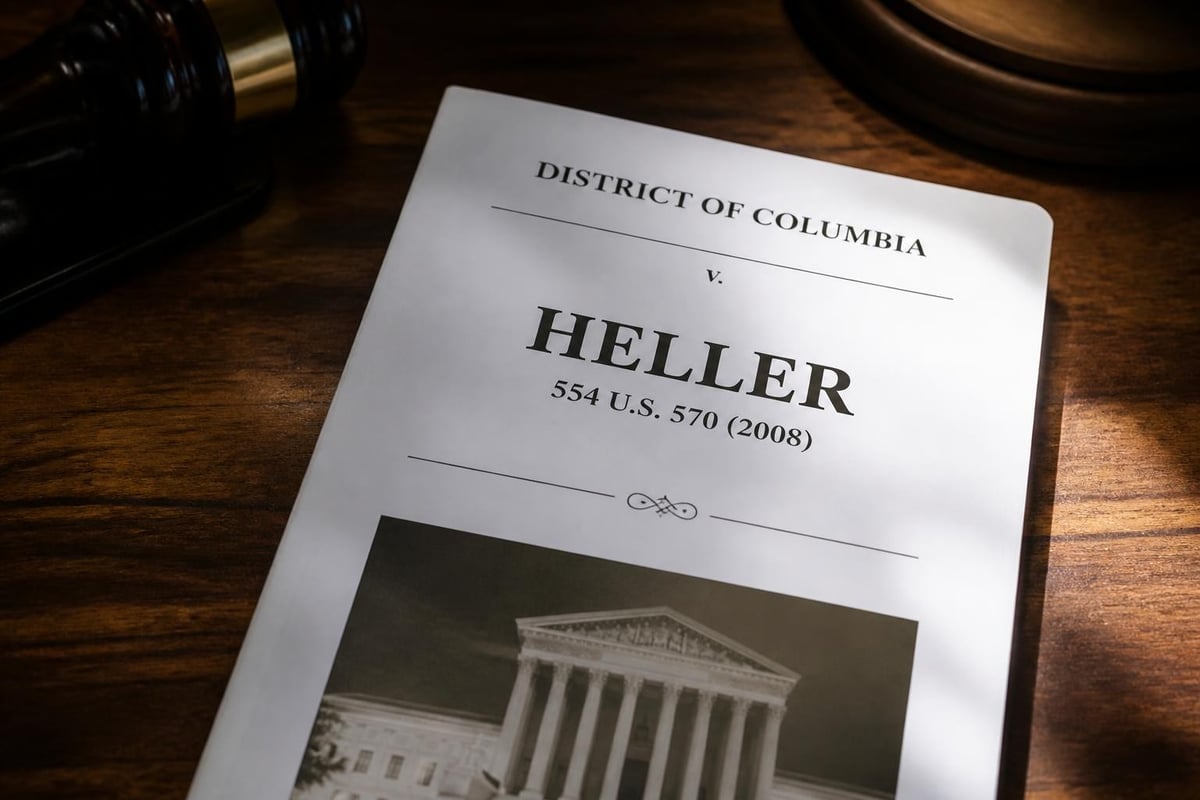
In 2008, the Supreme Court issued its first major Second Amendment ruling in nearly seventy years. District of Columbia v. Heller fundamentally altered the legal landscape by establishing that the Second Amendment protects an individual right to possess firearms, independent of militia service. Justice Antonin Scalia's majority opinion struck down Washington D.C.'s handgun ban, reasoning that the amendment's prefatory clause about militias did not limit the operative clause protecting the right to keep and bear arms.
The decision created several important precedents:
- Individual right recognition: The Court confirmed that gun ownership is a personal constitutional right
- Self-defense emphasis: Protection in the home was identified as the core lawful purpose
- Reasonable regulation allowance: The ruling acknowledged that gun rights are not unlimited
- Longstanding prohibitions: Certain restrictions on dangerous persons and sensitive places remained permissible
This framework has guided subsequent gun rights and Supreme Court cases, establishing boundaries that lower courts continue to interpret and apply.
McDonald v. Chicago: Extending Federal Protections
Two years after Heller, the Court addressed whether Second Amendment protections applied to state and local governments. McDonald v. Chicago (2010) incorporated the Second Amendment against the states through the Fourteenth Amendment's Due Process Clause, preventing local jurisdictions from implementing regulations that would violate federal constitutional standards.
This incorporation meant that federal investigations into gun rights violations could now encompass state and local actions, significantly expanding the scope of Second Amendment enforcement. The decision reflected broader constitutional principles about fundamental rights that transcend geographic boundaries within the United States.
The Bruen Standard and Its Implications
The most consequential recent development in gun rights and Supreme Court cases came with New York State Rifle & Pistol Association, Inc. v. Bruen (2022). This decision invalidated New York's "may-issue" concealed carry licensing system and established a new analytical framework for evaluating firearms regulations.
Justice Clarence Thomas's majority opinion introduced a text-and-history test that requires courts to examine whether challenged regulations are consistent with the nation's historical tradition of firearm regulation. This methodology departed from previous interest-balancing approaches, making it substantially more difficult for governments to defend modern gun restrictions.
The Bruen standard requires:
- Historical analogue identification: Governments must demonstrate that regulations align with historical precedents from the founding era
- Burden justification: Modern laws must address comparable problems through similar means as historical regulations
- Text-based interpretation: Courts should focus on constitutional text rather than judicial interest balancing
| Pre-Bruen Analysis | Post-Bruen Analysis |
|---|---|
| Interest balancing between rights and safety | Text-and-history examination |
| Intermediate scrutiny common | Historical tradition required |
| Modern justifications accepted | Historical analogues necessary |
| More regulatory flexibility | Stricter constitutional limits |
This shift has created significant challenges for domestic policy makers attempting to address gun violence while respecting constitutional boundaries established by recent Supreme Court precedents.
Contemporary Challenges in Gun Rights Litigation
Several emerging issues demonstrate how gun rights and Supreme Court cases continue to evolve in response to technological changes, social developments, and legislative innovations.
Assault Weapons and High-Capacity Magazines
State-level bans on semiautomatic rifles and high-capacity magazines have generated substantial litigation. In 2025, the Supreme Court declined to hear two significant cases challenging Maryland's and Illinois's assault weapons bans, despite dissenting opinions from Justices Thomas and Gorsuch arguing that lower courts had improperly applied Bruen.
More recently, the Court agreed to review whether assault weapon bans violate the Second Amendment, signaling potential willingness to clarify constitutional standards for regulating specific firearm categories. This case could establish whether weapons commonly used for lawful purposes receive constitutional protection even when classified as particularly dangerous.
Marijuana Users and Firearm Possession
The intersection of evolving marijuana laws and gun rights presents novel constitutional questions. The Supreme Court’s decision to review whether regular marijuana users can own firearms highlights tensions between federal prohibitions and state-level legalization.
Federal law prohibits unlawful drug users from possessing firearms, but marijuana's changing legal status complicates enforcement. As more states legalize recreational cannabis, gun rights and Supreme Court cases may need to address whether conduct legal under state law but prohibited federally can justify firearm rights restrictions.
Sensitive Places and Public Carry Restrictions
Following Bruen's invalidation of discretionary licensing schemes, jurisdictions have attempted to expand "sensitive places" where firearms remain prohibited. New York and other states designated numerous locations as gun-free zones, prompting litigation about whether such expansive restrictions comply with constitutional requirements.
Lower courts have reached conflicting conclusions about:
- Public transit restrictions: Whether subways and buses qualify as sensitive places
- Private property defaults: If firearms can be prohibited without explicit permission
- Entertainment venue bans: Whether theaters, stadiums, and parks warrant special treatment
- Government building limitations: How broadly such restrictions may extend beyond courthouses and legislatures
These disagreements may require Supreme Court intervention to establish clearer boundaries for permissible sensitive place designations.
First Amendment Intersections with Gun Rights
An often-overlooked aspect of gun rights and Supreme Court cases involves First Amendment protections for firearms advocacy organizations. National Rifle Association v. Vullo (2024) addressed whether government officials could use regulatory pressure to suppress gun rights advocacy.
The Court unanimously held that New York’s financial regulator violated the First Amendment by allegedly coercing banks and insurers to sever ties with the NRA. Justice Sonia Sotomayor's opinion emphasized that government cannot use indirect pressure to punish advocacy groups for their viewpoints, regardless of how controversial those positions might be.
This decision protects not just gun rights organizations but all advocacy groups from viewpoint-based government retaliation, establishing important precedents for constitutional speech protections.
Presidential Influence on Gun Rights Jurisprudence
Presidential appointments to the Supreme Court significantly impact gun rights and Supreme Court cases, as demonstrated by the ideological composition's influence on recent decisions. The current 6-3 conservative majority has proven more receptive to Second Amendment challenges than previous Court configurations.
Presidential nominations shape:
- Constitutional interpretation methodologies (originalism versus living constitutionalism)
- Willingness to revisit precedent and expand gun rights protections
- Analytical frameworks applied to firearms regulations
- Receptiveness to historical tradition arguments versus modern policy justifications
These appointments create lasting legacies extending decades beyond any president's term, as demonstrated by justices appointed in previous administrations continuing to influence contemporary gun rights litigation. Those interested in presidential firearms policies can explore resources at Gun Shop Range to understand how legal frameworks affect practical firearm ownership and commerce.
Lower Court Implementation Challenges
While the Supreme Court establishes constitutional principles, lower federal and state courts must apply these standards to specific regulations. This implementation process has revealed substantial disagreement about gun rights and Supreme Court cases, particularly following Bruen's text-and-history methodology.
Circuit Splits and Inconsistent Applications
Federal appeals courts have reached contradictory conclusions about similar regulations:
| Regulation Type | Circuits Upholding | Circuits Invalidating | Key Disagreement |
|---|---|---|---|
| Carry restrictions | 2nd, 3rd Circuits | 5th, 9th Circuits | Sensitive places scope |
| Age-based limits | 4th, 6th Circuits | 5th Circuit | Historical tradition existence |
| Domestic violence prohibitions | 7th, 8th Circuits | (pending) | Temporary order coverage |
| Nonviolent felon bans | 3rd Circuit | (pending) | Historical disarmament practices |
These conflicts often require Supreme Court resolution to establish nationwide uniformity, creating backlogs as gun rights and Supreme Court cases accumulate on the Court's docket.
Historical Evidence Disputes
Bruen's historical methodology has created evidentiary battles over founding-era practices. Parties dispute whether specific regulations existed, their scope, their rationales, and whether they represent sufficiently analogous precedents for modern laws.
Judges without historical training struggle with:
- Source reliability: Evaluating competing expert testimony about historical documents
- Analogue sufficiency: Determining how similar historical regulations must be to modern counterparts
- Tradition establishment: Deciding how widespread historical practices must be to constitute a tradition
- Temporal proximity: Weighing founding-era evidence versus later nineteenth-century developments
Future Trajectories for Gun Rights Litigation
Several emerging areas suggest gun rights and Supreme Court cases will continue generating significant constitutional litigation throughout the coming years.
Technological Advancements
Modern firearms technology raises questions that founding-era precedents cannot directly address. 3D-printed guns, trigger modifications, and smart gun technology present regulatory challenges requiring courts to extrapolate from historical principles to contemporary circumstances.
The Supreme Court will likely need to clarify how text-and-history analysis applies when no historical analogues exist for novel technologies, potentially establishing frameworks for technological change more broadly.
Red Flag Laws and Due Process
Extreme risk protection orders, commonly called red flag laws, allow temporary firearm removal from individuals deemed dangerous. These laws raise both Second Amendment and Due Process questions about:
- Evidentiary standards: What proof justifies temporary rights deprivation
- Hearing procedures: Whether ex parte orders comply with constitutional requirements
- Return mechanisms: How quickly rights must be restored when threats dissipate
- Appellate review: What process protections apply to emergency orders
As more states adopt such laws, gun rights and Supreme Court cases will likely address their constitutional boundaries. Key Second Amendment Supreme Court cases have shaped gun law in ways that inform these emerging challenges.
Commercial Regulation Questions
Beyond individual possession rights, courts increasingly confront questions about firearms commerce regulation. Issues include:
- Dealer licensing requirements: How stringent regulations can be before burdening Second Amendment rights
- Manufacturer liability: Whether tort lawsuits impermissibly restrict lawful commerce
- Online sales restrictions: If digital commerce receives different treatment than traditional retail
- Zoning limitations: Whether governments can effectively ban gun stores through location restrictions
These commercial aspects of gun rights and Supreme Court cases may significantly impact how Americans exercise constitutional rights practically rather than theoretically.
The Role of Evidence in Gun Rights Cases
Unlike many constitutional disputes, gun rights litigation increasingly involves empirical debates about regulation effectiveness. Courts must decide how heavily to weigh social science evidence when historical tradition provides the controlling legal framework.
Key evidentiary questions include:
- Whether modern crime data can justify restrictions lacking historical analogues
- How courts should evaluate competing studies about regulation effectiveness
- If legislative findings deserve deference despite contrary historical evidence
- Whether public safety interests can overcome clear historical tradition
These methodological questions affect not just gun rights but broader administrative law and constitutional interpretation principles. Understanding key Supreme Court rulings on the Second Amendment provides context for how evidence and history interact in constitutional analysis.
International Comparisons and Constitutional Uniqueness
The United States' approach to gun rights and Supreme Court cases reflects constitutional commitments largely unparalleled in other democracies. While many nations treat firearms possession as a privilege subject to extensive regulation, American constitutional text explicitly protects gun rights, creating unique jurisprudential challenges.
This exceptionalism means that international precedents offer limited guidance for American courts, reinforcing reliance on domestic historical tradition. Presidential involvement in international agreements cannot override constitutional protections, ensuring that gun rights remain primarily matters of domestic constitutional law rather than international human rights frameworks.
Congressional Responses to Court Decisions
Federal legislation addressing firearms must navigate constitutional boundaries established through gun rights and Supreme Court cases. Congress has limited tools for responding to unfavorable Court decisions short of constitutional amendment, which requires supermajorities Congress rarely achieves on contentious issues.
Legislative approaches include:
- Narrow tailoring: Crafting regulations to satisfy historical tradition requirements
- Funding restrictions: Using appropriations limitations to discourage certain activities
- Interstate commerce regulation: Leveraging federal commerce power for gun trafficking laws
- Background check expansion: Strengthening existing systems within constitutional bounds
These legislative efforts reflect broader tensions between democratic policy preferences and constitutional constraints, themes central to understanding how Supreme Court rulings impact current gun laws and future regulatory possibilities.
Gun rights and Supreme Court cases will continue shaping American firearms policy as courts apply constitutional principles to evolving circumstances and technologies. The Supreme Court's increasingly active role in Second Amendment jurisprudence ensures that these issues will remain central to presidential appointments, legislative debates, and public policy discussions for years to come. For comprehensive, non-partisan coverage of how presidential administrations approach these constitutional questions and their broader governance implications, U.S. Presidential Report provides timely analysis that helps readers understand the intersection of presidential power, judicial interpretation, and fundamental rights.