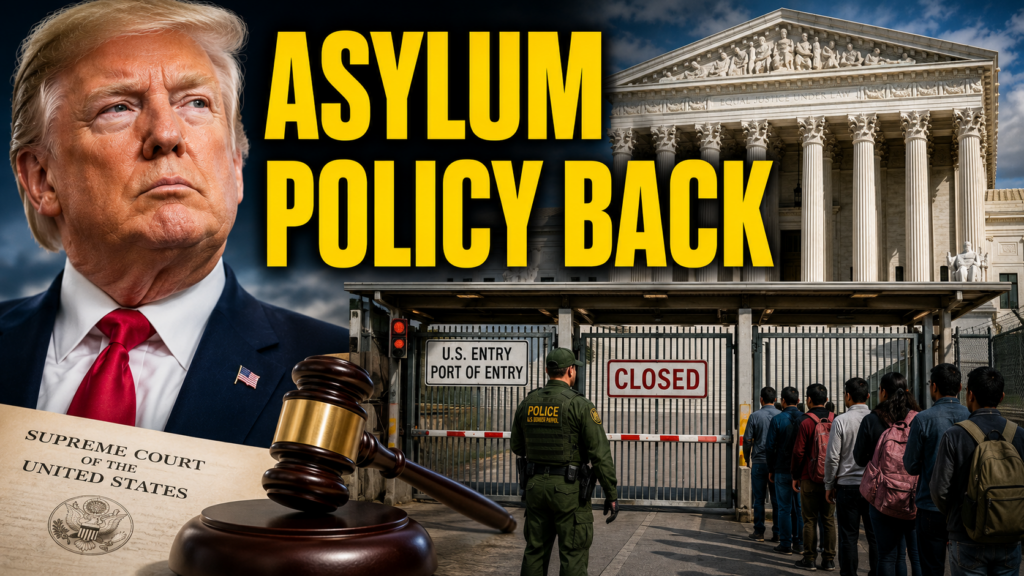
The U.S. Supreme Court has cleared the way for the Trump administration to potentially revive a restrictive immigration policy that limits the number of migrants allowed to apply for asylum each day at the U.S.-Mexico border. The decision marks another significant legal victory for the administration as it seeks to strengthen border enforcement and reshape the nation’s immigration policies. According to a report by PBS NewsHour, the Court ruled that federal officials may once again use the controversial “metering” policy if the administration chooses to reinstate it.
What Happened
In a 6-3 decision, the Supreme Court overturned a lower court ruling that had blocked the use of border metering, a policy that limits how many migrants can present asylum claims at official ports of entry each day.
The policy was first introduced during the Obama administration to manage growing numbers of asylum seekers before being expanded nationwide during President Donald Trump’s first term.
Although the Department of Homeland Security has not announced whether it will immediately restore the policy, officials welcomed the Court’s decision, calling it another tool for strengthening border security.
Understanding the Metering Policy
Under the metering system, asylum seekers arriving at ports of entry may be required to wait before being allowed to begin the asylum application process.
Supporters argue the policy helps immigration officials manage limited resources during periods of high migration while maintaining orderly border operations.
Critics contend the practice leaves vulnerable migrants stranded in dangerous conditions near the border, sometimes for extended periods, while awaiting an opportunity to apply for asylum.
Supreme Court Majority and Dissent
The Court’s conservative majority concluded that migrants who have not yet been formally admitted into the United States are not legally entitled to begin the asylum process immediately.
Writing for the majority, Justice Samuel Alito argued that individuals waiting at ports of entry have not legally entered the country, allowing immigration officials to regulate when asylum processing begins.
Justice Sonia Sotomayor strongly disagreed, reading her dissent from the bench and warning that the ruling weakens protections historically afforded to asylum seekers under U.S. law.
The exchange between Alito and Sotomayor underscored the significance of the decision and highlighted deep divisions within the Court over immigration law.
Political and Immigration Impact
The ruling could significantly strengthen the Trump administration’s immigration enforcement strategy if officials choose to revive the metering policy.
The case is one of several major immigration disputes currently before the Supreme Court involving the administration’s efforts to tighten border security, including litigation over birthright citizenship and temporary legal protections for certain migrant populations.
Supporters view the decision as reinforcing executive authority to manage border operations, while immigrant advocacy organizations argue it could increase humanitarian challenges for people seeking refuge in the United States.
Readers interested in the administration’s broader immigration strategy can also read the proposed expansion of ICE detention warehouses, another initiative aimed at strengthening federal immigration enforcement.
Legal Background
Federal immigration law generally allows individuals who arrive in the United States to apply for asylum if they demonstrate a credible fear of persecution based on protected grounds such as religion, nationality, race, political opinion, or membership in a particular social group.
The Justice Department argued that individuals waiting outside ports of entry have not legally arrived in the country and therefore are not yet entitled to asylum screening.
Immigrant rights organizations, including Democracy Forward and Al Otro Lado, criticized the ruling and warned it could expose asylum seekers to greater risks while waiting outside the United States.
What Happens Next
The Department of Homeland Security has not confirmed whether it will immediately restore the metering policy.
Any decision to revive the practice could face additional legal challenges depending on how the administration implements the policy. Immigration advocates are also expected to continue pursuing litigation involving asylum access and other border enforcement measures.
The Supreme Court continues to consider several other major immigration cases that could further shape federal immigration policy during President Trump’s second term. Readers can also follow recent Republican policy debates surrounding the Trump administration for broader political context.
Conclusion
The Supreme Court’s ruling gives the Trump administration another legal pathway to expand immigration enforcement at the southern border by allowing the possible return of the metering policy. While supporters argue the decision provides immigration officials with greater flexibility to manage border crossings, critics warn it may make asylum protections more difficult to access. Whether the administration chooses to reinstate the policy could become one of the most closely watched immigration decisions of Trump’s second term.
Border metering limits how many migrants can apply for asylum each day at official U.S. ports of entry, requiring others to wait before their claims are processed.
The Court ruled that the Trump administration may legally revive the policy, but the Department of Homeland Security has not yet announced whether it will reinstate it.