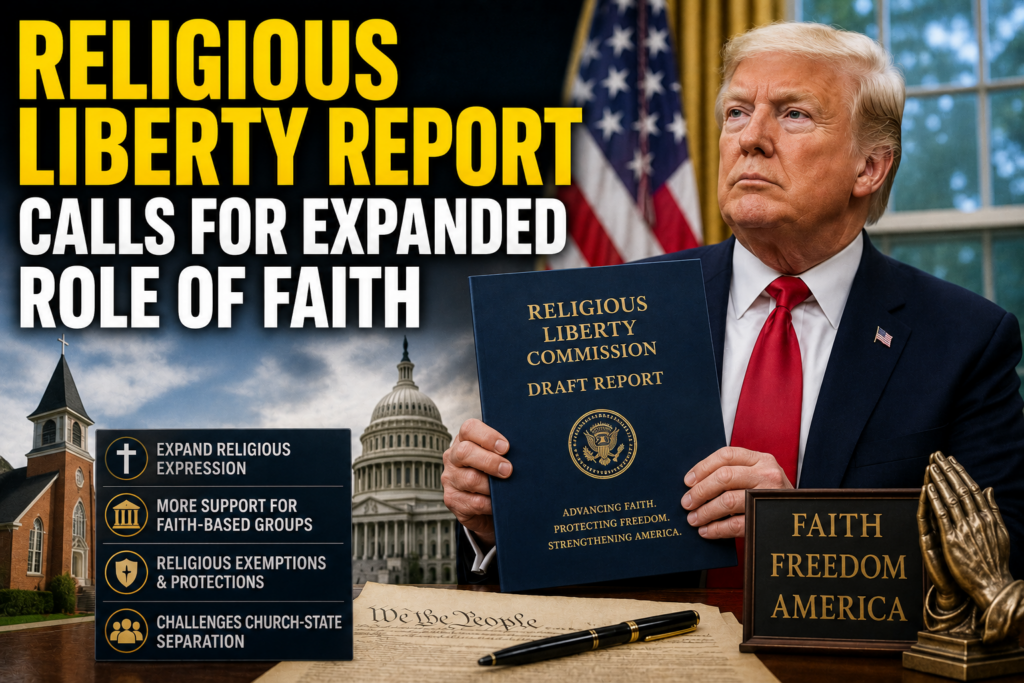
President Donald Trump received a draft report from the Religious Liberty Commission that proposes expanding the role of religion in government and public life while challenging the traditional interpretation of the separation of church and state. The recommendations are expected to spark national debate over religious freedom, constitutional law, and the relationship between government and faith-based organizations. According to a report by PBS NewsHour, the commission’s 224-page draft encourages policies that strengthen religious expression in schools, government institutions, and public spaces.
What Happened
The Religious Liberty Commission presented its draft report to President Trump during a meeting in the Oval Office.
Created by the Trump administration in 2025, the advisory commission is composed primarily of conservative Christian members. The newly released draft outlines dozens of policy recommendations designed to expand protections for religious expression while encouraging greater cooperation between religious institutions and government.
The report has been released for a 15-day public comment period before any final recommendations are considered.
Key Recommendations in the Report
The commission proposes several significant policy changes affecting religious liberty in the United States.
Among its recommendations are repealing the Johnson Amendment, which restricts political activity by tax-exempt religious organizations, increasing public funding opportunities for faith-based organizations, expanding religious exemptions related to vaccine mandates and educational policies, and establishing federal hotlines to receive complaints involving alleged religious liberty violations.
The report also recommends creating a Presidential Medal of Religious Liberty and new federal recognition programs honoring individuals who promote religious freedom.
Debate Over Church and State
One of the report’s most closely watched arguments involves its interpretation of the relationship between religion and government.
Rather than embracing the traditional concept of a strict separation between church and state, the commission argues that government and religious institutions should work together while respecting constitutional protections under the First Amendment.
The report cites historical interpretations suggesting religion has played a foundational role in American public life and argues that modern applications of church-state separation have become overly restrictive.
Critics Raise Constitutional Concerns
Civil liberties organizations and several religious advocacy groups have criticized both the commission’s composition and its recommendations.
A coalition of organizations, including the Center for American Progress and Interfaith Alliance, argues that religious liberty protections should apply equally to Americans of every faith as well as those with no religious affiliation. Critics have also challenged the commission’s ideological diversity, noting ongoing litigation questioning whether the advisory panel satisfies federal requirements for balanced representation.
Others argue the report gives insufficient attention to issues such as discrimination affecting Muslims, Jewish Americans, and nonreligious communities.
Political and Legal Impact
The recommendations arrive as several conservative-led states continue expanding the role of religion in public education and government institutions.
Recent Supreme Court decisions have also reshaped the legal landscape surrounding religious expression, allowing greater accommodation of religious practices in certain public settings while narrowing earlier interpretations of church-state separation.
If adopted, some of the commission’s proposals could influence future executive actions, congressional legislation, or legal challenges concerning religious freedom.
Readers following the administration’s broader domestic agenda may also be interested in recent Republican policy tensions within the Trump administration and how policy priorities continue evolving during Trump’s second term.
What Happens Next
The draft report will remain open for public comment over the next 15 days before the commission finalizes its recommendations.
Although the commission’s proposals are advisory rather than legally binding, they may shape future discussions surrounding religious liberty, constitutional law, education policy, and federal civil rights protections.
The administration continues advancing several domestic policy initiatives alongside these recommendations, including plans to expand ICE detention facilities as part of its broader federal policy agenda.
Conclusion
The Religious Liberty Commission’s draft report marks one of the Trump administration’s most comprehensive efforts to redefine the role of religion in American public life. While supporters argue the recommendations strengthen First Amendment protections, critics contend they could weaken long-standing constitutional principles governing church-state separation. The public comment process and any future policy actions will likely shape one of the administration’s most closely watched constitutional debates.
The Religious Liberty Commission is a Trump administration advisory panel created to recommend policies promoting religious freedom and religious expression in public life.
The draft report proposes expanding religious protections, repealing the Johnson Amendment, increasing support for faith-based organizations, and strengthening religious expression in government and schools.