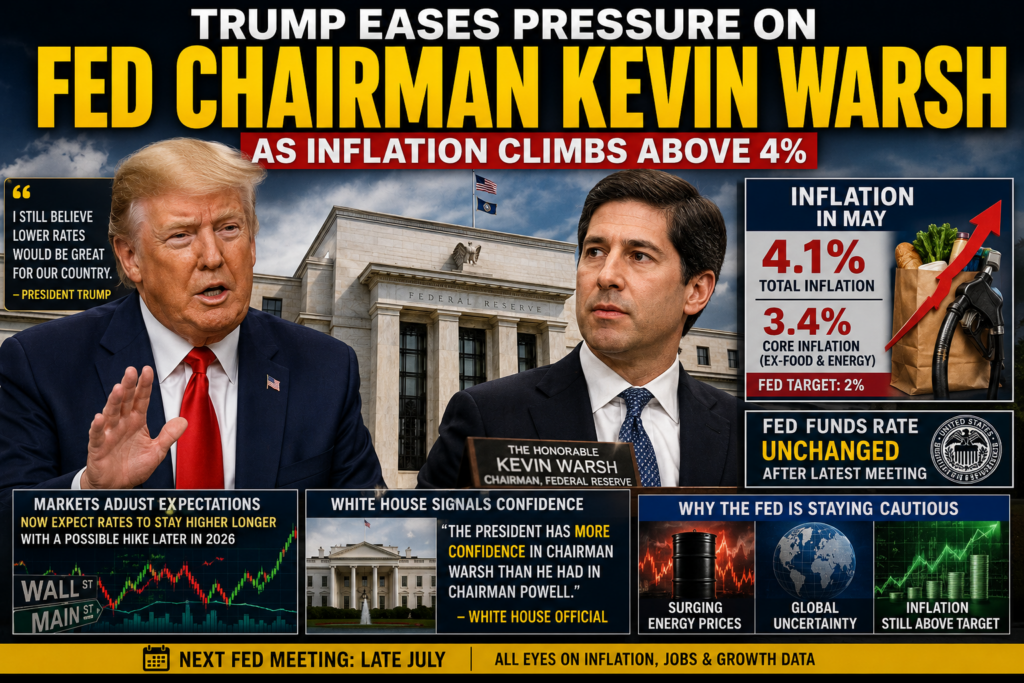
President Donald Trump appears to be softening his long-standing push for immediate interest rate cuts as inflation continues to run above the Federal Reserve’s target. While Trump has repeatedly urged the central bank to lower borrowing costs, recent comments from senior administration officials suggest newly appointed Federal Reserve Chairman Kevin Warsh is being given more time to respond to changing economic conditions. According to a report by CNBC, the shift reflects growing confidence in Warsh despite persistent inflation and global economic uncertainty.
What Happened
Inflation in the United States rose 4.1% in May, according to data released by the Bureau of Economic Analysis, remaining well above the Federal Reserve’s long-term target of 2%. Higher energy prices, driven in part by tensions in the Middle East, contributed significantly to the increase, while core inflation excluding food and energy reached 3.4%.
Despite the elevated inflation figures, the Federal Reserve voted last week to leave interest rates unchanged. Under Kevin Warsh’s leadership, policymakers also ended previous guidance that had suggested future rate cuts, signaling a more cautious approach as they evaluate incoming economic data.
White House Signals Greater Confidence in Warsh
Although President Trump reiterated this week that he believes lower interest rates would strengthen the U.S. economy, several senior administration officials have adopted a more measured tone regarding monetary policy.
A White House official told CNBC that the administration’s economic outlook has not fundamentally changed. Instead, officials emphasized that Trump has greater confidence in Warsh than he had in former Federal Reserve Chair Jerome Powell, giving the new chairman additional flexibility to determine the appropriate course for interest rates.
Treasury Secretary Scott Bessent also stressed that Warsh would operate independently, while White House National Economic Council Director Kevin Hassett suggested it was reasonable for the new chairman to maintain current policy as he settles into the role.
Inflation and Global Events Complicate Rate Decisions
The Federal Reserve’s challenge has become more complicated following recent geopolitical developments.
Energy prices surged after conflict involving Iran disrupted oil markets, contributing to stronger inflation readings across the U.S. economy. Although gasoline prices have eased following the reopening of the Strait of Hormuz, uncertainty remains after renewed attacks in the region raised concerns about future supply disruptions.
With inflation still above target and global markets facing ongoing volatility, many economists now believe the Federal Reserve will prioritize price stability over near-term interest rate cuts.
Markets Shift Expectations
Financial markets have also adjusted their outlook following the Federal Reserve’s latest meeting.
According to CME FedWatch data, investors now largely expect the Federal Reserve to keep rates elevated through much of the year, with many anticipating the possibility of an additional rate increase before the end of 2026 rather than a reduction.
The change reflects growing expectations that inflation may remain stubborn despite easing energy prices and continued economic expansion.
Readers interested in how voters are responding to the administration’s handling of the economy can also explore Trump’s economic approval rating and what it could mean for future policy debates.
Political Implications for the Trump Administration
The administration’s evolving message highlights the balance between supporting economic growth and maintaining confidence in an independent Federal Reserve.
While President Trump continues to advocate for lower borrowing costs, allowing Kevin Warsh additional flexibility may help reinforce the Federal Reserve’s credibility during a period of elevated inflation.
The administration’s approach also reflects broader concerns that premature rate cuts could undermine progress in reducing inflation, particularly as international events continue to affect energy markets and consumer prices.
The Federal Reserve’s decisions are expected to remain a major political and economic issue heading into future policy debates, alongside broader discussions about fiscal policy, trade, and international conflicts. Readers can also learn how recent geopolitical developments are influencing U.S. policy by reading Trump’s cease-fire efforts in the Middle East.
What Happens Next
The Federal Reserve is scheduled to meet again in late July, when officials will review updated inflation, employment, and economic growth data before determining whether changes to interest rates are necessary.
For now, Kevin Warsh appears to have the White House’s confidence as he navigates one of the most challenging inflation environments in recent years. However, if inflation remains elevated or economic conditions deteriorate, pressure from both financial markets and political leaders could quickly intensify.
Conclusion
President Trump’s softer stance toward Federal Reserve Chairman Kevin Warsh signals an important shift in the administration’s economic messaging as inflation remains above 4%. Rather than demanding immediate rate cuts, White House officials are emphasizing patience while Warsh evaluates evolving economic conditions. With inflation, energy markets, and global instability continuing to shape the outlook, the Federal Reserve’s next decisions will likely carry significant consequences for the U.S. economy, financial markets, and the administration’s broader economic agenda.
The administration says it has confidence in Warsh’s leadership as the Federal Reserve responds to elevated inflation and uncertain economic conditions.
The Fed chose to keep rates steady because inflation remains well above its 2% target and policymakers want more evidence that price pressures are easing.