The United States Supreme Court plays a pivotal role in shaping how Americans elect their leaders, from presidential contests to congressional races. Through landmark decisions on voting rights, campaign finance, redistricting, and ballot access, the Court's rulings establish precedents that govern election administration across all fifty states. Understanding supreme court and election cases explained requires examining both historical precedents and contemporary controversies that continue to define the boundaries of American democracy. For readers of U.S. Presidential Report, grasping these legal principles provides essential context for interpreting how judicial decisions influence presidential elections and the broader electoral landscape.
The Constitutional Foundation of Election Law
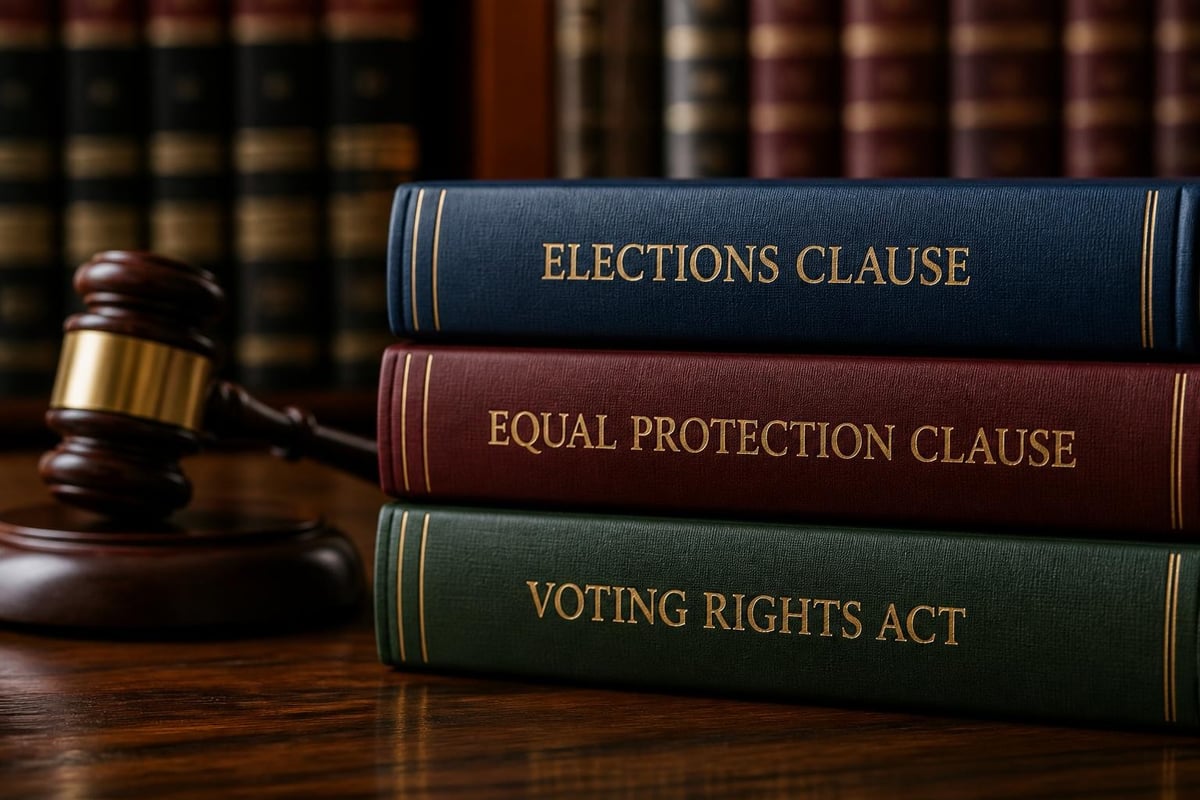
The Supreme Court's authority to decide election cases stems from several constitutional provisions that grant both federal and state governments overlapping powers over election administration. Article I, Section 4 of the Constitution-known as the Elections Clause-grants state legislatures primary authority to regulate congressional elections while permitting Congress to override state rules. Meanwhile, the Fourteenth Amendment's Equal Protection Clause and the Fifteenth Amendment's prohibition on racial discrimination in voting have become central to modern election jurisprudence.
These constitutional provisions create tension between state sovereignty and federal oversight. The Court frequently mediates disputes about where state authority ends and federal protection begins. This balance has shifted dramatically over the past century as the Court has expanded and contracted voting rights protections depending on the composition of the justices and prevailing legal philosophies.
Independent State Legislature Theory
Recent debates have centered on the "independent state legislature theory," which argues that state legislatures possess nearly unchecked power to regulate federal elections without oversight from state courts or governors. The Supreme Court addressed this theory in Moore v. Harper (2023), ultimately rejecting the most extreme version while preserving legislative authority within constitutional bounds.
The Court held that state constitutions do constrain legislative power over elections, but state courts must respect legislative choices unless they violate clear constitutional provisions. This decision has significant implications for how states handle election disputes and whether state judiciaries can review partisan gerrymandering or restrictive voting laws passed by legislatures.
Landmark Voting Rights Decisions
The Supreme Court's voting rights jurisprudence has evolved dramatically since the mid-twentieth century, with decisions both expanding and contracting federal protections for ballot access. Understanding supreme court and election cases explained means examining how the Court interprets the Voting Rights Act of 1965, which remains the cornerstone of federal voting rights protection despite significant erosion in recent years.
Shelby County v. Holder (2013)
This watershed decision struck down the coverage formula in Section 4(b) of the Voting Rights Act, which determined which states required federal "preclearance" before changing voting laws. Chief Justice John Roberts wrote that the formula relied on decades-old data and no longer reflected current conditions. The decision effectively gutted Section 5 preclearance, removing a key tool that had blocked discriminatory voting changes before they took effect.
Following Shelby County, numerous states enacted stricter voter identification requirements, reduced early voting periods, and purged voter rolls. The Brennan Center for Justice has documented how this decision led to a surge in restrictive voting legislation across states that previously required preclearance.
Brnovich v. Democratic National Committee (2021)
The Court further limited the Voting Rights Act's remaining enforcement mechanism in Brnovich, establishing a multi-factor test that makes it harder to challenge voting restrictions under Section 2. The decision upheld Arizona laws prohibiting ballot collection and rejecting out-of-precinct ballots, finding they did not violate the law's prohibition on discriminatory voting practices.
Justice Samuel Alito's majority opinion emphasized that states have legitimate interests in preventing fraud and maintaining voter confidence, even when evidence of actual fraud is minimal. This decision signals the Court's deference to state regulations that impose modest burdens on voting access.
| Case | Year | Key Holding | Impact on Elections |
|---|---|---|---|
| Shelby County v. Holder | 2013 | Struck down VRA preclearance formula | States no longer need federal approval for voting changes |
| Brnovich v. DNC | 2021 | Narrowed Section 2 enforcement | Harder to challenge restrictive voting laws |
| Crawford v. Marion County | 2008 | Upheld voter ID requirement | Legitimized strict identification laws |
| Harper v. Virginia Board | 1966 | Banned poll taxes | Expanded ballot access for low-income voters |
Campaign Finance and Election Spending
Supreme court and election cases explained would be incomplete without examining how the Court has transformed campaign finance law, fundamentally altering how money flows through presidential and congressional elections. These decisions rest on the premise that political spending constitutes protected speech under the First Amendment.
Citizens United v. FEC (2010)
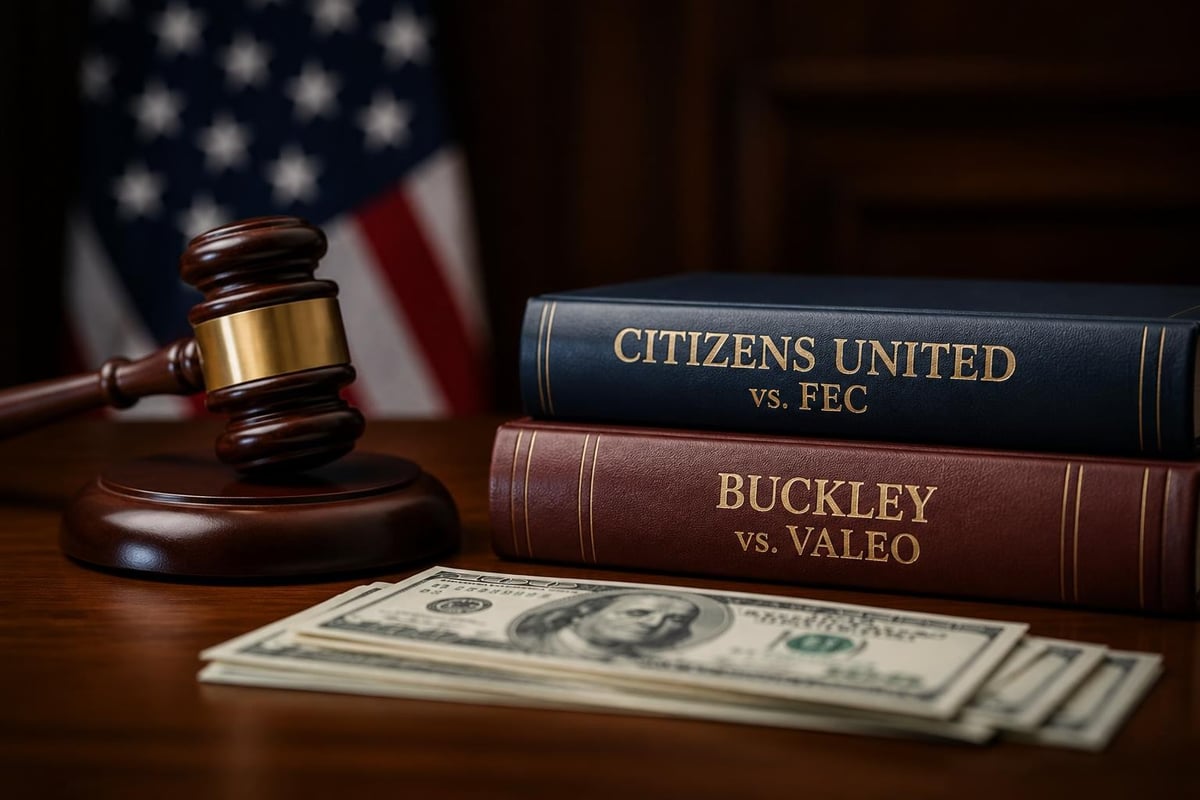
Perhaps no modern election case has proven more controversial than Citizens United, which held that the government cannot restrict independent political expenditures by corporations, unions, or associations. The decision overturned precedent and unleashed unlimited spending by outside groups through Super PACs and dark money organizations.
Justice Anthony Kennedy's majority opinion reasoned that independent expenditures do not create corruption or the appearance of corruption because they lack coordination with candidates. Dissenting justices warned the decision would allow wealthy interests to dominate elections-a prediction many observers believe has materialized. The influence of campaign spending on presidential contests has grown exponentially since 2010, as documented in analyses of Biden vs Trump campaign money.
Buckley v. Valeo (1976)
This foundational decision established the framework that still governs campaign finance law: contribution limits are constitutional because they prevent corruption, but expenditure limits violate free speech. The Court drew a distinction between giving money directly to candidates (which can be limited) and spending money independently to support or oppose candidates (which cannot).
Key principles from Buckley:
- Direct contributions may be capped to prevent quid pro quo corruption
- Independent expenditures receive full First Amendment protection
- Disclosure requirements are generally permissible
- Candidate spending limits unconstitutional except for publicly funded campaigns
The Buckley framework has generated criticism from across the political spectrum, with some arguing it provides insufficient corruption protection while others contend it restricts too much political activity.
Redistricting and Gerrymandering Cases
The Supreme Court's approach to redistricting cases demonstrates the limits of judicial intervention in political processes. While the Court has ruled against racial gerrymandering, it has declined to address partisan gerrymandering despite acknowledging its potentially corrosive effects on representative democracy.
Rucho v. Common Cause (2019)
In a 5-4 decision, the Court held that partisan gerrymandering presents a nonjusticiable political question beyond the reach of federal courts. Chief Justice Roberts acknowledged that excessive partisanship in redistricting is "incompatible with democratic principles," yet concluded that courts lack manageable standards to distinguish permissible from unconstitutional partisan advantage.
The decision leaves partisan gerrymandering challenges to state courts applying state constitutional provisions or to Congress through legislation. Some states have established independent redistricting commissions, while others continue to allow legislatures to draw district lines favoring the party in power.
Baker v. Carr (1962) and Reynolds v. Sims (1964)
These earlier decisions established the "one person, one vote" principle, requiring legislative districts to contain roughly equal populations. Baker held redistricting challenges are justiciable, while Reynolds applied equal population requirements to state legislative districts. Together, they revolutionized American democracy by ending malapportionment that gave rural areas disproportionate representation.
The principle extends to congressional districts, requiring states to draw maps with minimal population deviation. However, precise equality doesn't prevent gerrymandering-districts can have equal populations while being shaped to maximize partisan advantage.
Bush v. Gore and Presidential Election Disputes
No discussion of supreme court and election cases explained can omit Bush v. Gore (2000), which effectively decided the 2000 presidential election. The per curiam opinion halted Florida's recount, finding that varying standards across counties violated the Equal Protection Clause. The decision awarded Florida's electoral votes-and the presidency-to George W. Bush.
The Court explicitly limited the decision's precedential value, stating it applied only to the specific circumstances presented. However, the case established that Equal Protection principles apply to vote-counting procedures and that federal courts can intervene in state election processes under certain circumstances. For readers interested in how Supreme Court nominations intersect with presidential politics, President Biden’s Supreme Court nominee offers relevant context about judicial selection.
Trump v. Anderson (2024)
The Court recently addressed whether states could remove candidates from ballots based on Section 3 of the Fourteenth Amendment, which bars insurrectionists from office. In a narrow, unanimous decision, the Court held that states cannot enforce Section 3 against federal candidates without congressional legislation establishing enforcement procedures. This decision prevented multiple states from removing a candidate from the 2024 presidential ballot.
The ruling avoided the broader question of whether the candidate engaged in insurrection, focusing instead on the procedural question of who has authority to make that determination. The decision illustrates judicial preference for narrow holdings that avoid direct entanglement in presidential politics.
Recent Developments in Election Administration
The Supreme Court continues to shape election law through cases addressing voter registration, mail ballots, signature matching, and deadline extensions. These seemingly technical issues can determine electoral outcomes in close races.
Purcell Principle and Emergency Relief
The Court has developed an informal doctrine-called the Purcell principle after Purcell v. Gonzalez (2006)-disfavoring last-minute changes to election rules. When lower courts block state election laws shortly before elections, the Supreme Court often stays those injunctions, allowing the laws to take effect despite ongoing legal challenges.
Recent applications include:
- Allowing voter ID requirements to remain in effect pending appeal
- Permitting witness signature requirements for mail ballots
- Blocking extended ballot receipt deadlines ordered by lower courts
- Preventing enforcement of new redistricting maps close to elections
Critics argue the Purcell principle has become a one-way ratchet favoring restrictive laws, while defenders contend it prevents voter confusion and maintains election integrity. The Harvard Law Review’s Election Law section provides scholarly analysis of how this principle has evolved.
Mail Voting and COVID-19 Cases
The 2020 election generated numerous emergency applications concerning pandemic-related voting changes. The Court generally deferred to state legislatures, blocking some lower court orders extending mail ballot deadlines while allowing others to stand. These decisions reinforced that state legislatures-not courts or election officials-possess primary authority to set election rules.
Access to the Ballot and Third-Party Candidates
The Supreme Court has addressed numerous cases involving ballot access requirements for presidential candidates, minor parties, and independent candidates. These decisions balance states' interests in manageable ballots against candidates' rights to seek office and voters' rights to choose among alternatives.
Anderson v. Celebrezze (1983)
This case established the framework courts use to evaluate ballot access restrictions. The Court held that states must demonstrate important regulatory interests that justify the burden imposed on voting rights. Early filing deadlines, excessive signature requirements, and prohibitive filing fees must survive this balancing test.
The decision recognized that overly restrictive ballot access laws can effectively create a two-party system by excluding alternative voices. However, the Court has generally upheld reasonable signature requirements and filing deadlines that give states time to prepare ballots and voters time to evaluate candidates.
Williams v. Rhodes (1968)
The Court struck down Ohio's ballot access scheme as unconstitutionally burdensome on minor parties. The law required new parties to obtain signatures equal to 15% of votes cast in the previous gubernatorial election and prohibited voters from signing petitions for more than one party. The decision established that while states need not make ballot access easy, they cannot make it virtually impossible for new parties to compete.
| Ballot Access Factor | Constitutional Status | Rationale |
|---|---|---|
| Reasonable signature requirements | Generally upheld | States may ensure meaningful support |
| Excessive signatures (15%+ of electorate) | Struck down | Creates insurmountable barrier |
| Early filing deadlines (8+ months before election) | Questioned | Limits responsive candidacies |
| Filing fees in moderate amounts | Upheld | Prevents frivolous candidates |
| Write-in candidate bans | Mixed results | Depends on availability of alternatives |
Voter Identification and Registration Cases
Voter identification laws have generated significant litigation, with the Supreme Court upholding Indiana's photo ID requirement in Crawford v. Marion County Election Board (2008). Justice John Paul Stevens acknowledged the law imposed burdens on some voters but found insufficient evidence that those burdens were severe or widespread.
The Crawford decision opened the door to stricter ID requirements nationwide. States have enacted varying standards, from requiring government-issued photo identification to accepting utility bills or other documents. The National Constitution Center’s voting rights resources explain how these requirements interact with constitutional protections.
Arizona v. Inter Tribal Council (2013)
The Court struck down Arizona's requirement that voters provide proof of citizenship when registering using the federal voter registration form. Justice Antonin Scalia's opinion held that the National Voter Registration Act preempts state documentary proof requirements for federal elections, though states retain authority over state-specific registration forms.
This decision illustrates federalism tensions in election administration, where federal law may supersede state preferences about voter eligibility verification. However, the decision left open whether states could require proof of citizenship through alternative mechanisms.
Looking Ahead: Pending and Future Cases
The Supreme Court's election law docket remains full as litigation continues over voting restrictions, redistricting challenges, and campaign finance regulations. Several cases working through lower courts may reach the Supreme Court in coming terms, potentially reshaping election administration before the 2028 presidential contest.
Pending issues include challenges to ranked-choice voting systems, questions about the scope of remaining Voting Rights Act protections, and disputes over state efforts to regulate social media companies' content moderation during elections. The Court's composition and judicial philosophy will determine whether it expands or further restricts federal oversight of state election practices.
Emerging areas of election litigation:
- Digital campaign advertising and disclosure requirements
- Social media platform regulation and candidate access
- Foreign influence in elections through sophisticated information operations
- Artificial intelligence-generated campaign content and deepfakes
- Blockchain voting security and verification
- Automatic voter registration systems
For comprehensive coverage of how these legal developments affect presidential politics, resources like Oyez’s case summaries and the Brookings Institution’s Supreme Court analysis provide accessible explanations alongside primary sources from the Supreme Court’s official opinions.
The Court's Institutional Role in Democracy
Supreme court and election cases explained reveals how the Court serves as both guardian of electoral integrity and potential threat to democratic participation. When the Court protects voting rights from discriminatory laws, it fulfills its counter-majoritarian role by defending minority interests against legislative overreach. Conversely, when it defers to restrictive state laws or creates obstacles to enforcement, critics argue it enables democratic backsliding.
The Court's legitimacy depends partly on public perception that it decides cases based on constitutional principles rather than partisan preferences. However, with election cases often splitting along predictable ideological lines, maintaining this perception grows increasingly difficult. The 6-3 conservative majority appointed through processes many Democrats view as illegitimate has intensified scrutiny of the Court's election law decisions.
Judicial Restraint vs. Activism Debate
Conservative justices typically advocate judicial restraint in election cases, arguing courts should defer to elected legislatures except when laws clearly violate constitutional text. This philosophy underlies decisions like Rucho (declining to address partisan gerrymandering) and Shelby County (limiting the Voting Rights Act based on federalism concerns).
Progressive justices more often support active judicial protection of voting rights, viewing the Court as essential safeguard against legislative majorities that manipulate election rules to entrench power. They argue that judicial intervention is necessary when political processes themselves have been corrupted through gerrymandering, voter suppression, or unlimited money in politics.
Understanding how the Supreme Court shapes American elections through its rulings provides essential context for interpreting presidential politics and democratic governance. The Court's decisions on voting rights, campaign finance, redistricting, and ballot access establish the rules under which all candidates compete for office. For readers seeking non-partisan coverage of how these judicial developments intersect with presidential politics, U.S. Presidential Report offers comprehensive analysis of current and historical election-related decisions, helping you stay informed about the legal framework governing American democracy.