Presidential elections represent the pinnacle of American democracy, but razor-thin margins sometimes demand a second look at the ballots. Understanding how recounts work in presidential elections is essential for voters, journalists, and political observers who want to grasp what happens when Election Night results hang in the balance. The recount process involves a complex interplay of state law, federal deadlines, and meticulous procedures designed to ensure every valid vote is counted accurately. Unlike congressional or local races, presidential recounts carry unique pressures because of the Electoral College system and the tight timeline mandated by federal law for certifying electors.
The Legal Framework Behind Presidential Recounts
Presidential recounts operate within a dual system of state and federal requirements. Each state writes its own election code governing when and how recounts occur, but presidential contests face an additional layer of federal constraints. The Electoral Count Reform Act and the safe harbor deadline create firm boundaries that state recount processes must respect.
States fall into three broad categories regarding recount triggers. Some mandate automatic recounts when the margin falls below a specific threshold, typically between 0.25% and 1.0% of votes cast. Others permit candidates or voters to request recounts, sometimes requiring the petitioner to pay costs if the margin exceeds certain levels. A third group combines both automatic and requested recount provisions, creating a tiered system based on how close the race actually is.
The detailed state-by-state recount and audit laws reveal significant variation in thresholds and procedures. Wisconsin, for instance, allows any candidate to request a recount but requires the petitioner to pay if the margin exceeds 0.25%. Pennsylvania provides no automatic recount for presidential races but permits voters in a precinct to petition for one. These differences become critically important when multiple states simultaneously fall within recount range.
Federal Deadlines That Constrain the Process
Presidential recounts cannot extend indefinitely because federal law imposes strict certification deadlines. The safe harbor provision requires states to resolve all election disputes and certify their results at least six days before the Electoral College meets in mid-December. In 2026, this timeline means states must complete any recounts, canvassing, and certification well before the electors gather.
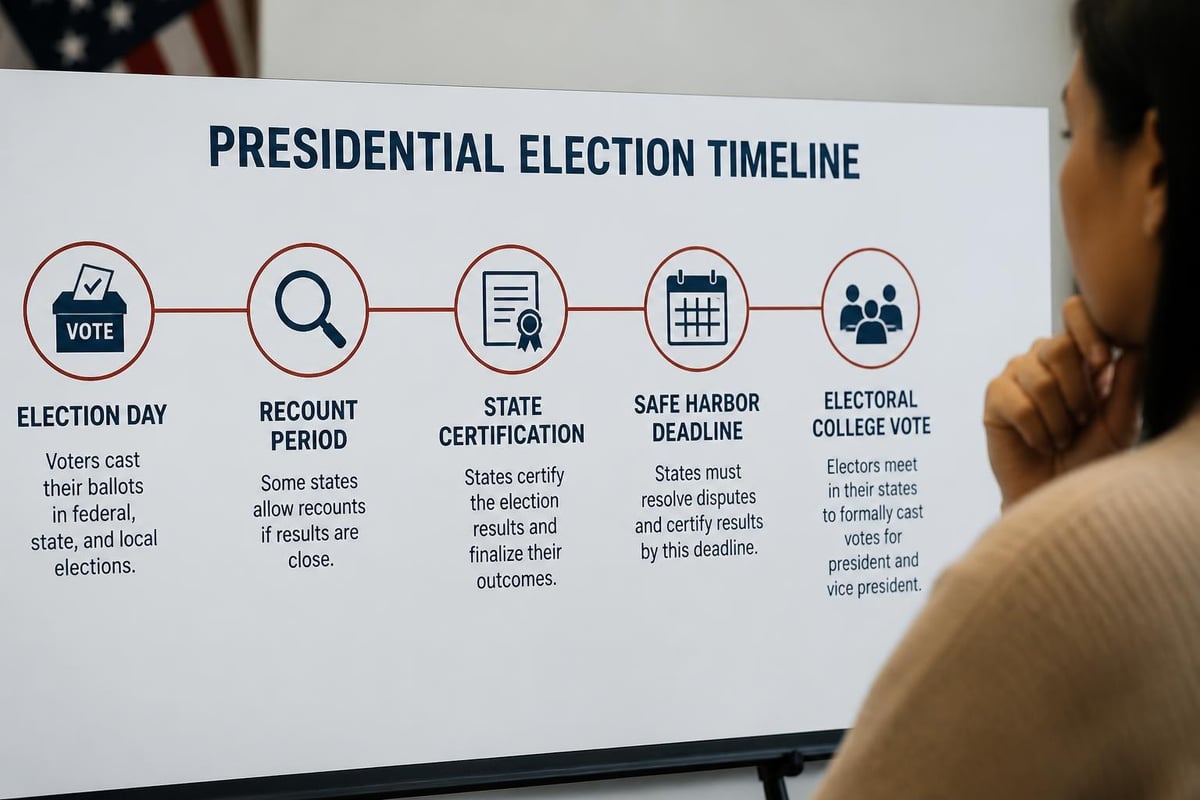
This compressed schedule dramatically affects how recounts work in presidential elections compared to other races. A state legislative contest might allow weeks for a careful hand recount, but presidential recounts often must be completed in days. The election results canvass and certification process shows how recounts fit into the broader sequence of post-election activities that must conclude before the Electoral College convenes.
Types of Recounts and Their Procedures
Election officials employ different recount methodologies depending on state law, the voting equipment used, and the closeness of the race. Understanding these distinctions clarifies why some recounts take hours while others require days or weeks.
Machine Recounts Versus Hand Recounts
Machine recounts involve running ballots through the same tabulation equipment a second time, often with different settings or personnel. This approach works quickly but may not catch systematic errors in how machines interpret voter intent. Hand recounts require trained election workers to physically examine each ballot and determine the voter's choices according to state standards.
The choice between these methods significantly impacts both accuracy and timeline. A machine recount of 100,000 ballots might finish overnight, while a hand recount of the same ballots could take a week. States with paper ballot systems can conduct either type of recount, but jurisdictions using certain electronic voting machines face limitations on what recounting actually means.
| Recount Type | Typical Duration | Best For | Limitations |
|---|---|---|---|
| Machine recount | 1-3 days | Large jurisdictions, tight deadlines | May repeat original errors |
| Partial hand recount | 3-7 days | Targeted verification, sample audits | Doesn't examine all ballots |
| Full hand recount | 1-3 weeks | Extremely close races, disputed counts | Labor intensive, expensive |
| Audit (not technically a recount) | Varies | Verifying machine accuracy | May not change official results |
Hand recount standards prove particularly controversial in presidential contests. The 2000 Florida recount demonstrated how different counties applying different standards to determine "voter intent" on unclear ballots can create equal protection concerns. Since then, most states have adopted more specific criteria defining what constitutes a valid vote on a hand-marked ballot.
Who Conducts and Observes Recounts
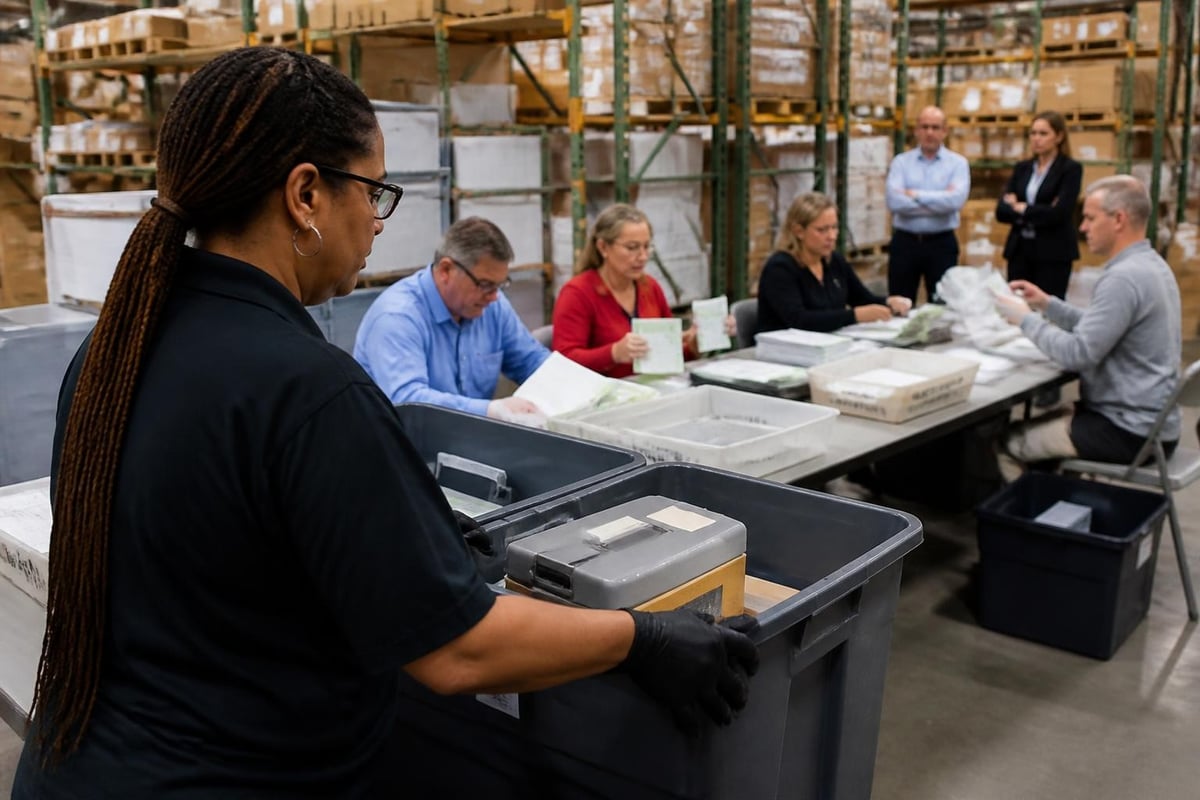
Recounts typically occur at the county level under supervision of local election boards, with state officials coordinating and establishing uniform procedures. The practical guidance on conducting recounts emphasizes the importance of chain of custody, bipartisan teams, and transparency throughout the process.
Most states require bipartisan counting teams, with one Democrat and one Republican examining each ballot together during hand recounts. Political party representatives and candidate observers typically have rights to monitor the recount, challenge specific ballot interpretations, and raise procedural objections. This transparency serves dual purposes: it builds public confidence and creates a real-time adversarial review system.
The role of state election officials varies considerably. Some secretaries of state actively supervise recounts and can issue binding interpretations of ballot-marking standards. Others serve primarily as coordinators, compiling county results without direct authority over local recount procedures. These differences in state administration structure affect how uniformly recount standards are applied across a state's counties.
Triggering a Recount in Presidential Contests
The mechanics of how recounts work in presidential elections begin with determining whether a recount will occur at all. Automatic triggers, candidate petitions, and legal challenges each follow distinct pathways.
Automatic Recount Provisions
Nineteen states have automatic recount laws that require a second count when results fall within a specified margin, no request necessary. These thresholds range from 0.1% in South Dakota to 1.0% in Maryland. When the certified vote count shows a margin within the automatic threshold, the recount begins immediately after the initial canvass.
Common automatic recount thresholds include:
- 0.25%: States that use this tight margin typically conduct machine recounts first
- 0.5%: The most common threshold, balancing accuracy concerns with practical limits
- 1.0%: Broader thresholds sometimes trigger machine recounts with hand recount options at narrower margins
Automatic recounts remove political pressure from the decision to recount. Neither candidate must make the uncomfortable choice of requesting verification, and officials simply follow statutory requirements. This system worked smoothly in the 2020 Georgia presidential race, where the narrow margin triggered an automatic hand recount that confirmed the original result.
Candidate-Requested Recounts
States without automatic provisions typically allow candidates to petition for recounts, often with conditions. Payment requirements vary based on the margin. If the race falls within a certain range (often 0.5%), the state absorbs costs. Beyond that threshold, the requesting candidate must pay estimated recount costs upfront, receiving a refund only if the recount changes the outcome.
The comprehensive overview of election administration details which states require payment and under what circumstances. Wisconsin's 2016 presidential recount, requested by a third-party candidate, cost over $3.5 million, paid by the requesting campaign.
Petition deadlines are strict. Most states require recount requests within 48 to 72 hours after the canvass, compressing the timeline even further. Candidates must decide whether to pursue a recount before having time to investigate alleged irregularities or determine whether a recount might actually change the outcome.
The Recount Process Step by Step
Once triggered, presidential recounts follow a systematic process designed to maintain ballot security while allowing thorough review. The specific steps vary by state, but common elements appear across jurisdictions.
Standard recount procedures typically include:
- Securing the ballots: Election officials retrieve sealed ballot containers from secure storage and verify tamper-evident seals remain intact
- Establishing counting teams: Bipartisan teams receive training on ballot-marking standards and counting procedures specific to the recount
- Organizing the workspace: Ballots are sorted by precinct or batch, with separate areas for uncontested ballots, challenged ballots, and spoiled ballots
- Counting: Teams systematically review each ballot, marking tallies and segregating any ballots where the voter's intent is unclear
- Resolving challenges: A canvassing board or recount official adjudicates disputed ballots based on state standards
- Compiling results: Precinct totals are aggregated to county totals, then forwarded to state officials
- Certification: The state canvassing board certifies the recount results, which become the official final count
This process must occur under continuous observation, with strict chain of custody documentation at every transfer. The compressed timeline for presidential recounts means multiple counties often work simultaneously, requiring careful coordination to ensure uniform application of standards.
Ballot Adjudication Standards
The most contentious aspect of hand recounts involves determining voter intent on ballots with unclear markings. Did the voter mean to select a candidate when they made a small mark next to a name? If a voter marked two candidates but crossed one out, does that show clear intent to vote for the unmarked candidate?
State law typically provides general principles: give effect to voter intent where possible, don't disenfranchise voters due to minor marking errors, apply standards consistently. Specific guidance might address common issues like overvotes (selecting more candidates than allowed), stray marks, and partially filled ovals or arrows. The canvassing board makes final decisions on challenged ballots, creating a record that can be reviewed if litigation follows.
Political and Legal Challenges During Recounts
Presidential recounts rarely occur in a vacuum. Political pressure, legal challenges, and public scrutiny create a charged atmosphere that can complicate the technical work of recounting ballots.
Litigation and Recounts
Lawsuits frequently accompany close presidential races, addressing issues ranging from ballot-marking standards to recount procedures to the validity of specific categories of ballots. The analysis of election certification processes examines how courts can order recounts, halt them pending resolution of legal issues, or modify the procedures being used.
Federal courts sometimes intervene when plaintiffs raise constitutional claims, such as equal protection violations from inconsistent ballot standards. State courts interpret state election codes and resolve disputes about whether recounts are being conducted according to statutory requirements. This dual-court system can create conflicting orders and jurisdictional battles during the recount window.
The safe harbor deadline creates enormous pressure on courts to rule quickly. Judges must balance the need for careful deliberation with the practical reality that delayed decisions might disenfranchise an entire state's voters by preventing timely certification of electors. The report on certification crises documents several instances where this tension nearly prevented states from meeting federal deadlines.
The Role of State Certification Officials
Understanding how recounts work in presidential elections requires recognizing that certification is a separate step from counting or recounting. After the recount concludes, state officials must certify the results, declaring them final and official. This certification enables the governor to prepare the Certificate of Ascertainment listing the state's presidential electors.
Most states treat certification as ministerial-officials must certify results that have been properly canvassed and recounted. However, some states give canvassing boards limited discretion to investigate irregularities before certifying. This discretion becomes controversial when losing candidates pressure officials to delay or refuse certification based on alleged fraud or procedural violations.
The state-level canvassing and certification timelines compiled by election officials show how little time exists between the completion of recounts and certification deadlines. Most states must certify results within three to four weeks of Election Day, leaving minimal room for extended recounts or legal proceedings.
Cost and Logistics of Presidential Recounts
Presidential recounts impose significant financial and operational burdens on state and local governments. Even machine recounts require staff overtime, security personnel, and observer accommodations. Hand recounts multiply these costs dramatically.
Financial Implications
A statewide presidential recount in a large state can cost millions of dollars. The expense includes:
- Personnel costs: Overtime for election workers, temporary hiring for counting teams, security staff
- Facility expenses: Renting space large enough to accommodate counting operations and observers
- Materials: Printing tally sheets, securing additional ballot storage, providing equipment
- Legal fees: Defending procedures against challenges, seeking court guidance on disputed issues
- Technical support: Maintaining and operating counting equipment, troubleshooting problems
States with automatic recounts typically appropriate funds in advance to cover these contingencies. When candidates request recounts outside automatic thresholds, they usually must post bonds covering estimated costs. If the recount doesn't change the outcome, the state keeps the bond to reimburse its expenses.
| State | Automatic Threshold | Who Pays (Automatic) | Candidate Request | Who Pays (Requested) |
|---|---|---|---|---|
| Arizona | 0.1% or less | State | Yes, within 0.5% | Requester if margin >0.5% |
| Michigan | 2,000 votes or less | State | Yes | Requester pays all costs |
| Nevada | 1.0% or less | State | Yes, within 1.0% | State |
| Pennsylvania | 0.5% or less | State | Limited (by voters) | Petitioners |
| Wisconsin | No automatic | N/A | Yes | Requester unless margin <0.25% |
Logistical Challenges
The sheer volume of ballots in a presidential race creates practical obstacles. A state that cast 5 million votes needs space to spread out ballots for review, teams to count them, and systems to track results. Counties must balance recount operations against their regular duties and the approaching deadline for certifying results.
Security requirements add another layer of complexity. Ballots must remain in continuous custody with documented chain of control. Counting facilities need restricted access to prevent tampering while still accommodating dozens or hundreds of official observers. Election officials must prevent any possibility that ballots could be altered, substituted, or miscounted during the recount process.
When Recounts Change Outcomes
Despite intense scrutiny and careful procedures, recounts rarely reverse initial results in presidential races. Statistical analysis shows that recounts typically shift vote totals by a few hundred votes at most, far less than the margins that trigger automatic recounts.
Historical Examples
The 2000 Florida presidential recount remains the most famous example, though it concluded without completion when the Supreme Court halted the process. The initial count showed George W. Bush ahead by 1,784 votes. A mandatory machine recount narrowed the margin to 327 votes. The subsequent partial hand recount was stopped before determining whether it would have changed the outcome.
More recently, the 2020 presidential election saw recounts in several states. Georgia conducted a hand recount that shifted the margin by a few thousand votes but confirmed the original winner. Wisconsin's recount actually increased the winning candidate's margin slightly. These recounts demonstrated that modern voting systems generally count accurately the first time, with recounts primarily serving to verify rather than reverse initial tallies.
Why Recounts Seldom Flip Results
Several factors explain the stability of election results through recounts. Modern optical scan voting equipment reads ballots with very high accuracy, making systematic counting errors unlikely. Human counters in hand recounts may catch individual ballots the machines misread, but they also make their own errors that often balance out statistically.
The margins that trigger recounts-typically 0.5% to 1.0%-usually represent thousands or tens of thousands of votes in statewide presidential races. Finding enough miscounted ballots to overcome such margins requires either massive systematic error (rare with modern equipment) or deliberate fraud (which recounts may not detect if fraudulent ballots appear valid).
Recounts Versus Audits
Confusion often arises about the difference between recounts and audits. While related, these processes serve distinct purposes and follow different procedures. Audits verify that voting equipment functioned correctly by hand-counting a sample of ballots and comparing results to machine tallies. Recounts aim to produce an accurate final vote count, examining all (or most) ballots again.
Key distinctions include:
- Purpose: Audits verify system accuracy; recounts determine the actual winner
- Scope: Audits typically sample ballots; recounts examine all or most ballots
- Timing: Audits may occur before certification; recounts usually occur after initial canvass
- Effect: Audit findings inform whether problems exist; recount results replace original counts
- Triggers: Audits often occur routinely; recounts require close margins or requests
Some states conduct risk-limiting audits before certification, using statistical methods to verify that reported outcomes match actual votes with high confidence. These audits can detect problems that might warrant a full recount but serve primarily as a verification tool rather than a recount mechanism. Understanding how recounts work in presidential elections requires distinguishing these complementary processes that both aim to ensure accurate results.
The Future of Recount Procedures
Election technology and security concerns continue to evolve, prompting discussions about improving recount procedures. Paper ballot requirements, enhanced auditing methods, and clearer legal standards represent areas of ongoing development.
Technological Improvements
Modern voting systems increasingly incorporate features that facilitate accurate recounts. Ballot-marking devices that assist voters in creating hand-marked paper ballots ensure clear voter intent while maintaining a paper trail for recounts. Ballot scanners with digital imaging capture pictures of every ballot, allowing officials to review disputed ballots on screen rather than repeatedly handling physical paper.
These technologies don't eliminate the need for recounts but can make them more efficient and accurate. Digital ballot images enable remote observation and expert review without requiring physical access to ballots. Automated assistance in sorting and counting can speed hand recounts while maintaining accuracy.
Legal and Policy Reforms
Recent elections have exposed gaps and ambiguities in recount laws. Reform proposals include:
- Uniform recount standards: Establishing consistent criteria for determining voter intent across all counties
- Clearer timelines: Better coordinating state recount deadlines with federal safe harbor requirements
- Enhanced transparency: Requiring live-streaming of recount proceedings and real-time publication of results
- Improved funding: Ensuring adequate resources for thorough recounts without creating financial barriers
Several states have already implemented reforms based on experiences from recent close elections. As we continue to see competitive presidential races in swing states, the recount procedures in those jurisdictions will face ongoing scrutiny and refinement. The U.S. Presidential Report covers these evolving procedures and their implications for future elections.
Presidential recounts serve as essential safeguards ensuring that every valid vote is counted and the true winner takes office, though the complex procedures and tight deadlines create significant challenges for election officials. For non-partisan, in-depth coverage of how these processes unfold in real elections and their broader implications for presidential governance, U.S. Presidential Report provides comprehensive analysis of election procedures, certification disputes, and the constitutional framework governing presidential transitions.