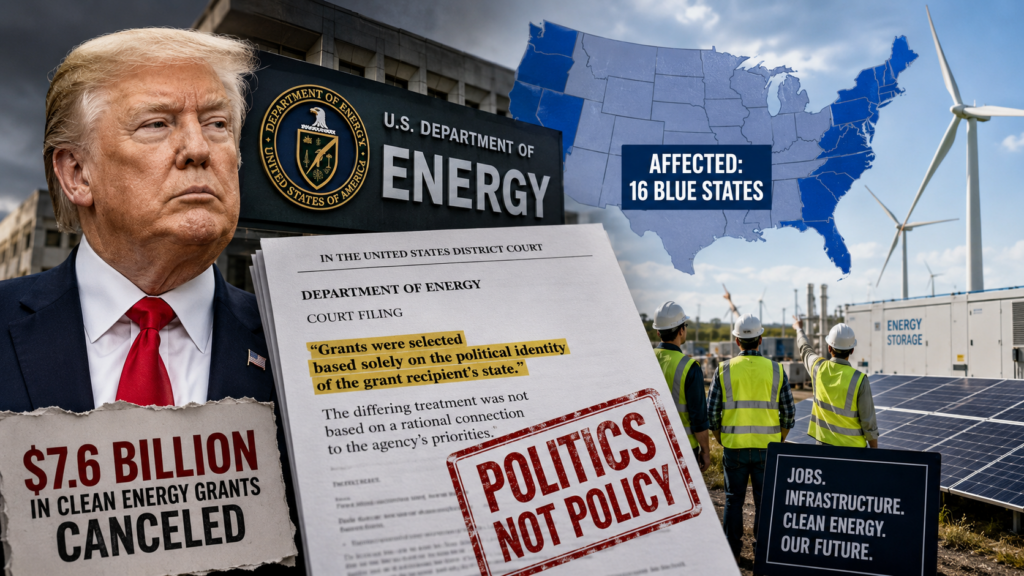
The Trump administration has acknowledged in federal court that it canceled $7.6 billion in clean energy grants based solely on whether projects were located in states that supported Kamala Harris in the 2024 presidential election. The admission contradicts previous statements from administration officials, who had maintained the funding cuts were driven by economic and energy policy considerations rather than politics.
According to a report by Los Angeles Times, the Department of Energy (DOE) admitted in a court filing that the terminated grants were selected “based solely on the political identity of the grant recipient’s state,” affecting projects across 16 Democratic-leaning states.
What Happened
The latest court filing centers on the administration’s decision to terminate approximately 321 federal funding awards covering 223 clean energy projects, representing roughly $7.6 billion in federal grants.
The projects included investments in:
- Battery manufacturing
- Hydrogen technology
- Electric grid modernization
- Carbon capture systems
- Other clean energy infrastructure
Initially, Energy Secretary Chris Wright and other administration officials defended the cancellations by arguing the projects no longer aligned with national energy priorities or represented poor investments of taxpayer funds.
However, the Department of Energy’s latest legal filing states that grant cancellations were determined solely by whether recipients were located in “Blue States” rather than states that generally supported President Donald Trump.
Court Filing Contradicts Earlier Statements
The Trump clean energy grants lawsuit has drawn renewed attention because the Department of Energy acknowledged that political affiliation—not project merit—guided the selection process.
In the filing, the department stated that the differing treatment between Democratic-leaning and Republican-leaning states “was not based on a rational connection” to the agency’s priorities.
The admission follows earlier court documents in separate litigation indicating that federal officials also screened projects using keywords related to diversity, gender, and COVID-19 to identify initiatives that conflicted with administration priorities.
The legal dispute is part of ongoing challenges against the administration’s broader rollback of climate-related funding programs.
Which States Were Affected?
The terminated projects were located in 16 states that supported Kamala Harris in the 2024 presidential election, including:
- California
- Colorado
- Connecticut
- Delaware
- Hawaii
- Illinois
- Maryland
- Massachusetts
- Minnesota
- New Hampshire
- New Jersey
- New Mexico
- New York
- Oregon
- Vermont
- Washington
The projects had been expected to support new manufacturing facilities, clean energy research, infrastructure upgrades, and emissions reduction initiatives.
The funding cancellations occurred alongside broader administration efforts to redirect federal energy policy while pursuing other technology priorities, including new restrictions on advanced AI model access for government use.
Democrats and Environmental Groups Respond
The court filing prompted immediate criticism from Democratic lawmakers and environmental organizations.
Representative Marcy Kaptur of Ohio and Senator Patty Murray of Washington said the filing confirms that the administration terminated hundreds of energy projects based solely on election results rather than public policy considerations.
The lawmakers described the decision as an abuse of federal authority and called on congressional Republicans to investigate the matter.
The Sierra Club also criticized the administration, arguing that canceling infrastructure projects could increase energy costs, reduce job creation, and slow investments in cleaner technologies.
The administration has not publicly issued additional comments following the latest court filing.
Legal Challenges Continue
The funding cuts remain the subject of multiple lawsuits.
One case, Thakur v. Trump, has been ongoing since 2025, while other lawsuits have been filed by clean energy organizations and local governments seeking restoration of the canceled grants.
Separately, the Department of Energy’s Office of Inspector General launched an investigation after members of Congress requested an independent review of the cancellations.
The administration has simultaneously continued advancing other domestic policy priorities, including efforts to expand AI infrastructure across the United States, reflecting a broader shift in federal investment priorities.
What Happens Next
The lawsuits challenging the canceled grants are expected to continue in federal court, where judges will determine whether the funding decisions violated constitutional protections or federal administrative law.
If the courts rule against the administration, some projects could potentially be reinstated or reconsidered under revised review procedures.
The case also raises broader questions about the role of political considerations in distributing federal funding and could influence future standards governing executive branch grant programs.
As litigation moves forward, the Trump clean energy grants controversy is likely to remain a significant legal and political issue, with implications for federal energy policy, climate investment, and the administration’s use of executive authority.
According to a Department of Energy court filing, the grants were canceled based on whether recipients were located in states that voted for Kamala Harris in the 2024 election.
Approximately $7.6 billion in federal grants covering 223 clean energy projects across 16 states was terminated.