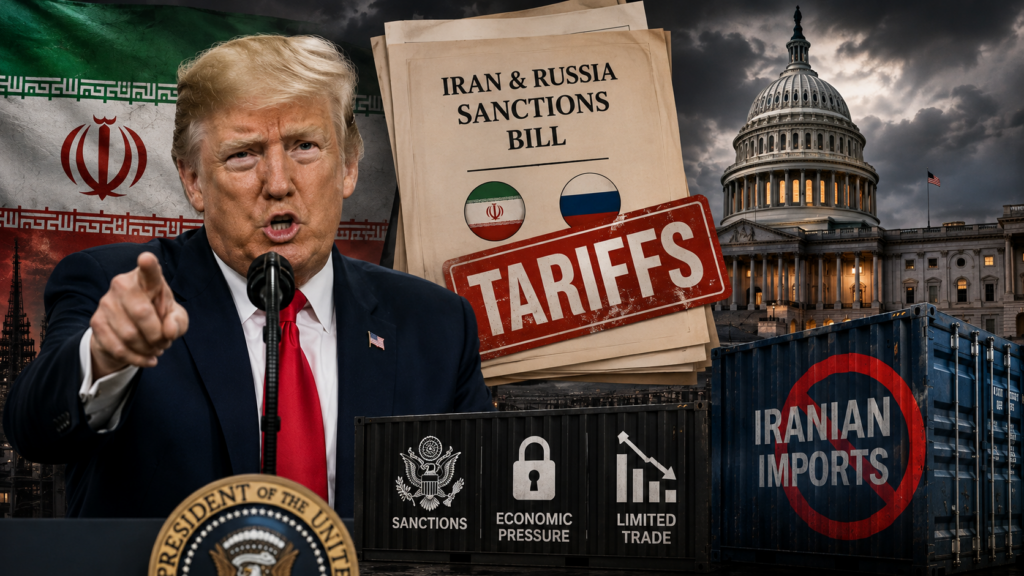
President Donald Trump is urging Congress to strengthen a bipartisan sanctions bill targeting Iran and Russia by adding tariffs on Iranian imports, arguing the move would increase economic pressure on Tehran. Although U.S. imports from Iran are extremely limited due to decades of sanctions, Trump’s proposal reflects his continued support for using tariffs alongside sanctions as tools of foreign policy.
According to a report by CNBC, Trump said he wants lawmakers to include tariffs on Iran in pending legislation that already combines sanctions against both Iran and Russia.
What Happened?
Speaking at the White House, President Trump said the sanctions legislation moving through Congress should go beyond existing penalties by adding tariffs on imports from Iran.
“I’d like them to add Iran as tariffs, not just as sanctions,” Trump said, arguing that tariffs would make the legislation stronger.
The bipartisan bill, which recently advanced in the Senate with an 86-12 procedural vote, would tighten economic pressure on Russia over its war in Ukraine while also expanding sanctions on Iran.
Trump’s proposal would modify that legislation by authorizing tariffs against Iranian imports in addition to existing sanctions.
Key Details
Trade Between the U.S. and Iran Remains Minimal
While Trump supports imposing tariffs on Iran, trade between the two countries is already extremely limited.
According to data from the Office of the U.S. Trade Representative, the United States imported only about $1.4 million worth of Iranian goods during 2025.
More than half of those imports consisted of artwork, collectors’ items, and antiques.
Because existing U.S. sanctions already prohibit nearly all commercial trade with Iran, economists say additional tariffs would have little direct economic impact.
Experts Say Existing Sanctions Carry More Weight
International trade experts argue that sanctions remain far more effective than tariffs in restricting Iran’s economy.
Jonathan Doh, professor of international business at Villanova School of Business, told CNBC that tariffs on Iranian imports would be “entirely symbolic” because U.S. imports from Iran are already negligible.
He noted that primary sanctions prohibit U.S. businesses from trading with Iran, while secondary sanctions discourage foreign companies from conducting business with Tehran by exposing them to U.S. penalties.
Political Impact
Trump’s proposal could complicate passage of legislation that previously enjoyed broad bipartisan support.
Although lawmakers from both parties generally support maintaining pressure on Russia and Iran, tariffs remain a politically divisive issue.
Democrats have repeatedly criticized Trump’s expanded use of tariffs throughout his second term, arguing that broad tariffs increase costs and complicate international trade relationships.
Adding tariff provisions to the sanctions package could therefore create additional debate as Congress considers final passage.
The proposal also follows the administration’s broader use of trade policy to pursue national security objectives, including Trump’s forced labor tariffs that expanded import restrictions under existing trade authorities.
Connection to U.S.-Iran Policy
The tariff proposal comes amid continued tensions between Washington and Tehran.
The United States has maintained extensive sanctions on Iran for decades, and additional economic restrictions have been introduced during the ongoing conflict involving Iran and Israel that intensified earlier this year.
Although the United States and Iran briefly reached a temporary ceasefire agreement in June that included discussions about sanctions relief, those negotiations ultimately collapsed as military operations resumed.
The administration has continued pursuing economic pressure alongside broader regional security measures, including actions related to the Trump Iran conflict and Strait of Hormuz strategy.
What Happens Next?
The sanctions legislation must still move through Congress before becoming law.
If lawmakers accept Trump’s request, the final bill could include tariff authority targeting Iranian imports alongside expanded sanctions against both Iran and Russia.
However, because existing trade between the United States and Iran is already extremely limited, analysts expect the practical economic effects of new tariffs to be minimal. Instead, the proposal is likely to serve as a symbolic demonstration of continued U.S. economic pressure on Tehran while reinforcing the administration’s broader strategy of combining trade policy with national security objectives.
Trump argues that adding tariffs would strengthen the legislation and increase economic pressure on Iran alongside existing sanctions.
Experts say the impact would likely be minimal because U.S. imports from Iran are already extremely small due to longstanding sanctions.