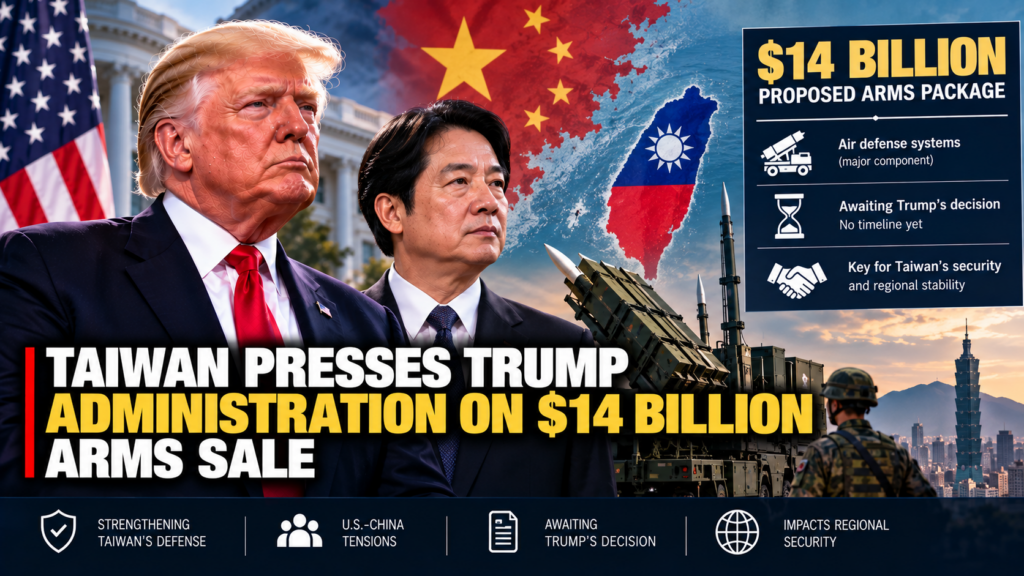
Taiwan is pressing the Trump administration to move forward with a stalled $14 billion arms package as uncertainty grows over Washington’s approach to Beijing and its long-standing security relationship with Taipei.
What Happened
Taiwan’s representative to the United States, Alexander Yui, said he remains confident that President Donald Trump will ultimately approve additional weapons sales to the self-governing island.
“Obviously the speed could be a little faster,” Yui said, while emphasizing that the United States understands the security threat facing Taiwan and is expected to provide the necessary equipment.
The proposed package is worth approximately $14 billion, with air defense systems making up a substantial portion, according to people familiar with the matter.
According to a report by The Japan Times, Trump’s engagement with Chinese President Xi Jinping has increased uncertainty over Washington’s commitment to Taiwan, making the pending arms decision particularly significant.
Trump Administration Faces Pressure Over Taiwan Arms Sale
A senior administration official said Trump is expected to make a determination on the arms package in a relatively short period, although no specific timeline was provided.
Trump has previously said he would make the decision “soon” and has described arms sales to Taiwan as a useful negotiating tool in his dealings with Beijing.
Yui said the United States has been clear that there has been no change in its policy toward Taiwan. He also said Washington has not accepted Beijing’s call for the United States to explicitly oppose Taiwanese independence.
The issue comes as Trump and Xi are expected to meet twice more this year, including around the APEC summit in China in November and the G20 meeting in Miami in December. Yui said Taiwan’s objective is to ensure that it is not treated as a bargaining item in U.S.-China relations.
Conflicting Signals From Washington
Concerns over the Taiwan arms sale intensified after U.S. Ambassador to China David Perdue said Trump had asked Xi whether China wanted to purchase American weapons.
Trump disputed that account and subsequently suggested that selling weapons to China could potentially be a good idea. The State Department later clarified that U.S. law prohibits arms sales to China and said there is no offer or plan to sell American weapons to Beijing.
Republican House Speaker Mike Johnson has defended Trump’s record on Taiwan, describing Taipei as an important partner, friend and ally. Johnson said the delay in the latest package was connected to broader developments and demands involving the Middle East.
The administration has also pointed to Trump’s approval of a record $11 billion in arms sales to Taiwan in December as evidence of his support for the island.
Why the Taiwan Arms Sale Matters
The dispute extends beyond Taiwan’s immediate defense needs.
American support for Taiwan is closely watched by other U.S. allies in Asia, including Japan and South Korea, which depend on Washington’s broader security commitments.
A failure by the United States to support Taiwan during a crisis could provide Beijing with a significant geopolitical advantage, according to Jennifer Welch, chief geoeconomics analyst at Bloomberg Economics.
Taiwan is also central to the global technology industry. The island produces much of the world’s leading-edge semiconductors, making it particularly important to the artificial intelligence industry, data centers and advanced computing.
For Washington, the Taiwan arms sale therefore carries both strategic and economic implications.
What Happens Next
The immediate question is when Trump will approve, modify or otherwise resolve the pending $14 billion package.
A bipartisan group of U.S. senators urged Trump in May to formally notify Congress about the proposed arms sale. House Democrats have separately called on the administration to reaffirm the longstanding One China policy.
Under that policy, Washington recognizes Beijing as China’s sole legal government while acknowledging, without endorsing, Beijing’s position that Taiwan is part of China. The United States maintains unofficial relations with Taipei and provides defensive weapons while keeping deliberately ambiguous whether American forces would intervene in a conflict.
Former National Security Council official Ryan Hass expects additional arms sales during Trump’s presidency. He suggested that Washington could potentially move forward with smaller packages after Trump and Xi complete their expected meetings at the APEC and G20 summits.
For Taiwan, however, continued delays could carry their own strategic cost. Hass warned that uncertainty over the steadiness of U.S. support could help Beijing portray Taiwan as increasingly isolated.
The decision on the Taiwan arms sale will therefore be closely watched not only in Taipei and Beijing, but also across Asia as a test of the Trump administration’s broader security commitments.
Related Reading
- U.S.-China Board of Trade Recommends $30 Billion in Tariff Relief
- Melania Trump Highlights Culture During Xi State Visit
The Trump administration has not provided a firm timeline, while officials have cited broader developments, including the situation in the Middle East.
Taiwan is waiting for approval of an approximately $14 billion U.S. arms package, which includes substantial air defense capabilities.